
According to the IRCC processing times tool, Chilean nationals applying for a Canadian study permit from Chile are currently looking at 2 weeks (data pulled May 2026). That is one of the fastest study permit processing times for any Latin American nationality and among the lowest in the world. The 2-week figure reflects lower application volume from Chile compared to higher-volume countries, and it means a complete application submitted from Chile moves through the IRCC review stage very quickly. This article explains what that 2-week figure actually covers, how to build a realistic total timeline, and how a Chilean study permit connects to the PGWP and permanent residence pathway.
How to check your processing time on the IRCC tool
IRCC publishes current processing time estimates through a public tool organized by application type and country of residence. To find the Chile-specific figure:
- Go to the IRCC processing times tool
- Select "Temporary residence (visiting, studying, working)"
- Select "Study permit (from outside Canada)"
- Select Chile as your country of residence
- Click "Get processing time"
The result is based on your country of residence, not your nationality. Chilean citizens living outside Chile should select their current country of residence in the tool to get the applicable figure for their application.
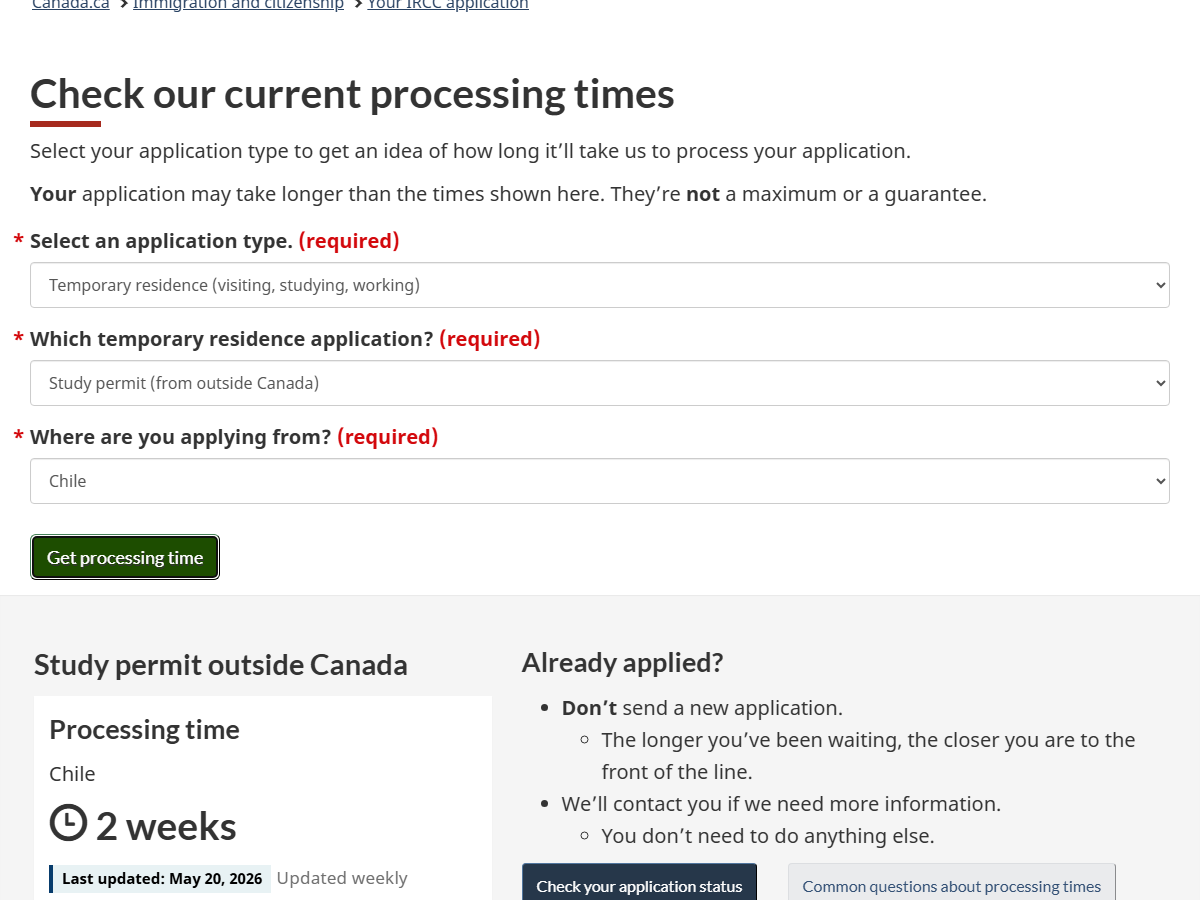
Processing times are updated weekly. The 2-week figure can change as IRCC workload and application intake shift, so check the tool again when you are close to submitting your application.
What "2 weeks" actually means
The IRCC processing time is the 80th percentile benchmark. It measures how long it took IRCC to finalize 80% of complete study permit applications from Chile in a recent historical period. One in five applicants will wait longer than 2 weeks. The 2-week benchmark is notably fast and reflects lower application volume from Chile compared to higher-volume countries where IRCC processes larger queues.
The 2-week clock starts only once your application is considered complete by IRCC. That means all forms are filled in correctly, the government fee is paid, all required supporting documents are uploaded, and biometrics have been submitted if required. An incomplete application is not in the processing queue and the 2 weeks has not begun.
Two weeks is the IRCC review stage only. Biometrics collection (if required for first-time applicants) adds time on top of this, and document preparation, obtaining your acceptance letter, and getting the Provincial Attestation Letter all happen before you submit. The total timeline from acceptance letter to permit in hand is longer than 2 weeks, but it is still among the shortest for any Latin American student applying to Canada.
What a complete study permit application requires
A study permit application is complete and ready for processing when all of the following are in place:
- Acceptance letter from a Designated Learning Institution (DLI) in Canada
- Provincial Attestation Letter (PAL) from the province where your school is located (required for most post-secondary applicants since 2024; some graduate programs are exempt)
- Proof of funds demonstrating you can cover tuition and living costs for the duration of your program. Bank statements, savings accounts, and any additional financial support should be clearly documented
- Valid passport covering the planned study period
- Biometrics if required (see below)
- Study plan explaining your academic goals, reasons for choosing the institution and program, and plans after completing your studies
- Immigration medical exam (IME) if required for your program category
The PAL has been required since 2024 and is issued through your institution. Confirm with your school that the PAL will be included with your enrollment documents before submitting. For Chilean applicants, proof of funds and the study plan are the elements most likely to need careful preparation, since the 2-week review window is fast enough that an officer who needs to request additional information can significantly delay the overall timeline.
SDS eligibility for Chilean students
Chile is not currently included in the Student Direct Stream (SDS). SDS is available to students from a specific list of countries, including Mexico, Colombia, India, the Philippines, China, and others. Chile is not on the list, so Chilean students apply through the standard study permit process.
The practical implication is minor, given Chile's 2-week processing time. SDS is designed to speed up processing for high-volume countries where standard processing can take longer. Chile's low application volume already produces a 2-week benchmark, which is faster than SDS outcomes for many of the countries on the eligible list. The standard stream is the appropriate route for Chilean applicants, and it is performing well for this nationality.
Biometrics for study permits
Biometrics (fingerprints and photo) are required for most study permit applicants. If this is your first Canadian application, or your biometrics on file are more than 10 years old, you will receive a Biometrics Instruction Letter (BIL) after submitting your application. You have 30 days to attend a Visa Application Centre (VAC) in person.
The VAC serving Chilean applicants is in Santiago. IRCC does not continue processing until biometrics are received. For first-time applicants, biometrics add approximately 2 to 3 weeks to the total timeline on top of the 2-week processing time.
Given the 2-week IRCC processing time, biometrics become the dominant variable in the total timeline for first-time applicants. The realistic total from complete application submission to permit is approximately 4 to 5 weeks when biometrics are required, compared to 2 weeks if biometrics are already on file. For Chilean students working against a tight deadline, confirming whether biometrics are on file or scheduling them promptly after submission is the most important timeline consideration.
Building your full timeline from Chile
Here is how to structure the complete process:
Biometrics already on file: Receive acceptance letter and PAL, gather proof of funds and study plan, submit complete application to IRCC, IRCC processes (2 weeks). Total from complete submission: approximately 2 weeks. Total from acceptance letter: add 1 to 3 weeks for document preparation.
First-time applicant (biometrics required): Receive acceptance letter and PAL, gather documents, submit application, give biometrics within 30 days of BIL (2-3 weeks), IRCC processes (2 weeks). Total from complete submission: approximately 4 to 5 weeks. Total from acceptance letter: 5 to 8 weeks including document preparation.
For September intake, Chilean students with biometrics already on file can submit applications as late as July or early August and still receive permits before classes start. For students who need to give biometrics, submitting in June is a more comfortable target. For January intake, similar logic applies with October as the submission target for biometrics-required applicants.
After approval: work rights and PGWP
A Canadian study permit for a full-time program at a DLI typically includes authorization to work off-campus up to 24 hours per week during academic sessions. Co-op and mandatory work terms require a separate co-op work permit in addition to the study permit.
Chilean students who complete a program at a PGWP-eligible institution can apply for a Post-Graduation Work Permit (PGWP) after graduating. The PGWP is an open work permit with a duration linked to your program length. Programs between 8 months and 2 years generate a PGWP of equivalent length. Programs of 2 years or more generate a PGWP valid for up to 3 years.
The Canada-Chile Free Trade Agreement (CCFTA) creates additional context for Chilean PGWP holders: graduates working in CCFTA-eligible occupations can transition from the PGWP to an LMIA-exempt work permit renewal if they remain in Canada in the relevant role. This extends the window available to accumulate the Canadian work experience needed for Express Entry's Canadian Experience Class, one of the main permanent residence pathways for Chilean graduates in Canada.
PGWP holders who accumulate one year of full-time skilled work experience in Canada can submit an Express Entry profile under CEC. Combined with strong language scores, Chilean applicants are typically well-positioned in CEC draws, which occur on a regular basis.
Already applied?
Applied through Up Immigration? We're already watching.
Our team monitors every active application on a regular basis. If IRCC requests documents, updates your status, or issues a decision, you will hear from us first.
If you applied independently, log into your IRCC secure account at canada.ca to track your application status and read any officer messages. The IRCC contact centre cannot provide more information than what is visible in your online account.
When to work with an RCIC
A 2-week processing time is the shortest available for Latin American study permit applicants, but it only applies to complete and correctly prepared applications. A missing PAL, insufficient proof of funds, a study plan that does not clearly establish genuine academic intent, or an officer request for additional information can easily double or triple the actual timeline, and a refusal creates a record that affects future applications.
A Regulated Canadian Immigration Consultant (RCIC) reviews the full application before submission. That includes verifying that the acceptance letter and PAL are correctly included, confirming that proof of funds clearly demonstrates sufficient resources, reviewing the study plan for specificity and clarity, and checking that no documentation gaps remain. For Chilean students who also want to plan the PGWP and CCFTA post-graduation pathway, an RCIC can map the full immigration sequence from day one.
If you have an acceptance letter or are planning your application, a consultation is the right starting point. Book a consultation with Up Immigration and we will review your documents, confirm the timeline, and make sure your application is complete and correctly structured before it goes to IRCC.
Processing time data sourced from the IRCC processing times tool, May 2026. Times are updated weekly and subject to change. This article does not constitute legal advice. Verify current figures at canada.ca before making decisions.