
For French citizens applying for a Canadian study permit from outside Canada, the current IRCC processing time is 2 weeks. That figure is drawn directly from the IRCC processing times tool in May 2026, and it places France among the fastest European countries for study permit processing. Two weeks is fast, but the full timeline from decision-to-apply to being ready to travel is longer. This article explains what the 2-week figure covers, what a complete application needs, the specific Quebec study pathway that is uniquely relevant to French speakers, and what the realistic end-to-end process looks like from France.
How to check your processing time on the IRCC tool
IRCC publishes country-specific processing times through a publicly accessible tool at canada.ca. The result depends on where you currently live. If you are a French citizen living in France, run the tool with France selected. If you have relocated, use your current country of residence instead.
Steps to check:
- Go to the IRCC processing times tool.
- Select "Temporary residence (visiting, studying, working)".
- Select "Study permit (from outside Canada)".
- Select "France".
- Click "Get processing time" — currently 2 weeks.
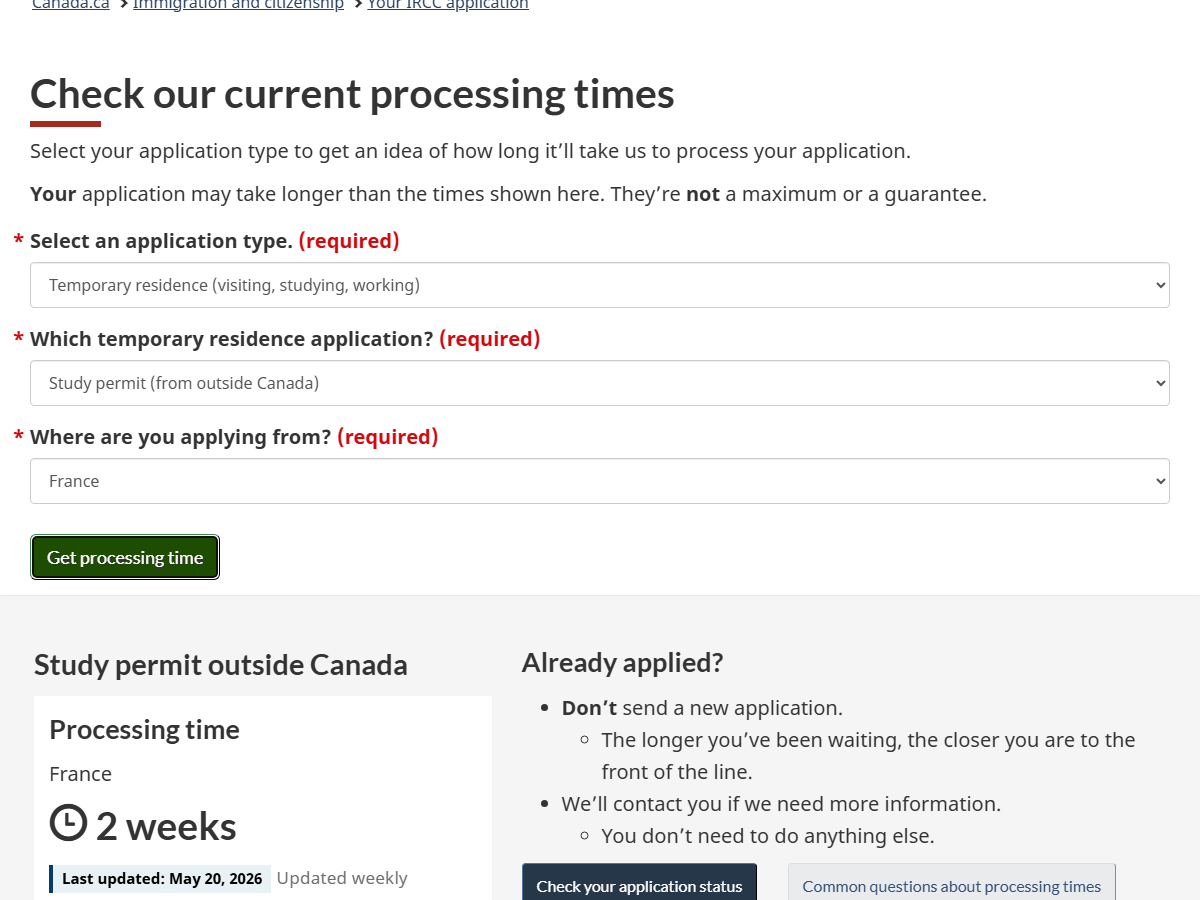
The tool is updated weekly. Check it again close to your submission date rather than relying on a number you read weeks earlier.
What "2 weeks" actually means
The processing time published by IRCC represents the time it took to finalize 80% of applications in that category over a recent historical window. It is not an average and not a guarantee. One in five French study permit applicants will wait longer than 2 weeks.
The clock starts only when IRCC considers your application complete: all required forms uploaded and correctly completed, fees paid, supporting documents present and consistent, and biometrics submitted if required. The 2-week clock has not started if any of those elements are missing.
The 2-week figure also covers only the IRCC processing stage. Document preparation, obtaining a DLI acceptance letter, biometrics, and any Quebec-specific requirements (covered below) all happen before or alongside the IRCC review. The total end-to-end timeline is longer.
France is not in the Student Direct Stream (SDS)
The Student Direct Stream (SDS) is a faster processing pathway for study permit applicants from specific countries including India, the Philippines, Vietnam, China, and others. France is not in the SDS program.
In practice, this makes no difference for French applicants. The regular processing time for France is 2 weeks, which is already faster than many SDS-eligible countries under normal conditions. French students apply through the standard study permit stream without the SDS-specific requirements.
What a complete application needs
For French applicants, a complete study permit application includes:
Acceptance letter from a Designated Learning Institution (DLI). Your offer of admission must come from a Canadian school on the official IRCC DLI list. The letter must specify the program, its duration, and the start date. If you are applying to study in Quebec, your school must be both a DLI and an institution approved by Quebec's Ministère de l'Immigration, de la Francisation et de l'Intégration (MIFI).
Certificat d'acceptation du Québec (CAQ), if studying in Quebec. Students enrolled at a Quebec institution need a CAQ from MIFI in addition to the federal study permit. These are two separate applications processed by two separate governments. You cannot submit your federal study permit application to IRCC without the CAQ. CAQ processing adds several weeks before your IRCC application can be submitted. If your school is in Quebec, request the CAQ from your institution or apply through MIFI as soon as your admission is confirmed.
Proof of financial support. You need to demonstrate enough funds to cover tuition plus living costs. The current IRCC financial requirement for the first year outside Quebec is CAD $22,895 for living expenses, on top of tuition. Quebec has its own financial threshold, which varies and is confirmed through the CAQ process. Funds should be in a documented bank account with consistent history. Large recent deposits without a clear source explanation create questions.
Study plan. A written statement explaining why you chose this specific program at this specific school, how it connects to your background, and what you intend to do after graduation. The plan should be specific and logical, not a generic statement.
Valid French passport. Valid for the full duration of your intended stay in Canada, with additional margin.
Biometrics. If required (see below).
Biometrics: add time if this is your first Canadian application
If you have never provided biometrics for a Canadian immigration application, or if your biometrics on file are more than 10 years old, you will receive a Biometrics Instruction Letter (BIL) after submitting your study permit application. You have 30 days from that letter to attend a Visa Application Centre (VAC) and provide fingerprints and a photo.
For French applicants, VACs operate in Paris and Lyon. Biometrics add approximately 2 to 4 weeks to the total timeline for first-time applicants. Given the 2-week IRCC processing time, biometrics are typically the longest single step in the process.
Full realistic timeline for French study permit applicants
English-language program, outside Quebec:
- Obtain DLI acceptance letter: variable (weeks to months before application)
- Document preparation and application submission: 1 to 2 weeks
- Biometrics (if required): add 2 to 4 weeks
- IRCC processing after biometrics received: approximately 2 weeks
- Total realistic range from submission: 5 to 8 weeks
Quebec-based program (French or English):
- Obtain DLI acceptance letter and apply for CAQ through MIFI: add 3 to 6 weeks for CAQ processing
- Document preparation and application submission after CAQ issued: 1 to 2 weeks
- Biometrics (if required): add 2 to 4 weeks
- IRCC processing: approximately 2 weeks
- Total realistic range from CAQ application: 8 to 14 weeks
The Quebec advantage for French speakers
French citizens considering Canadian study have an option that students from most other countries do not: Quebec's French-language institutions and the province's distinct immigration pathways for French speakers.
The Programme de l'expérience québécoise (PEQ) is one of Quebec's most accessible pathways to provincial permanent residence for people who studied and worked in Quebec with French as their working language. French citizens who study at a Quebec DLI, graduate, gain work experience in Quebec in a qualifying occupation, and demonstrate functional French proficiency may be eligible for the PEQ, which leads to a Quebec Selection Certificate (CSQ) and subsequently federal permanent residence.
This pathway is not automatic, and French language proficiency must be genuinely demonstrated rather than assumed. But for French citizens who are fluent in French and interested in long-term Canadian immigration, Quebec study followed by the PEQ track is one of the clearest paths to permanent residence available from France.
Post-graduation: PGWP and CEC for programs outside Quebec
For French students studying at DLIs outside Quebec, the standard post-graduation pathway applies. After completing a program of at least 8 months at an eligible DLI, most international graduates qualify for a Post-Graduation Work Permit (PGWP). The PGWP is an open work permit, valid for up to 3 years for programs of 2 years or more. After 12 months of skilled Canadian work experience, PGWP holders become eligible for the Canadian Experience Class (CEC) under Express Entry, which is one of the most reliable permanent residence pathways for candidates with Canadian work history.
Already applied?
Applied through Up Immigration? We're already watching.
Our team monitors every active application on a regular basis. If IRCC requests documents, updates your status, or issues a decision, you will hear from us first.
If you applied independently, log into your IRCC secure account at canada.ca to check your status. Application updates and officer messages appear there. With a 2-week IRCC processing time, most French study permit files resolve quickly after biometrics are received.
Ready to apply?
French students have fast processing times, genuine Quebec options for French speakers, and a clear post-graduation pathway through PGWP and CEC. The 2-week IRCC processing time is the fastest stage of the process. The steps that take longer are document preparation, biometrics, and, if applicable, the Quebec CAQ.
If you are choosing between a Quebec program and an English-language program outside Quebec, the long-term immigration implications of that choice are worth understanding before you commit to a school and program. Book a consultation with Up Immigration and we will walk through your situation, including how your program choice affects your post-graduation options.
Processing time data sourced from the IRCC processing times tool, May 2026. Times are updated weekly and subject to change. This article does not constitute legal advice. Verify current figures at canada.ca before making decisions.