
According to the IRCC processing times tool, Mexican nationals applying for a Canadian study permit from Mexico are currently looking at 3 weeks (data pulled May 2026). That is among the fastest study permit processing times in Latin America, and Mexico's eligibility for the Student Direct Stream (SDS) means there is a structured fast-track option available for applicants who meet the SDS criteria. This article explains what the 3-week figure actually covers, how SDS works for Mexican students, and how to build your complete timeline before your program start date.
How to check your processing time on the IRCC tool
IRCC maintains a public tool where applicants can look up the current processing time for their specific application type and country of residence. To find the Mexico-specific figure:
- Go to the IRCC processing times tool
- Select "Temporary residence (visiting, studying, working)"
- Select "Study permit (from outside Canada)"
- Select Mexico as your country of residence
- Click "Get processing time"
The result is based on your country of residence, not your nationality. Mexican students currently living outside Mexico should run the tool with their current country selected for an accurate estimate.
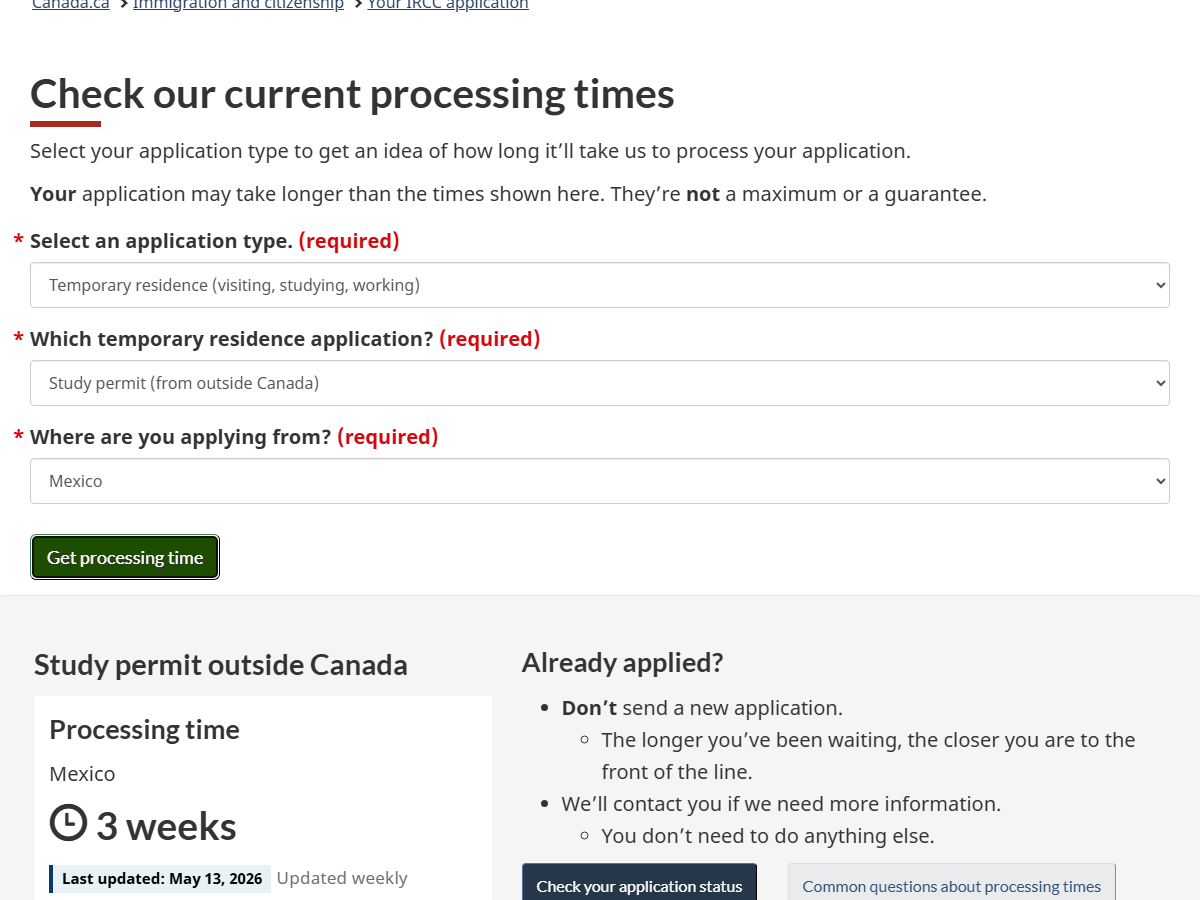
Processing times are updated weekly. Check the tool again when you are close to submitting your application, as the figure can change as IRCC workload shifts.
What "3 weeks" actually means
The IRCC processing time is the 80th percentile benchmark. It measures how long it took IRCC to finalize 80% of complete study permit applications from Mexico in a recent historical period. One in five applicants will wait longer than 3 weeks. For some files, the wait is considerably longer, particularly if documentation is incomplete or an officer requests additional information.
The 3-week clock starts only when IRCC considers your application complete. That means all forms are correctly filled out, the government fee is paid, all required documents are uploaded, and biometrics have been submitted if required. An application missing any of those elements is not yet in the processing queue.
Three weeks is the IRCC review time only. It does not account for the time required to gather documents, obtain your acceptance letter, complete a medical exam if required by SDS, or give biometrics at a VAC. The full end-to-end timeline is longer, and the section on building your timeline below explains how to add it all up.
What a complete study permit application requires
A study permit application is not complete until the following elements are in place:
- Acceptance letter from a Designated Learning Institution (DLI) in Canada
- Proof of funds demonstrating you can cover tuition and living expenses for your program. This typically means showing tuition for the first year plus CAD $10,000 for living expenses (or more for some provinces)
- Valid passport covering the duration of your planned studies
- Biometrics if required (see below)
- Immigration medical exam (IME) if required for your program or country (SDS applicants must complete the IME upfront)
- Provincial Attestation Letter (PAL) from the province where your school is located, for most post-secondary applicants (certain exemptions apply for master's and doctoral programs)
- Statement of purpose or study plan explaining why you chose the program and institution
The PAL requirement was introduced in 2024. Most provincial attestation letters are provided directly by the school as part of the admissions process, but you should confirm with your institution that the PAL is included in your enrollment documents before submitting your application.
Student Direct Stream (SDS) for Mexican students
Mexico is one of the countries eligible for the Student Direct Stream (SDS), a processing stream designed for study permit applicants who meet specific upfront requirements. SDS applicants generally see faster processing, sometimes within the same 3-week benchmark or faster. The requirements for SDS eligibility include:
- Acceptance letter from a DLI for a full-time program
- Guaranteed Investment Certificate (GIC) of at least CAD $10,000 from a participating Canadian financial institution, purchased before applying
- Payment of the first year of tuition in full before applying
- Immigration medical exam (IME) completed before applying
- Language test results showing a minimum score of CLB 7 (IELTS 6.0 general or equivalent) for English programs, or a TEF equivalent for French programs
- No active study permit application already in processing
The upfront medical exam and GIC are what distinguish SDS from the standard stream. They require additional preparation time and cost, but they remove two potential delays from the IRCC review stage and give your application a more complete profile at the time of submission.
If your timeline is tight and you are applying for a September or January intake, meeting the SDS criteria and applying through that stream is worth the extra preparation. Standard stream applications are also processed within the 3-week benchmark for Mexico, but SDS provides a more structured path with fewer variables.
Biometrics for study permits
Biometrics (fingerprints and photo) are required for most study permit applicants. First-time applicants, or those whose biometrics on file are more than 10 years old, will receive a Biometrics Instruction Letter (BIL) after submitting their application. You then have 30 days to attend a Visa Application Centre (VAC) in person.
VAC locations serving Mexican applicants include Mexico City, Guadalajara, and Monterrey. IRCC does not continue processing until biometrics are received. In practice, biometrics add approximately 2 to 4 weeks to the total timeline for first-time applicants on top of the published 3-week processing time.
SDS applicants can give biometrics before submitting their study permit application, which eliminates this delay from the IRCC review stage. If you are applying through SDS and want the fastest possible processing, completing biometrics in advance is a practical step.
Building your full timeline from Mexico
Here is how to structure a realistic timeline:
Standard stream: Receive acceptance letter and PAL from school, gather proof of funds, complete application, submit to IRCC, give biometrics within 30 days of BIL (2-4 weeks), IRCC processes (3 weeks). Total from complete application submission: approximately 5 to 7 weeks. Total from acceptance letter: add document preparation time, typically 2 to 4 weeks.
SDS stream: Receive acceptance letter, pay first-year tuition, open GIC account, complete immigration medical exam, obtain language test results, submit complete application with all SDS documents, biometrics (can be done before submission), IRCC processes. Total from complete SDS submission: 3 to 5 weeks when biometrics are already given. Total from acceptance letter: 4 to 8 weeks depending on IME and GIC timing.
Plan backwards from your program start date. For September intake, most applicants should be submitting no later than June. For January intake, no later than October. These are conservative targets that account for document preparation and biometrics.
After approval: co-op, work, and PGWP
Once your study permit is approved, the letter of introduction you receive will specify whether you are authorized to work on or off campus. For most full-time students at DLIs, off-campus work of up to 24 hours per week during academic sessions is permitted under the study permit. Co-op work terms and mandatory internships require a co-op work permit in addition to the study permit.
Mexican students who complete a program at a PGWP-eligible institution can apply for a Post-Graduation Work Permit (PGWP) after graduating. The PGWP is an open work permit with a duration linked to the length of your program. A PGWP holder who accumulates one year of Canadian work experience in a skilled occupation can qualify for the Canadian Experience Class (CEC) under Express Entry, one of the main pathways to permanent residence. This makes the study permit the first step in a longer immigration strategy for many Mexican students.
Already applied?
Applied through Up Immigration? We're already watching.
Our team monitors every active application on a regular basis. If IRCC requests documents, updates your status, or issues a decision, you will hear from us first.
If you applied independently, log into your IRCC secure account at canada.ca to track your application status. Officer messages and status updates appear there. Calling the IRCC contact centre will not provide more information than what is visible online.
When to work with an RCIC
A 3-week processing time is only achievable when the application is complete and correctly prepared. Missing the PAL, submitting insufficient proof of funds, failing to meet SDS criteria in a way that disqualifies the application from that stream, or omitting the immigration medical exam when required are all sources of delays or refusals that add months to the process and create records that affect future applications.
A Regulated Canadian Immigration Consultant (RCIC) reviews the full application package before it reaches an officer. That includes confirming SDS eligibility, verifying financial documentation meets the standard, checking that the PAL is included and correctly formatted, and ensuring the study plan demonstrates genuine academic intent. The 3-week processing window is what happens when the file going in is complete and correct.
If you are planning your application or have already received an acceptance letter and want to move quickly, a consultation is the right starting point. Book a consultation with Up Immigration and we will map out your specific timeline, confirm whether SDS applies to your situation, and make sure your application is ready to submit.
Processing time data sourced from the IRCC processing times tool, May 2026. Times are updated weekly and subject to change. This article does not constitute legal advice. Verify current figures at canada.ca before making decisions.