
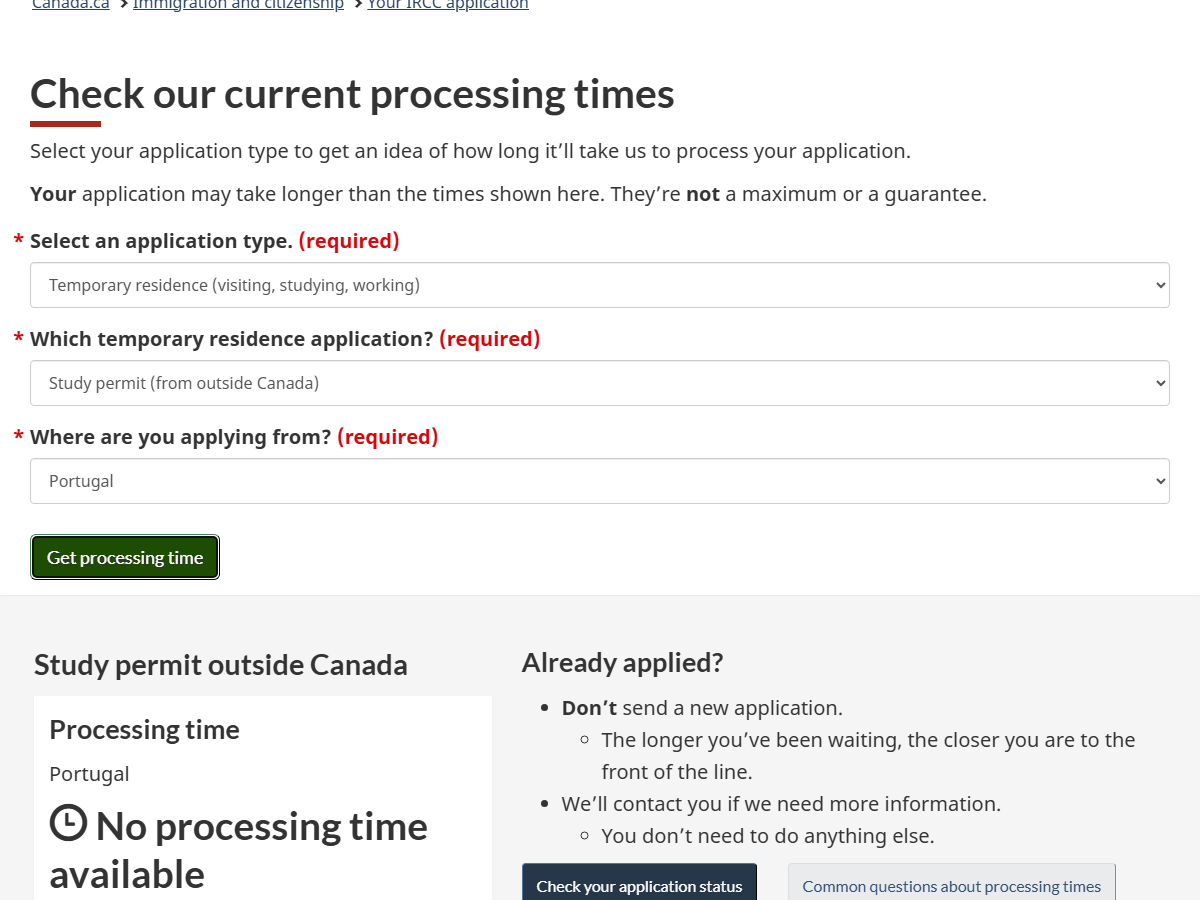
When you run the IRCC processing times tool for a study permit from Portugal, the result is "No processing time available." This is not a barrier, a flag, or a problem with Portuguese applications. It means IRCC does not have enough recent study permit application data from Portugal to publish a statistically reliable figure. Portuguese students can apply for Canadian study permits, and their applications are processed under the same rules as all other nationalities. This article explains what "no processing time available" means in practice, how to build a planning timeline without a specific number, what a complete application requires, and what post-graduation pathways look like for Portuguese graduates.
How to check your processing time on the IRCC tool
IRCC publishes country-specific processing times through a publicly accessible tool at canada.ca. For countries with sufficient recent application volume, a number in weeks appears. For lower-volume countries like Portugal for study permits, the tool returns "no processing time available" because the dataset is too small to produce a reliable statistic.
Steps to check:
- Go to the IRCC processing times tool.
- Select "Temporary residence (visiting, studying, working)".
- Select "Study permit (from outside Canada)".
- Select "Portugal".
- Click "Get processing time" — result: No processing time available.
What "no processing time available" means in practice
IRCC calculates processing times using the 80th percentile of finalized applications within a recent historical window. When the number of applications from a given country is too low to generate a statistically meaningful result, the tool returns "no processing time available." This happens for countries with relatively low study permit application volumes. Portugal falls into this category.
The absence of a published figure is not a flag, a delay, or a problem specific to Portuguese applications. Applications from Portuguese nationals are accepted through the standard IRCC online system, processed by IRCC officers under the same criteria as all other nationalities, and subject to the same approval standards.
For planning purposes, Portuguese applicants should use benchmark processing times from comparable EU countries. Based on published data from France (2 weeks), Germany (1 week), and Spain (1 week) in May 2026, a reasonable planning range for a complete study permit application from Portugal is 1 to 4 weeks at the IRCC stage. For conservative planning, use 4 to 8 weeks as your IRCC buffer, which accounts for normal fluctuation.
Portugal is not in the Student Direct Stream (SDS)
The Student Direct Stream (SDS) is a faster processing pathway for study permit applicants from specific countries. Portugal is not in the SDS program. Portuguese students apply through the standard study permit stream. Given the low application volumes from Portugal and the fast processing times seen across other EU countries, the absence of SDS designation does not represent a significant disadvantage in practice.
What a complete application needs
Whether or not a specific processing time is published, the application requirements are the same for all nationalities. For Portuguese students, a complete study permit application includes:
Acceptance letter from a Designated Learning Institution (DLI). Your offer of admission must come from a Canadian institution on the official IRCC DLI list. The letter must specify the program, duration, and start date. Confirm your school's DLI status before applying.
Proof of financial support. You need to demonstrate enough funds to cover tuition plus living costs. The current IRCC financial requirement for the first year outside Quebec is CAD $22,895 for living expenses, on top of tuition. Funds should be in a documented bank account with consistent transaction history. Large recent deposits without a clear origin create questions during officer review.
Study plan. A written statement explaining your specific program choice, how it relates to your educational background, and what you plan to do after graduation. The plan should be specific and credible. Generic statements about improving career prospects are not sufficient.
Valid Portuguese passport. Valid for the duration of your intended stay in Canada, with additional margin beyond your program end date.
Photographs. Current passport-style photographs meeting IRCC specifications.
Biometrics. If required (see below).
Biometrics: add time if this is your first Canadian application
If you have never provided biometrics for a Canadian immigration application, or if your biometrics on file are more than 10 years old, you will receive a Biometrics Instruction Letter (BIL) after submitting your study permit application. You have 30 days from that letter to attend a Visa Application Centre (VAC) and provide fingerprints and a photo.
For Portuguese applicants, VAC service is available in Lisbon. Biometrics add approximately 2 to 4 weeks to the total timeline for first-time applicants. Given the fast IRCC processing benchmarks for EU countries, biometrics are likely the longest single step in the total process.
Full realistic timeline for Portuguese study permit applicants
Using conservative benchmarks for IRCC processing:
- Obtain DLI acceptance letter: variable (weeks to months before application)
- Document preparation and application submission: 1 to 2 weeks
- Biometrics (if required): add 2 to 4 weeks
- IRCC processing after biometrics received: estimated 1 to 4 weeks
- Total realistic range from submission: 5 to 10 weeks
For a September 2026 intake, submitting by late June to early July gives a comfortable margin. For a January 2027 intake, submitting by mid-October provides adequate buffer. Use the conservative end of the IRCC range for planning rather than the optimistic end.
Portuguese speakers and Quebec: what applies
Quebec's immigration programs are French-language focused. They are not Portuguese-language programs. Portuguese speakers are not automatically advantaged for Quebec immigration pathways. Quebec's Programme de l'expérience québécoise (PEQ) and related programs require demonstrated French proficiency, not Portuguese proficiency.
Portuguese students interested in Canada typically apply to English-language programs at institutions outside Quebec. Studying in English-language programs and gaining Canadian work experience in English-speaking markets is the standard pathway for Portuguese students. If a Portuguese student also speaks functional French, Quebec programs become an option, but this is determined by language ability rather than national origin.
Post-graduation: PGWP and the path to permanent residence
After completing a program of at least 8 months at an eligible Canadian DLI, most international graduates qualify for a Post-Graduation Work Permit (PGWP). The PGWP is an open work permit, valid for up to 3 years for programs of 2 years or more. After 12 months of skilled Canadian work experience in a NOC TEER 0, 1, 2, or 3 occupation, PGWP holders become eligible for the Canadian Experience Class (CEC) under Express Entry.
Portuguese graduates with strong English proficiency, Canadian credentials, and in-demand work experience are competitive in the Express Entry pool. Planning your program choice with post-graduation pathways in mind, including program length, institution eligibility, and which occupations align with your field, significantly improves your long-term immigration outcomes.
Already applied?
Applied through Up Immigration? We're already watching.
Our team monitors every active application on a regular basis. If IRCC requests documents, updates your status, or issues a decision, you will hear from us first.
If you applied independently, log into your IRCC secure account at canada.ca to check your status. Application updates and officer messages appear there. The absence of a published processing time means you should use the conservative 4 to 8 week benchmark before considering any follow-up action.
Ready to apply?
Portuguese students do not face a disadvantage because no specific processing time is published for Portugal. Applications are accepted, processed, and decided under the same standards as all other nationalities. The "no processing time available" response is a data volume note, not a flag on your application.
The steps that require attention are the same for all applicants: a strong acceptance letter from a DLI, well-documented financials, a coherent study plan, and biometrics. If you want a review of your application package before submission, or if you are planning your study pathway with post-graduation immigration options in mind, a consultation is the right starting point. Book a consultation with Up Immigration and we will walk through your situation.
Processing time data sourced from the IRCC processing times tool, May 2026. Times are updated weekly and subject to change. This article does not constitute legal advice. Verify current figures at canada.ca before making decisions.