
For Spanish citizens applying for a Canadian study permit from outside Canada, the current IRCC processing time is 1 week. That figure is drawn directly from the IRCC processing times tool in May 2026. Spain ties with Germany for the fastest published study permit processing time among European countries in the current dataset. One week at the IRCC stage is exceptional. But it only counts once your application is complete. This article explains what the 1-week figure actually means, what a complete application includes, what the realistic total timeline looks like, and what Spanish students should know about post-graduation work authorization and permanent residence pathways.
How to check your processing time on the IRCC tool
IRCC publishes country-specific processing times through a publicly accessible tool at canada.ca. The result depends on where you currently live, not your citizenship. If you are a Spanish citizen living in Spain, run the tool with Spain selected. If you have relocated, use your current country of residence instead.
Steps to check:
- Go to the IRCC processing times tool.
- Select "Temporary residence (visiting, studying, working)".
- Select "Study permit (from outside Canada)".
- Select "Spain".
- Click "Get processing time" — currently 1 week.
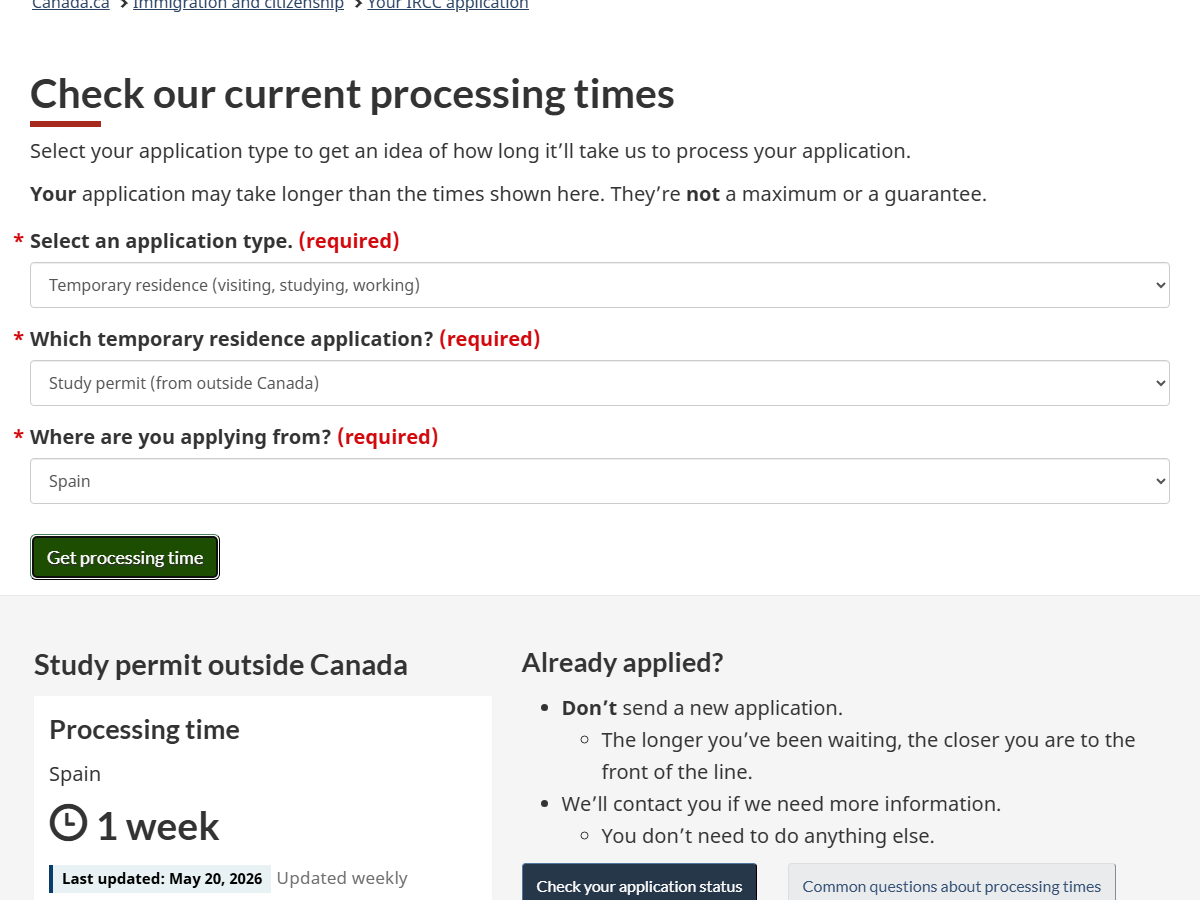
The tool is updated weekly. Check it again close to your intended submission date. Spain's 1-week figure reflects low application volume relative to well-prepared files, and this figure can fluctuate as volumes change throughout the year.
What "1 week" actually means
The processing time published by IRCC represents the time it took to finalize 80% of applications in that category over a recent historical window. It is not an average and not a guarantee. One in five Spanish study permit applicants may wait longer than 1 week.
The clock starts only when IRCC considers your application complete: all required forms uploaded and correctly completed, fees paid, supporting documents present and consistent, and biometrics submitted if required. A 1-week processing time on an incomplete file is not relevant. The fast clock only applies once your application is fully in order.
Spain's 1-week figure reflects a combination of low application volume and applications that arrive well-documented. Officers can review and decide files quickly when documentation is clear and consistent. Individual outcomes depend on your specific file.
Spain is not in the Student Direct Stream (SDS)
The Student Direct Stream (SDS) is a faster processing pathway for study permit applicants from specific countries, including India, the Philippines, Vietnam, China, and others. Spain is not in the SDS program.
This is not a disadvantage in practice. Spain's regular (non-SDS) processing time is 1 week, which is already among the fastest globally. Spanish students apply through the standard study permit stream and benefit from fast processing without the additional requirements that SDS imposes.
What a complete application needs
For Spanish applicants, a complete study permit application includes:
Acceptance letter from a Designated Learning Institution (DLI). Your offer of admission must come from a Canadian institution on the official IRCC DLI list. The letter must specify the program, duration, and start date. Confirm your school's DLI status through the IRCC DLI search before submitting your application.
Proof of financial support. You need to demonstrate enough funds to cover tuition plus living costs for your program duration. The current IRCC financial requirement for the first year outside Quebec is CAD $22,895 for living expenses, on top of tuition. Funds should be documented with consistent bank statements. An unexplained large deposit shortly before the application raises questions during review.
Study plan. A written statement explaining your specific program choice at this specific institution, how it relates to your academic and professional background, and what you plan to do after graduation. The plan needs to be logical and specific. A Spanish marketing graduate applying for a data analytics certificate should explain the career transition clearly. A history student applying for a hospitality management diploma should articulate the connection. Generic statements are not enough.
Valid Spanish passport. Valid for the full duration of your intended stay in Canada, with additional margin beyond your program end date.
Photographs. Current passport-style photographs meeting IRCC specifications.
Biometrics. If required (see below).
Biometrics: add time if this is your first Canadian application
If you have never provided biometrics for a Canadian immigration application, or if your biometrics on file are more than 10 years old, you will receive a Biometrics Instruction Letter (BIL) after submitting your study permit application. You have 30 days from that letter to attend a Visa Application Centre (VAC) and provide fingerprints and a photo.
For Spanish applicants, VACs operate in Madrid and Barcelona. Biometrics add approximately 2 to 4 weeks to the total timeline for first-time applicants. With a 1-week IRCC processing time, biometrics are the longest single step in the process for most Spanish applicants.
Full realistic timeline for Spanish study permit applicants
- Obtain DLI acceptance letter: variable (weeks to months before application)
- Document preparation and application submission: 1 to 2 weeks
- Biometrics (if required): add 2 to 4 weeks
- IRCC processing after biometrics received: approximately 1 week
- Total realistic range from submission: 4 to 7 weeks
For a September 2026 intake, submitting by late July gives a comfortable buffer. For a January 2027 intake, submitting by mid-November is adequate. Spanish students have more flexibility than applicants from countries with 6 to 12 week IRCC times, but biometrics and document preparation should not be left until the week before a deadline.
Spanish speakers, Quebec, and what applies
Spanish is not an official language of Canada. Spanish-language proficiency does not provide automatic advantages for Quebec immigration programs. Quebec's immigration pathways for international students are French-language focused. A Spanish-speaking student from Spain who does not speak French would not have access to Quebec's Programme de l'expérience québécoise (PEQ) or other French-language immigration tracks.
Spanish students in Canada typically study at English-language institutions. Their post-graduation pathway runs through the Post-Graduation Work Permit (PGWP) and the Canadian Experience Class (CEC), both of which are federal programs available throughout Canada. If a Spanish student also speaks functional French, Quebec programs become an option, but this is determined by language ability, not national origin.
Post-graduation: PGWP and the path to permanent residence
After completing a program of at least 8 months at an eligible Canadian DLI, most international graduates qualify for a Post-Graduation Work Permit (PGWP). The PGWP is an open work permit, valid for up to 3 years for programs of 2 years or more. It allows you to work for any employer in Canada, in any province, in almost any occupation. This work experience builds toward permanent residence eligibility.
After 12 months of skilled Canadian work experience in a NOC TEER 0, 1, 2, or 3 occupation, PGWP holders become eligible for the Canadian Experience Class (CEC) under Express Entry. CEC is consistently one of the most reliable permanent residence pathways for candidates with Canadian work experience and English language scores. Spanish graduates who complete a Canadian credential, gain relevant work experience, and score well on an English language test are competitive in the Express Entry pool.
Choosing a program that leads to a TEER 0, 1, 2, or 3 occupation, and a program of at least 2 years to maximize PGWP duration, gives Spanish students the strongest possible foundation for a permanent residence application after graduation.
Already applied?
Applied through Up Immigration? We're already watching.
Our team monitors every active application on a regular basis. If IRCC requests documents, updates your status, or issues a decision, you will hear from us first.
If you applied independently, log into your IRCC secure account at canada.ca to check your status. Application updates and officer messages appear there. With Spain's 1-week processing time, most files resolve quickly after biometrics are received. If your application has not moved after 2 weeks past biometrics submission, check your IRCC account for messages.
Ready to apply?
Spanish students have some of the fastest study permit processing times in the world. That speed is fully realized when the application is complete, the financial documentation is solid, and the study plan clearly connects your academic background to your program choice and post-graduation goals. The 1-week IRCC processing time is the fastest stage. The steps that take longer are biometrics and document preparation.
If you want a review of your application package before submission, or if you are planning your study program with permanent residence pathways in mind, a consultation is the right starting point. Book a consultation with Up Immigration and we will review your situation and confirm your application is structured correctly.
Processing time data sourced from the IRCC processing times tool, May 2026. Times are updated weekly and subject to change. This article does not constitute legal advice. Verify current figures at canada.ca before making decisions.