
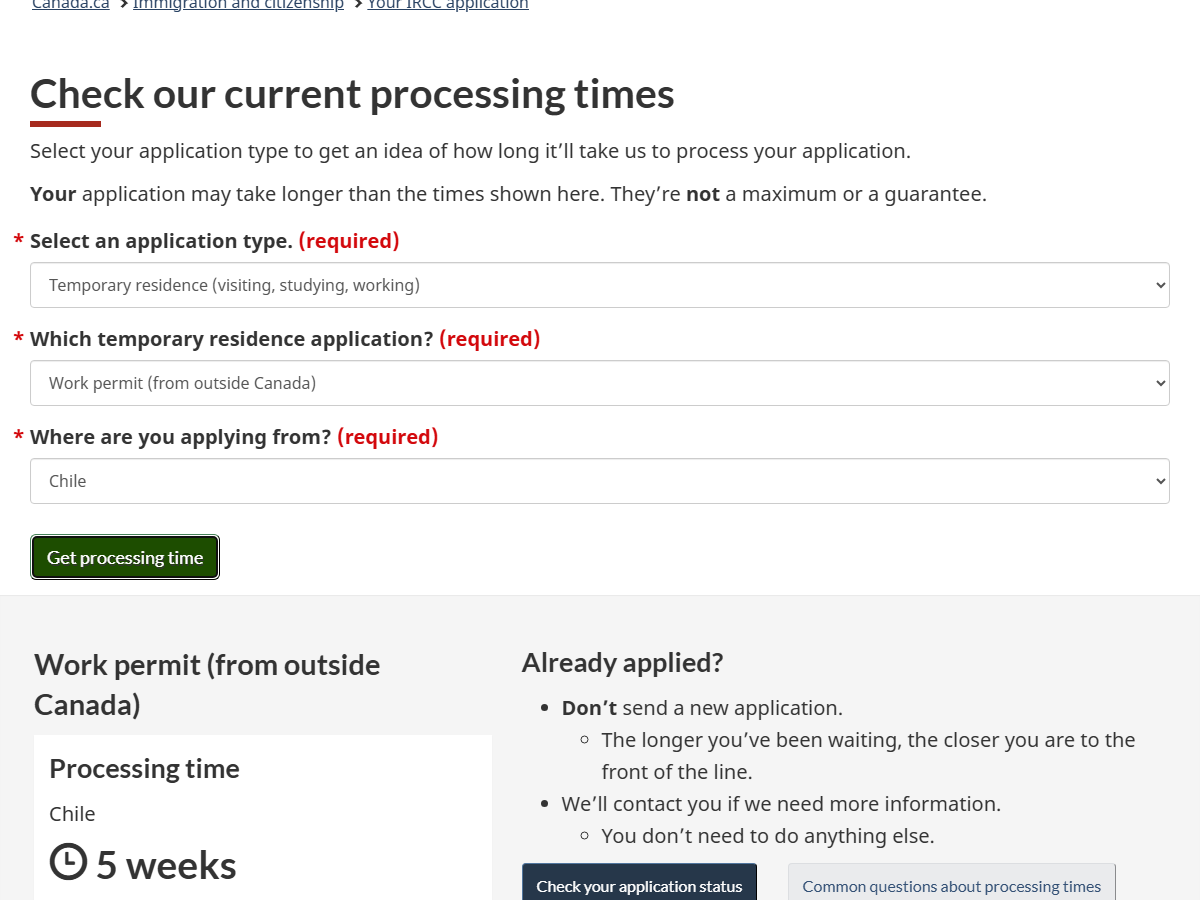
According to the IRCC processing times tool, Chilean nationals applying for a Canadian work permit from Chile are currently looking at 5 weeks (data pulled May 2026). Chile has a bilateral free trade agreement with Canada (CCFTA) and participates in the IEC Working Holiday program, which means Chilean workers have access to LMIA-exempt streams that most other Latin American nationalities do not. This combination makes the path to a Canadian work permit more accessible for Chileans than the 5-week processing time alone suggests. This article explains both routes and how to plan your total timeline.
How to check your processing time on the IRCC tool
IRCC publishes current processing time estimates through a public tool organized by application type and country of residence. To find the figure for Chile:
- Go to the IRCC processing times tool
- Select "Temporary residence (visiting, studying, working)"
- Select "Work permit (from outside Canada)"
- Select Chile as your country of residence
- Click "Get processing time"
The result is tied to your country of residence, not your nationality. Chilean citizens living outside Chile should run the tool with their current country of residence selected to get the applicable figure.
Processing times are updated weekly. Check the tool again when you are close to submitting your application, as the figure can move as IRCC intake and inventory shifts.
What "5 weeks" actually means
The IRCC processing time is the 80th percentile benchmark. It reflects how long it took IRCC to finalize 80% of complete applications from Chile during a recent historical window. One in five applicants will wait longer than 5 weeks, sometimes by a meaningful margin, without anything being wrong with their file.
The 5-week clock starts only when your application is considered complete by IRCC. That means all forms are correctly filled out, the fee is paid, all required documents are attached, and biometrics have been submitted if required. An incomplete application is not in the processing queue and the clock has not started.
This figure covers only the IRCC review stage, not the employer-side steps that may need to happen before you can submit. The full timeline depends heavily on which stream applies to your situation.
The two tracks: LMIA-backed and LMIA-exempt
LMIA-exempt permits under the Canada-Chile FTA
The Canada-Chile Free Trade Agreement (CCFTA) includes provisions that allow certain Chilean professionals and intra-company transferees to obtain work permits without an LMIA. Categories covered under the FTA include intra-company transferees (executives, senior managers, and specialized knowledge employees moving between Chilean and Canadian entities) and business visitors in certain capacities.
For LMIA-exempt applications under the FTA or other LMIA exemptions, the employer submits an Offer of Employment through the IRCC Employer Portal (typically a few days) and pays the compliance fee. You then submit your work permit application and the 5-week IRCC window applies. Total timeline from offer confirmation to permit: approximately 7 to 9 weeks when biometrics are factored in.
LMIA-backed permits (Temporary Foreign Worker Program)
For job roles that do not qualify under the FTA or another LMIA exemption, the employer must obtain an LMIA from Employment and Social Development Canada (ESDC) before you can submit the work permit application to IRCC. LMIA processing at ESDC is a separate government process, currently running approximately 8 to 12 weeks for most streams. The IRCC 5-week window begins only after the LMIA is issued.
Total realistic timeline for an LMIA-backed work permit from Chile: ESDC LMIA (8-12 weeks) plus IRCC processing (5 weeks) plus biometrics if required (2-4 weeks). From job offer confirmation to permit: approximately 3 to 5 months.
IEC Working Holiday
Chile participates in the International Experience Canada (IEC) Working Holiday program. IEC Working Holiday is an open work permit, meaning you can work for any Canadian employer and do not need a job offer before applying. Eligibility requires Chilean citizenship, age 18 to 35 (inclusive), and a valid passport. Spots are allocated through pool draws with bilateral caps.
IEC Working Holiday bypasses the LMIA entirely. Once you receive an Invitation to Apply from the IEC pool, you submit your work permit application and IRCC processes it. The 5-week benchmark applies once your complete application is submitted. Total time from ITA to permit: approximately 7 to 9 weeks.
Biometrics for work permits
Biometrics (fingerprints and photo) are required for most work permit applicants before IRCC will begin processing. If this is your first Canadian application, or your biometrics on file are more than 10 years old, you will receive a Biometrics Instruction Letter (BIL) after submitting your application. You have 30 days to attend a Visa Application Centre (VAC) to provide your biometrics in person.
The VAC serving Chilean applicants is in Santiago. IRCC does not continue processing until biometrics are received. In practice, biometrics add approximately 2 to 4 weeks to the total timeline for first-time applicants on top of the published 5-week processing time.
If your biometrics from a previous Canadian application are on file and less than 10 years old, this step does not apply and your application moves through the queue immediately upon submission.
Building your full timeline from Chile
To plan accurately, stack each stage in sequence:
LMIA-exempt route (CCFTA or IMP): Confirm your role qualifies under the FTA or another exemption, employer submits Offer of Employment through IRCC portal (a few days), you prepare and submit application, biometrics if required (2-4 weeks), IRCC processing (5 weeks). Total from offer confirmation: approximately 7 to 9 weeks.
LMIA-backed route (TFWP): Employer prepares and submits LMIA to ESDC (2-4 weeks to prepare, 8-12 weeks ESDC processing), LMIA issued, you prepare and submit application, biometrics if required (2-4 weeks), IRCC processing (5 weeks). Total from job offer: approximately 3 to 5 months.
IEC Working Holiday: Enter IEC pool, receive Invitation to Apply (timing varies), submit application, biometrics if required, IRCC processing (5 weeks). Total after ITA: approximately 7 to 9 weeks.
Do not commit to a firm start date until you know which stream applies and have tracked the relevant steps. The IEC and CCFTA routes are considerably faster than the LMIA-backed route, so identifying which one applies is the first decision to make.
Common reasons applications take longer than 5 weeks
Being in the 20% of applicants who wait beyond 5 weeks is often traceable to specific, preventable issues. Biometrics not yet on file add 2 to 4 weeks. A job offer letter that does not match the Offer of Employment exactly, a role claimed to be CCFTA-exempt that does not clearly qualify under the FTA categories, any prior Canadian immigration refusal on file, or the work location being in Quebec (which requires a provincial CAQ from MIFI before the federal application can be submitted) all extend timelines.
For CCFTA-exempt applications, the officer will assess whether the role genuinely qualifies under the FTA intra-company or professional categories. Documentation supporting the qualification, such as employment records confirming the intra-company relationship or professional credentials for relevant categories, should be thorough and clearly organized.
Already applied?
Applied through Up Immigration? We're already watching.
Our team monitors every active application on a regular basis. If IRCC requests documents, updates your status, or issues a decision, you will hear from us first.
If you applied independently, log into your IRCC secure account at canada.ca to check your application status and read any officer correspondence. Calling the IRCC contact centre will not provide additional information beyond what the online tracker shows.
When to work with an RCIC
Chile's access to IEC Working Holiday and CCFTA intra-company categories creates real advantages over countries without those pathways, but taking advantage of those options requires confirming that your specific situation actually qualifies. A role that does not genuinely fall within CCFTA categories will be refused if claimed incorrectly, and that refusal stays on file.
A Regulated Canadian Immigration Consultant (RCIC) evaluates whether your role qualifies under the FTA or other LMIA-exempt categories, ensures the employer's documentation is structured to support that claim, verifies that the job offer letter holds up to officer review, and anticipates biometrics and medical exam requirements before submission. Getting the stream classification right before submitting is the most important step, and it determines whether your timeline is 7 weeks or 5 months.
If you are evaluating your options or preparing to apply, a consultation is the right starting point. Book a consultation with Up Immigration and we will assess which stream applies, what documentation is required, and what your realistic end-to-end timeline looks like.
Processing time data sourced from the IRCC processing times tool, May 2026. Times are updated weekly and subject to change. This article does not constitute legal advice. Verify current figures at canada.ca before making decisions.