
According to the IRCC processing times tool, Colombian nationals applying for a Canadian work permit from Colombia are currently looking at 7 weeks (data pulled May 2026). That figure covers only the IRCC review stage. For most Colombian workers, the total timeline from job offer to permit in hand is significantly longer, particularly for LMIA-backed applications where employer-side steps precede the IRCC process. This article breaks down what the 7 weeks actually covers and how to plan your full timeline.
Colombia also participates in the IEC Working Holiday program, which opens a separate, faster track for eligible applicants under 35. Both routes are covered below.
How to check your processing time on the IRCC tool
The IRCC processing times tool lets you look up the current estimate for your specific application type and country. To find the figure for Colombia:
- Go to the IRCC processing times tool
- Select "Temporary residence (visiting, studying, working)"
- Select "Work permit (from outside Canada)"
- Select Colombia as your country of residence
- Click "Get processing time"
The result reflects your country of residence, not your citizenship. Colombian nationals living outside Colombia should run the tool with their current country of residence selected.
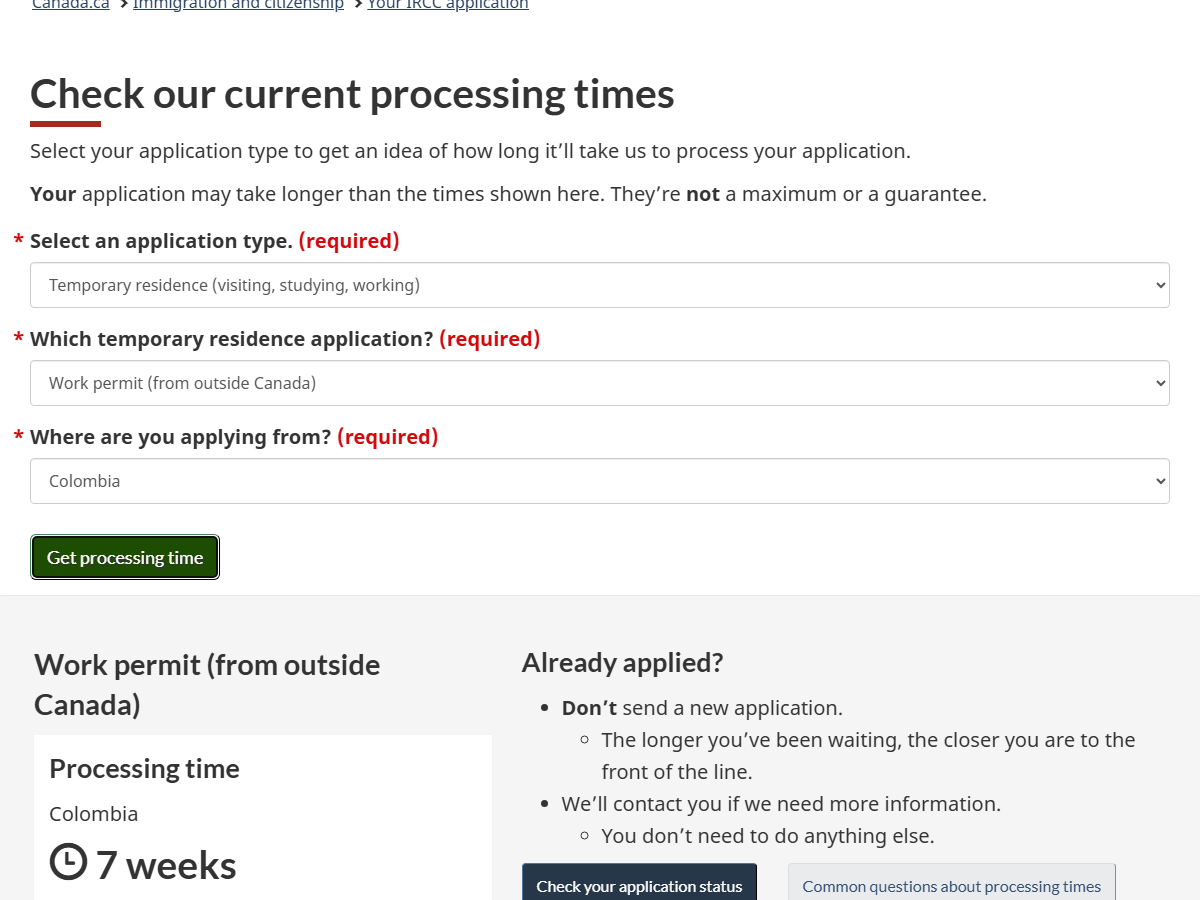
The tool is updated weekly. Check it again when you are close to submitting, as the figure can shift as IRCC intake and inventory evolves.
What "7 weeks" actually means
The IRCC processing time is the 80th percentile benchmark. It describes how long it took IRCC to finalize 80% of complete applications from Colombia during a recent historical period. One in five applicants will wait longer than 7 weeks. Some will wait considerably longer, particularly if there are documentation issues or a high-complexity review is required.
The 7-week clock starts only once IRCC considers your application complete. That means all forms are correctly filled out, the government fee is paid, all supporting documents are present, and biometrics have been submitted if required. If any of those elements are missing or incorrect, your file is not yet in the processing queue and the clock has not started.
Critically, the 7 weeks does not include any employer-side steps. It does not include LMIA processing at ESDC, document preparation time, or biometrics collection. The sections below explain how to stack all of these stages into a realistic total timeline.
The two tracks: LMIA-backed and LMIA-exempt
LMIA-backed permits (Temporary Foreign Worker Program)
Colombia does not have a free trade agreement with Canada that provides automatic work authorization categories equivalent to CUSMA's TN stream. For most Colombian workers with a job offer, the employer must first obtain a Labour Market Impact Assessment (LMIA) from Employment and Social Development Canada (ESDC) before the work permit application can be submitted to IRCC.
The LMIA process is separate from IRCC. ESDC reviews the employer's recruitment efforts to confirm that no qualified Canadian worker was available for the role. Current LMIA processing for most streams runs approximately 8 to 12 weeks, though this varies by occupational stream and ESDC workload. The IRCC 7-week window begins only after the LMIA is approved and in hand.
Total realistic timeline for an LMIA-backed work permit from Colombia: ESDC LMIA (8-12 weeks) plus IRCC work permit processing (7 weeks) plus biometrics if required (2-4 weeks). From job offer confirmation to permit, expect 4 to 6 months in most cases.
LMIA-exempt permits (International Mobility Program)
Some Colombian workers qualify for LMIA-exempt categories, which bypass the ESDC step. Common examples include intra-company transferees moving from a Colombian entity to a Canadian affiliate, workers covered by international agreements, certain researchers and specialists providing significant benefit to Canada, and IEC participants (covered separately below).
For LMIA-exempt applications, the employer submits an Offer of Employment through the IRCC Employer Portal (typically a few days) and pays the compliance fee. Once that is complete, you submit your work permit application and the 7-week IRCC window applies. Total timeline from job offer to permit is typically 9 to 11 weeks when biometrics are factored in.
IEC Working Holiday for Colombians
Colombia participates in the International Experience Canada (IEC) Working Holiday program. IEC Working Holiday is an open work permit, meaning you can work for any Canadian employer without a job offer in hand before you apply. Eligibility requirements include age 18 to 35 (inclusive), Colombian citizenship, and a valid passport. Spots are allocated through pool draws, and the number of spots available each year is set bilaterally.
The IEC Working Holiday permit is LMIA-exempt and open, making it the most flexible entry to the Canadian labour market for eligible Colombians. If you qualify by age and plan to gain Canadian work experience before pursuing permanent residence, IEC is often the most practical starting point. The work permit processing time under IEC follows the same IRCC tool figure once the Invitation to Apply (ITA) is received and the application is submitted.
Biometrics for work permits
Biometrics (fingerprints and photo) are required for most work permit applicants before IRCC will process the application. First-time applicants, or those whose biometrics on file are more than 10 years old, will receive a Biometrics Instruction Letter (BIL) after submission. You then have 30 days to attend a Visa Application Centre (VAC) to give your biometrics in person.
VAC locations serving Colombian applicants include Bogotá and Medellín. IRCC will not continue processing until biometrics are received, so factor in appointment availability. In practice, biometrics add approximately 2 to 4 weeks to the total timeline for first-time applicants on top of the published 7-week processing time.
Building your full timeline from Colombia
Here is how to stack the stages for a realistic estimate:
LMIA-backed route: Employer prepares and submits LMIA to ESDC (2-4 weeks to prepare, 8-12 weeks ESDC processing), LMIA approved and issued, you prepare and submit work permit application, biometrics if required (2-4 weeks), IRCC processing (7 weeks). Total: 4 to 6 months from job offer.
LMIA-exempt route: Employer submits Offer of Employment through IRCC portal (a few days), you prepare and submit work permit application, biometrics if required (2-4 weeks), IRCC processing (7 weeks). Total: approximately 9 to 11 weeks from offer confirmation.
IEC Working Holiday: Enter IEC pool, receive Invitation to Apply (timing varies by draw), submit application, biometrics if required, IRCC processing (7 weeks or the current figure for your profile). Total after ITA: approximately 9 to 11 weeks.
Do not set a firm start date with your employer until you have confirmed which route applies and tracked the relevant steps. The 7-week IRCC figure is accurate, but it is the last stage of a longer process.
Common reasons applications take longer than 7 weeks
Being in the 20% of applicants who wait beyond 7 weeks is not random. Predictable factors that extend timelines include biometrics not yet on file, a job offer letter that does not match the LMIA exactly in terms of NOC code, wage, or work location, financial documentation that raises questions about ties to Colombia, any prior Canadian immigration refusal on file, or work being performed in Quebec, which requires a provincial CAQ from MIFI before the federal application can be submitted.
For LMIA-backed applications, mismatches between the approved LMIA and the job offer letter presented to IRCC are one of the most common sources of delay or officer requests for additional information. The LMIA number, job title, NOC code, and wage must align precisely.
Already applied?
Applied through Up Immigration? We're already watching.
Our team monitors every active application on a regular basis. If IRCC requests documents, updates your status, or issues a decision, you will hear from us first.
If you applied independently, log into your IRCC secure account at canada.ca to check your application status. Officer messages and status updates appear there. Calling the IRCC contact centre will not provide information beyond what is visible in your online account.
When to work with an RCIC
Seven weeks sounds manageable. The challenge is that the steps leading to that 7-week window, particularly LMIA preparation and ensuring the complete application package holds up to officer scrutiny, are where most delays originate. An error in the LMIA application, a job offer letter that does not match what was approved, or biometrics and medical requirements that were not anticipated can extend the timeline by weeks or lead to a refusal that affects future applications.
A Regulated Canadian Immigration Consultant (RCIC) reviews the complete file before it reaches an IRCC officer. That includes verifying that the employer's LMIA or LMIA-exemption was structured correctly, that the job offer letter is aligned, that IEC eligibility is confirmed if that is the applicable route, and that no documentation gaps remain before submission.
If you are at the early stages, a consultation is the right starting point. Book a consultation with Up Immigration and we will assess which route applies to your situation, confirm what your employer needs to do, and give you a realistic timeline from your current position.
Processing time data sourced from the IRCC processing times tool, May 2026. Times are updated weekly and subject to change. This article does not constitute legal advice. Verify current figures at canada.ca before making decisions.