
According to the IRCC processing times tool, Mexican nationals applying for a Canadian work permit from Mexico are currently looking at 3 weeks (data pulled May 2026). That is one of the fastest work permit timelines in Latin America, and it reflects both lower application volume and the unique trade agreement advantages Mexico enjoys with Canada. This article explains what that 3-week figure covers, what it does not cover, and how to build a realistic end-to-end timeline.
If you have a job offer in Canada and you are applying from Mexico, the CUSMA trade agreement may change your process significantly. Read on.
How to check your processing time on the IRCC tool
IRCC maintains a public tool where any applicant can look up the current processing time for their specific application type and country of residence. Here is how to use it:
- Go to the IRCC processing times tool
- Select "Temporary residence (visiting, studying, working)"
- Select "Work permit (from outside Canada)"
- Select Mexico as your country of residence
- Click "Get processing time"
The result reflects your country of residence, not your nationality. If you are a Mexican citizen currently living in a different country, run the tool with that country selected to get the applicable figure.
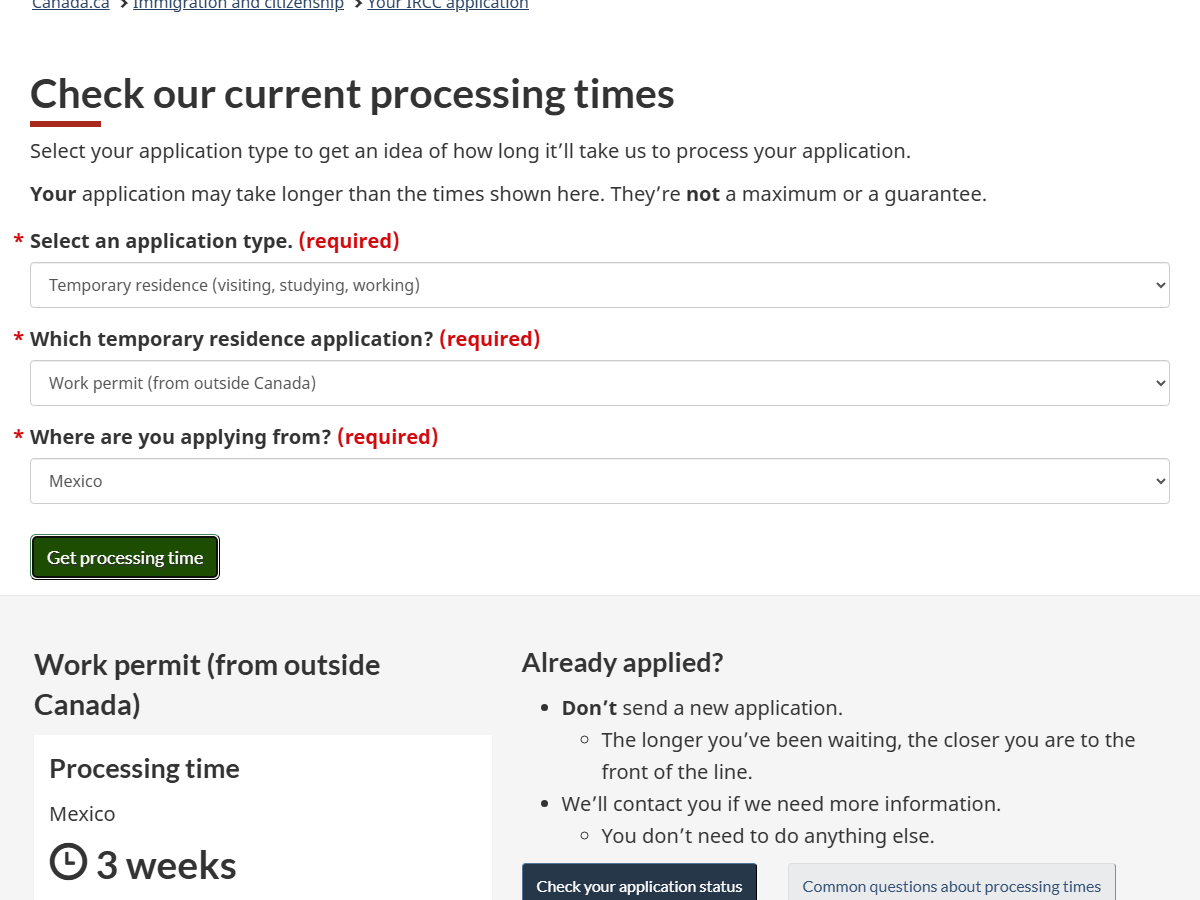
Processing times are updated on a weekly basis. The 3-week figure can shift up or down as IRCC intake and inventory changes, so check the tool again when you are close to submitting.
What "3 weeks" actually means
The IRCC processing time is the 80th percentile benchmark. It measures how long it took IRCC to finalize 80% of complete applications from Mexico in a recent historical window. One in five applicants will wait longer, sometimes by several weeks, without anything being wrong with their file.
More importantly, the 3-week clock starts only when IRCC considers your application complete. That means all forms are correctly filled out, government fees are paid, all required supporting documents are attached, and biometrics have been submitted if required. An incomplete application is not in the processing queue, and the 3 weeks has not begun.
This figure covers the IRCC review stage only. It does not include any employer-side steps, LMIA processing at ESDC, or biometrics collection time. The full picture is more nuanced, and the sections below build out that complete timeline.
The two tracks: LMIA-backed and LMIA-exempt
Every Canadian work permit application falls into one of two broad categories, and which category you fall into determines how long your total process takes before IRCC's 3-week clock even starts.
LMIA-backed permits (Temporary Foreign Worker Program)
If your employer needs to prove that no qualified Canadian worker was available for your role, they must apply to Employment and Social Development Canada (ESDC) for a Labour Market Impact Assessment (LMIA) before you submit your work permit application. The LMIA is a separate government process with its own processing time, currently 8 to 12 weeks for most streams, though this varies. Only after the LMIA is issued can you apply for the work permit itself, which is when the 3-week IRCC clock begins.
The total timeline for an LMIA-backed permit from Mexico is: employer prepares and submits LMIA, ESDC issues LMIA (8-12 weeks typically), you prepare and submit work permit application, IRCC processes (3 weeks). The 3 weeks is the last stage, not the whole journey.
LMIA-exempt permits (International Mobility Program)
Many Mexican workers qualify for LMIA-exempt streams, which bypass the ESDC step entirely. Common exemption categories include:
- CUSMA (Canada-United States-Mexico Agreement) professionals in listed occupations such as engineers, accountants, computer systems analysts, lawyers, scientists, and management consultants. Mexicans in these roles can apply for a TN work permit at the Canadian port of entry or by mail without an LMIA.
- Intra-company transferees moving within a multinational organization from a Mexican entity to a Canadian affiliate
- Significant benefit to Canada for specialized researchers, artists, and certain other categories
- Reciprocal employment and international agreement categories
For LMIA-exempt applications, the employer files an Offer of Employment through the IRCC Employer Portal, which typically takes a few days. The IRCC 3-week window then applies to the work permit itself, making the total timeline much shorter than the LMIA-backed route.
Note: International Experience Canada (IEC) Working Holiday is not available for Mexican nationals. The CUSMA pathway is often the most practical LMIA-exempt option for Mexican professionals.
Biometrics for work permits
Biometrics (fingerprints and photo) are required for most work permit applicants before IRCC will begin processing. If this is your first application to Canada, or your biometrics on file are more than 10 years old, you will receive a Biometrics Instruction Letter (BIL) after submitting your application. You then have 30 days to attend a Visa Application Centre (VAC) to complete biometrics in person.
VAC locations in Mexico include Mexico City, Guadalajara, and Monterrey. Processing does not continue until IRCC receives your biometrics, so factoring in VAC appointment availability is essential. In practice, biometrics add approximately 2 to 4 weeks to the total timeline for first-time applicants, on top of the published 3-week processing time.
If you have given biometrics for a previous Canadian application within the past 10 years and they are still on file, this step does not apply and your application can move through the queue immediately upon submission.
Building your full timeline from Mexico
To build a realistic timeline, you need to add each step in sequence:
LMIA-exempt route (e.g., CUSMA TN): Confirm your occupation qualifies under CUSMA (check the approved list), gather supporting credential documentation, employer submits Offer of Employment (a few days), you submit work permit application, biometrics if required (2-4 weeks), IRCC processing (3 weeks). Realistic total from job offer confirmation to permit: approximately 5 to 7 weeks.
LMIA-backed route (TFWP): Employer prepares and submits LMIA to ESDC (8-12 weeks), you receive LMIA number and prepare application, biometrics if required (2-4 weeks), IRCC processing (3 weeks). Realistic total from job offer to permit: approximately 3 to 5 months.
Do not commit to a firm start date with your employer until you have clarity on which route applies and where you are in the process. The 3-week IRCC figure is accurate, but it represents only one segment of a longer sequence.
Country-specific context for Mexican applicants
Mexico is one of only three countries with access to the CUSMA (formerly NAFTA) TN professional pathway, along with the United States. This is a significant structural advantage compared to other Latin American nationalities, most of whom must go through the full LMIA process for the same occupations. If your role is on the CUSMA occupation list, you should explore this route before defaulting to LMIA.
Mexican workers also have access to the Seasonal Agricultural Worker Program (SAWP), which is a distinct stream from the standard work permit process and has its own employer-driven intake mechanism. If your work in Canada is in the agricultural sector, SAWP may apply instead of the TFWP or IMP streams described above.
One thing to watch: CUSMA TN permits applied for at the port of entry require you to carry all supporting documentation with you when you cross the border. If a CBSA officer determines your documentation is insufficient, you may be turned back. Preparing this package carefully matters.
Common reasons applications take longer than 3 weeks
Even with a 3-week benchmark, some files take longer. The most predictable reasons include biometrics not yet on file (adds 2-4 weeks), a job offer letter that does not align precisely with the LMIA or Offer of Employment number, documentation of credentials that does not clearly establish CUSMA occupation eligibility, prior Canadian immigration refusals on file, or the work location being in Quebec (requiring a provincial CAQ from MIFI before the federal permit application can be submitted).
Quebec is a common destination for workers in certain sectors, and the CAQ requirement is often overlooked by applicants who focus only on the federal process. If your employer is in Quebec, factor in CAQ processing time from MIFI before the IRCC 3-week window opens.
Already applied?
Applied through Up Immigration? We're already watching.
Our team monitors every active application on a regular basis. If IRCC requests documents, updates your status, or issues a decision, you will hear from us first.
If you applied independently and want to track status, log into your IRCC secure account at canada.ca. Your application status and any officer correspondence will appear there. Calling the IRCC contact centre will not provide information beyond what the online tracker shows.
When to work with an RCIC
The 3-week processing time is encouraging, but the steps that precede it carry the real risk. Whether your occupation qualifies under CUSMA, whether your credentials documentation meets the officer's threshold, whether your job offer letter matches the Offer of Employment exactly, and whether the LMIA or exemption was set up correctly by your employer, all of these are points where errors cause delays or refusals. A refusal creates a record that adds complexity to future applications.
A Regulated Canadian Immigration Consultant (RCIC) reviews the entire file before it reaches an officer, not just the forms. That means checking that the CUSMA occupation list applies, that the offer letter is correctly structured, that biometrics and medical requirements are flagged in advance, and that nothing in the file creates an unnecessary question for the officer reviewing it.
If you are at the stage of evaluating your options or preparing to apply, a consultation is the right starting point. Book a consultation with Up Immigration and we will assess your situation, confirm which stream applies, and map the realistic timeline from your current position.
Processing time data sourced from the IRCC processing times tool, May 2026. Times are updated weekly and subject to change. This article does not constitute legal advice. Verify current figures at canada.ca before making decisions.