
When you run the IRCC processing times tool for a work permit from Portugal, the result is "No processing time available." That response stops many people in their tracks. It does not mean applications are not accepted or not processed. It means IRCC does not have enough recent application data from Portugal to publish a statistically reliable figure. Portuguese citizens can and do apply for Canadian work permits, and their applications are processed under the same rules as any other EU country. This article explains what "no processing time available" actually means, which streams are open to Portuguese nationals, what CETA and IEC offer, and how to build a realistic planning timeline when no specific number is published.
How to check your processing time on the IRCC tool
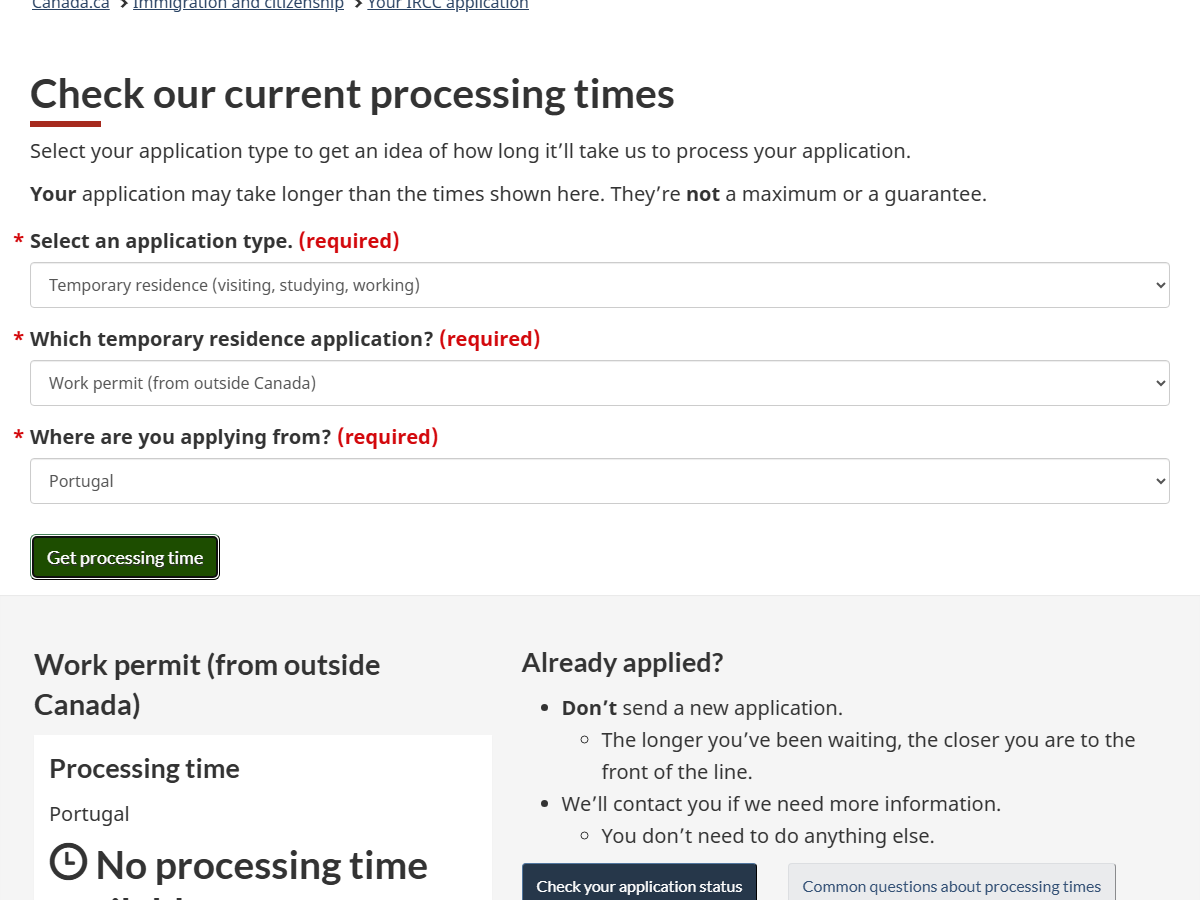
IRCC publishes country-specific processing times through a publicly accessible tool at canada.ca. For many countries, including most high-volume applicant nations, a specific number in weeks appears. For lower-volume countries like Portugal, the tool returns "no processing time available" because the dataset is too small to produce a meaningful statistic.
Steps to check:
- Go to the IRCC processing times tool.
- Select "Temporary residence (visiting, studying, working)".
- Select "Work permit (from outside Canada)".
- Select "Portugal".
- Click "Get processing time" — result: No processing time available.
What "no processing time available" means in practice
IRCC calculates processing times using the 80th percentile of finalized applications within a recent historical window. When the number of applications from a given country is too low to generate a statistically meaningful result, the tool returns "no processing time available" rather than publishing a number that would misrepresent the data.
This happens for countries with relatively low application volumes. Portugal falls into this category for work permits. The absence of a published figure is not a flag, a delay, or a problem with applications from Portugal. Applications from Portuguese nationals are accepted through the standard IRCC online system, processed by IRCC officers under the same criteria as all other nationalities, and subject to the same approval standards.
For planning purposes, Portuguese applicants should use benchmark processing times from comparable EU countries. Based on published data from France (4 weeks), Germany (8 weeks), and Spain (5 weeks) in May 2026, a reasonable planning range for a complete work permit application from Portugal is 4 to 10 weeks at the IRCC stage, depending on stream and application volume at the time of submission.
LMIA-exempt streams for Portuguese nationals: CETA and IEC
Portugal is a member of the European Union, which means Portuguese citizens benefit from the Canada-European Union Comprehensive Economic and Trade Agreement (CETA). CETA creates several LMIA-exempt categories that are not available to workers from countries outside the agreement.
CETA intra-company transferees. If you work for a multinational company with operations in both Portugal and Canada and your role qualifies as a manager, executive, or specialist, you may be eligible for an intra-company transfer work permit under CETA. No LMIA is required. Your employer files an Offer of Employment through the IRCC Employer Portal, and you apply directly for the work permit.
CETA contractual service suppliers and independent professionals. Certain Portuguese professionals providing services under a contract with a Canadian entity may qualify for a work permit without an LMIA, depending on occupation category and NOC code. Engineers, architects, accountants, and several other regulated classes are among the covered categories.
IEC Working Holiday. Portugal participates in International Experience Canada (IEC). The Working Holiday stream is an open work permit for Portuguese citizens aged 18 to 35. No job offer or LMIA is required. You submit a profile, receive an invitation to apply, and then apply for the open work permit. IEC is a common first step for Portuguese workers exploring Canada before considering permanent residence options.
LMIA-backed track: when CETA and IEC do not apply
If your situation does not fit CETA or IEC, the standard route is an LMIA-backed work permit through the Temporary Foreign Worker Program (TFWP). Your Canadian employer applies to Employment and Social Development Canada (ESDC) for an LMIA before you can submit your work permit application.
LMIA processing by ESDC adds its own timeline before the IRCC stage even begins:
- High-wage stream: typically 8 to 12 weeks depending on occupation and ESDC volumes
- Low-wage stream: similar range, with additional scrutiny in certain sectors
- Global Talent Stream (specific tech occupations): 2-week service standard from ESDC when conditions are met
The full picture for an LMIA-backed work permit: your employer prepares and submits the LMIA, waits for ESDC approval, then you submit your work permit application to IRCC, and IRCC processes it. For Portugal, use the 4 to 10 week IRCC benchmark. Total end-to-end under this track: 15 to 25 weeks from LMIA submission.
Biometrics: add time if this is your first Canadian application
If you have never provided biometrics for a Canadian immigration application, or if your biometrics on file are more than 10 years old, you will receive a Biometrics Instruction Letter (BIL) after submitting your work permit application. You have 30 days from that letter to attend a Visa Application Centre (VAC) and provide your fingerprints and photo. IRCC will not continue processing until biometrics are received.
For Portuguese applicants, VAC service is available in Lisbon. Biometrics add approximately 2 to 4 weeks to the total timeline for first-time applicants. Build this into your planning if your employer is counting on a specific start date.
Full realistic timeline for Portuguese work permit applicants
CETA or IEC route (LMIA-exempt):
- Employer files Offer of Employment in IRCC portal: 3 to 5 business days
- You prepare and submit your application: 1 to 2 weeks
- Biometrics (if required): add 2 to 4 weeks
- IRCC processing: estimated 4 to 10 weeks
- Total realistic range: 8 to 16 weeks from employer confirmation to permit issued
LMIA-backed route:
- Employer LMIA preparation and ESDC processing: 10 to 16 weeks
- You prepare and submit work permit application: 1 to 2 weeks
- Biometrics (if required): add 2 to 4 weeks
- IRCC processing: estimated 4 to 10 weeks
- Total realistic range: 17 to 32 weeks
Portuguese workers and permanent residence
Portuguese workers in NOC TEER 0, 1, 2, or 3 occupations are typically eligible for Canada's Express Entry system. Skilled trades, technology, engineering, and healthcare are all categories where Canadian employers actively recruit. An initial work permit under IEC or CETA can be the foundation for accumulating the 12 months of skilled Canadian work experience needed for the Canadian Experience Class (CEC) and a path to permanent residence.
Portugal's growing interest in Canada as a destination reflects both economic factors and the strong bilateral relationship between the two countries, including Portugal's EU membership and IEC participation. Portuguese applicants with in-demand skills and strong English profiles are competitive in the Express Entry pool.
Already applied?
Applied through Up Immigration? We're already watching.
Our team monitors every active application on a regular basis. If IRCC requests documents, updates your status, or issues a decision, you will hear from us first.
If you applied independently, log into your IRCC secure account at canada.ca to check your status. Application updates and officer messages appear there. Calling the IRCC contact centre will not give you more information than the online tracker already shows.
Ready to apply?
The absence of a published processing time for Portugal does not complicate your application. It means IRCC processes files from Portugal without the high-volume constraints that affect countries with published wait times. Portuguese citizens have strong options through CETA and IEC, and LMIA-backed routes remain available when those do not apply.
Identifying the right stream, preparing the correct documentation, and building an accurate timeline for your employer requires knowing your specific situation. An RCIC reviews your CETA eligibility, confirms the employer's obligations, and structures your file correctly before submission.
Book a consultation with Up Immigration and we will walk through your situation and identify the path that makes sense for you.
Processing time data sourced from the IRCC processing times tool, May 2026. Times are updated weekly and subject to change. This article does not constitute legal advice. Verify current figures at canada.ca before making decisions.