
For Spanish citizens applying for a Canadian work permit from outside Canada, the current IRCC processing time is 5 weeks. That figure is drawn directly from the IRCC processing times tool in May 2026, specific to applicants residing in Spain. Five weeks is a moderate processing time by European standards, sitting between France's 4 weeks and Germany's 8 weeks. Like all published IRCC figures, it covers only the IRCC processing stage. This article explains what the 5-week number means, which work permit streams are available to Spanish nationals, how CETA and IEC factor in, and what the full timeline looks like from start to permit in hand.
How to check your processing time on the IRCC tool
IRCC publishes country-specific processing times through a publicly accessible tool at canada.ca. The result depends on where you currently live, not your passport. If you are a Spanish citizen living in Spain, run the tool with Spain selected. If you have relocated, use your current country of residence.
Steps to check:
- Go to the IRCC processing times tool.
- Select "Temporary residence (visiting, studying, working)".
- Select "Work permit (from outside Canada)".
- Select "Spain".
- Click "Get processing time" — currently 5 weeks.
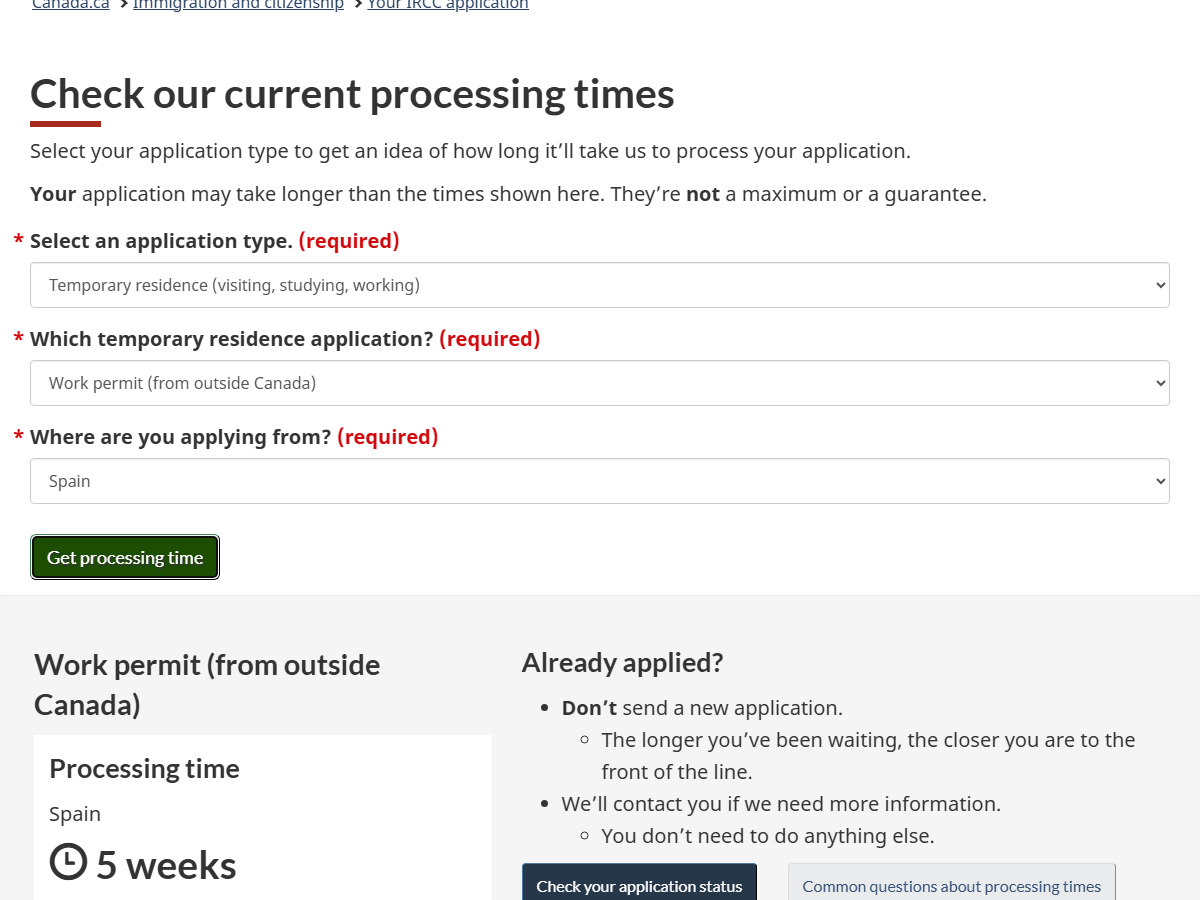
The tool is updated weekly. Check it again close to your intended submission date rather than relying on a figure you read weeks earlier.
What "5 weeks" actually means
The processing time published by IRCC represents the time it took to finalize 80% of applications in that category over a recent historical window. It is not an average, not a median, and not a guarantee. One in five applicants will wait longer than 5 weeks, sometimes considerably longer.
The clock starts only when IRCC considers your application complete: all required forms uploaded and correctly completed, government fees paid, supporting documents present and consistent, and biometrics submitted if required. A missing document, an inconsistent job offer letter, or unresolved biometrics means your application is not yet in the queue. The 5-week clock has not started.
This figure covers only the IRCC work permit processing stage. It does not include employer-side preparation, LMIA processing, or any provincial step that may apply. Those happen before your application reaches IRCC.
LMIA-exempt streams for Spanish nationals: CETA and IEC
Spain is a member of the European Union, which means Spanish citizens benefit from the Canada-European Union Comprehensive Economic and Trade Agreement (CETA). CETA creates several LMIA-exempt categories that significantly expand options for Spanish workers.
CETA intra-company transferees. If you work for a multinational company with operations in both Spain and Canada and your role qualifies as a manager, executive, or specialist, you may be eligible for an intra-company transfer work permit under CETA. No LMIA is required. Your employer files an Offer of Employment through the IRCC Employer Portal, and you apply for the work permit. The 5-week IRCC processing time applies once your application is submitted.
CETA contractual service suppliers and independent professionals. Certain Spanish professionals providing services under a contract with a Canadian entity may qualify for a work permit without an LMIA, depending on occupation and NOC code. This covers specific regulated professional categories including engineers, architects, and management consultants, among others.
IEC Working Holiday. Spain participates in International Experience Canada (IEC). The Working Holiday stream is an open work permit for Spanish citizens aged 18 to 35. No job offer or LMIA is required. You submit a profile, receive an invitation to apply, and then apply for the open work permit. For younger Spanish workers, IEC Working Holiday is typically the fastest and most straightforward path to working in Canada. It is also a practical first step before pursuing permanent residence through Express Entry.
IEC Young Professionals. Spain participates in the IEC Young Professionals category as well, which allows employer-specific work under arrangements between Canadian and Spanish employers or organizations.
LMIA-backed track: when CETA and IEC do not apply
If your situation does not fit CETA or IEC, the standard route is an LMIA-backed work permit through the Temporary Foreign Worker Program (TFWP). Your Canadian employer applies to Employment and Social Development Canada (ESDC) for an LMIA before you can submit your work permit application to IRCC.
LMIA processing by ESDC adds its own timeline before the IRCC stage begins:
- High-wage stream: typically 8 to 12 weeks depending on occupation and ESDC volumes
- Low-wage stream: similar range, with additional scrutiny in certain sectors
- Global Talent Stream (specific tech occupations): 2-week service standard from ESDC when conditions are met
The full picture for an LMIA-backed work permit: your employer prepares and submits the LMIA, waits for ESDC approval, then you submit your work permit application, and IRCC processes it in approximately 5 weeks. The 5-week figure is the final step, not the total timeline.
Quebec note: Spanish speakers and CAQ requirements
Spanish is not an official language of Canada, and Spanish-language proficiency does not provide automatic advantages for Quebec immigration programs. Quebec's immigration system is French-language focused, and the Certificat d'acceptation du Québec (CAQ) for workers is required if your job is located in Quebec, regardless of language. If your role is in Quebec, CAQ processing adds several weeks before your IRCC work permit application can be submitted.
Spanish-speaking workers interested in Quebec specifically would need to demonstrate French proficiency for most Quebec-specific programs. For work in other provinces, the standard federal work permit process applies without additional provincial requirements (unless your occupation is provincially regulated).
Biometrics: add time if this is your first Canadian application
If you have never provided biometrics for a Canadian immigration application, or if your biometrics on file are more than 10 years old, you will receive a Biometrics Instruction Letter (BIL) after submitting your work permit application. You have 30 days from that letter to attend a Visa Application Centre (VAC) and provide fingerprints and a photo. IRCC will not continue processing until biometrics are received.
For Spanish applicants, VACs operate in Madrid and Barcelona. Biometrics add approximately 2 to 4 weeks to the total timeline for first-time applicants. Build this into your planning if your employer has a specific start date in mind.
Full realistic timeline for Spanish work permit applicants
CETA or IEC route (LMIA-exempt):
- Employer files Offer of Employment in IRCC portal: 3 to 5 business days
- You prepare and submit your application: 1 to 2 weeks
- Biometrics (if required): add 2 to 4 weeks
- IRCC processing: approximately 5 weeks
- Total realistic range: 8 to 13 weeks from employer confirmation to permit issued
LMIA-backed route:
- Employer LMIA preparation and ESDC processing: 10 to 16 weeks
- You prepare and submit work permit application: 1 to 2 weeks
- Biometrics (if required): add 2 to 4 weeks
- IRCC processing: approximately 5 weeks
- Total realistic range: 18 to 27 weeks
Spanish workers and permanent residence pathways
Spanish citizens in NOC TEER 0, 1, 2, or 3 occupations are eligible for Canada's Express Entry system. IEC Working Holiday is frequently the first step for Spanish workers in their 20s and early 30s, providing open work authorization and a pathway to accumulating the 12 months of skilled Canadian work experience needed for the Canadian Experience Class (CEC).
Spanish professionals with bilingual Spanish-English profiles have strong career options in Canadian cities with significant Spanish-speaking communities, including Toronto, Vancouver, and Montreal. Bilingualism is an asset but not a factor in Express Entry CRS scoring unless the second language is French.
Already applied?
Applied through Up Immigration? We're already watching.
Our team monitors every active application on a regular basis. If IRCC requests documents, updates your status, or issues a decision, you will hear from us first.
If you applied independently, log into your IRCC secure account at canada.ca to check your status. Application updates and officer messages appear there first. Calling the IRCC contact centre will not give you more information than the tracker already shows.
Ready to apply?
A Canadian work permit application from Spain involves selecting the right stream from several options, preparing documentation that holds up to officer review, and planning a timeline that works for you and your employer. Spanish citizens have real advantages through CETA and IEC, but those advantages only apply when the right stream is correctly identified and the application is properly structured.
An RCIC reviews your CETA eligibility, confirms the employer's obligations under the Employer Portal process, checks biometrics and medical requirements before submission, and ensures your file is complete before it reaches an officer.
Book a consultation with Up Immigration and we will identify the right pathway for your situation and build an accurate timeline.
Processing time data sourced from the IRCC processing times tool, May 2026. Times are updated weekly and subject to change. This article does not constitute legal advice. Verify current figures at canada.ca before making decisions.