
For UK citizens applying for a Canadian work permit from outside Canada, the current IRCC processing time is 11 weeks. That figure is drawn directly from the IRCC processing times tool in May 2026, and it is specific to applicants residing in the United Kingdom. At 11 weeks, the UK's published processing time is the longest among European countries currently in the IRCC dataset, and it is worth understanding why. This article explains what the 11-week figure actually means, which work permit streams are open to UK nationals post-Brexit, how the UK-Canada Young Mobility Programme (YMP) fits in, and what a realistic end-to-end timeline looks like.
How to check your processing time on the IRCC tool
IRCC publishes country-specific processing times through a publicly accessible tool at canada.ca. The result depends on where you currently live, not your citizenship. If you are a UK citizen living in the UK, run the tool with United Kingdom selected. If you have relocated, use your current country of residence instead.
Steps to check:
- Go to the IRCC processing times tool.
- Select "Temporary residence (visiting, studying, working)".
- Select "Work permit (from outside Canada)".
- Select "United Kingdom".
- Click "Get processing time" — currently 11 weeks.
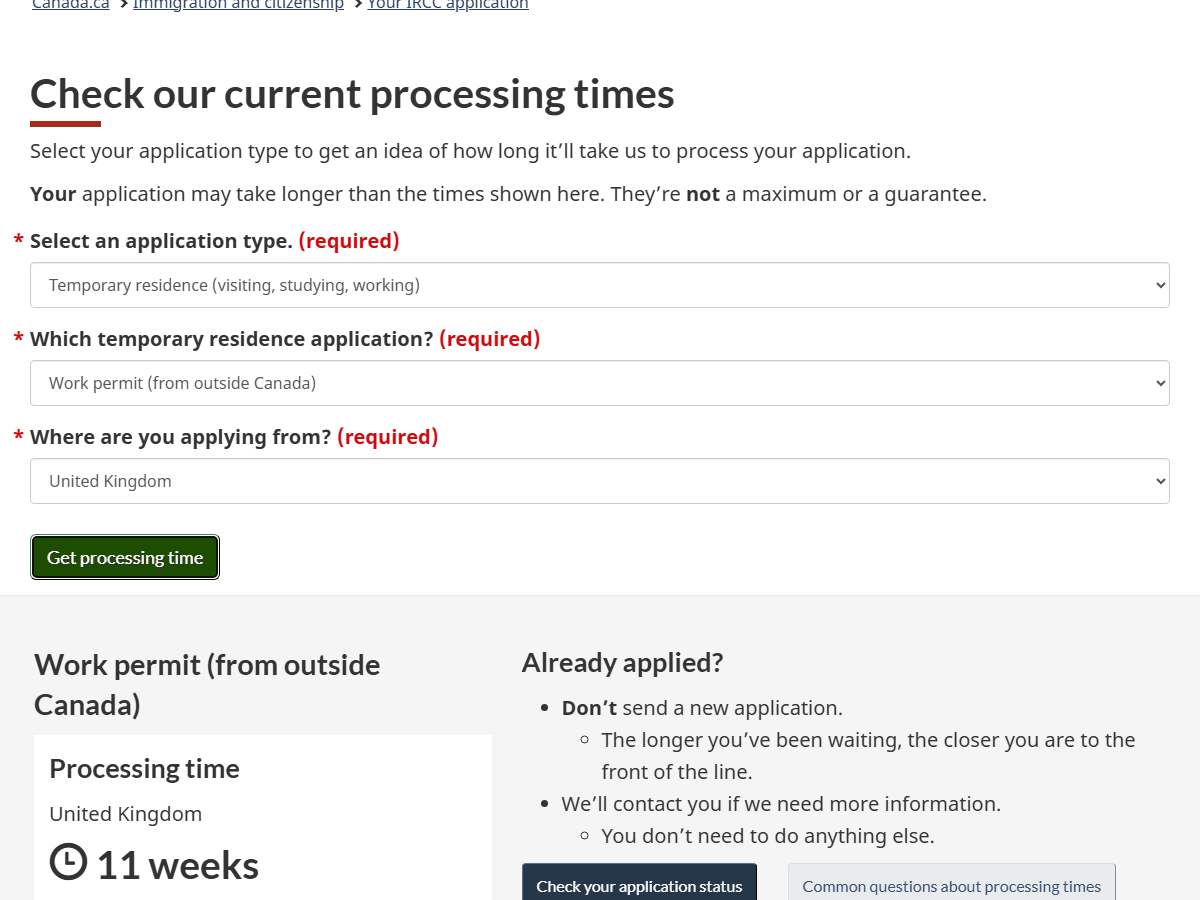
The tool is updated weekly. Check it again close to your intended submission date rather than relying on a figure you read weeks earlier. The 11-week figure reflects recent historical data and can shift as application volumes change.
What "11 weeks" actually means, and why the UK is higher than other European countries
The processing time published by IRCC represents the time it took to finalize 80% of applications in that category over a recent historical window. It is not an average and not a guarantee. One in five applicants will wait longer than 11 weeks.
The UK's longer processing time compared to France (4 weeks), Spain (5 weeks), and Germany (8 weeks) partly reflects higher application volume. The UK generates significantly more Canadian immigration applications than most individual European countries, which means more files in the IRCC queue and a longer 80th percentile time. This is a volume effect, not a reflection of UK applications being treated differently or scrutinized more heavily.
The clock starts only when IRCC considers your application complete: all forms correctly completed and uploaded, fees paid, documents present and consistent, and biometrics submitted if required. Incomplete applications do not start the 11-week clock.
This figure covers only the IRCC work permit processing stage. Employer-side preparation, LMIA processing, and any provincial steps happen before the IRCC stage begins.
Post-Brexit: no CETA for UK citizens
Following Brexit, the United Kingdom is no longer a member of the European Union and is therefore no longer covered by the Canada-European Union Comprehensive Economic and Trade Agreement (CETA). This is an important distinction. EU citizens from France, Germany, Spain, and Portugal can access CETA's LMIA-exempt intra-company transfer and contractual service supplier categories. UK citizens cannot.
UK citizens must use the standard work permit streams available to non-EU nationals, which means LMIA-backed work permits in most cases, or one of the specific LMIA-exempt categories that do apply to them: IEC/YMP, intra-company transfers under the general International Mobility Program rules, and significant benefit exemptions.
IEC and the UK-Canada Young Mobility Programme
IEC Working Holiday (UK-Canada Young Mobility Programme). The UK participates in International Experience Canada through a bilateral arrangement called the Young Mobility Programme (YMP). Under this program, UK citizens aged 18 to 35 can apply for an open work permit that allows them to work for any employer in Canada, in any province, in almost any occupation. No job offer or LMIA is required.
The YMP is the single most accessible route for younger UK citizens to work in Canada. It is open-ended, flexible, and does not require advance employment. The 11-week IRCC processing time applies to the work permit stage after an IEC invitation to apply is received.
IEC Young Professionals. The UK also participates in the IEC Young Professionals category, which allows employer-specific work under arrangements between Canadian and UK employers or organizations. Age eligibility and employer requirements apply.
LMIA-backed track: the main route for UK workers outside IEC
For UK citizens who are not eligible for IEC due to age or other restrictions, the primary route is an LMIA-backed work permit through the Temporary Foreign Worker Program (TFWP). The Canadian employer applies to Employment and Social Development Canada (ESDC) for an LMIA before you can submit your work permit application to IRCC.
LMIA processing by ESDC adds its own timeline before the IRCC stage begins:
- High-wage stream: typically 8 to 12 weeks depending on occupation and ESDC volumes
- Low-wage stream: similar range, with additional scrutiny in certain sectors
- Global Talent Stream (specific tech occupations): 2-week service standard from ESDC when conditions are met
The full picture for an LMIA-backed work permit from the UK: your employer prepares and submits the LMIA, waits for ESDC approval, then you submit your work permit application to IRCC, and IRCC processes it in approximately 11 weeks. The 11-week figure is the final step, not the total timeline.
Intra-company transfers under the general International Mobility Program (not CETA) may be available to UK employees of multinational companies with Canadian operations, subject to specific eligibility criteria.
Biometrics: add time if this is your first Canadian application
If you have never provided biometrics for a Canadian immigration application, or if your biometrics on file are more than 10 years old, you will receive a Biometrics Instruction Letter (BIL) after submitting your work permit application. You have 30 days from that letter to attend a Visa Application Centre (VAC) and provide fingerprints and a photo. IRCC will not continue processing until biometrics are received.
For UK applicants, VACs operate across multiple UK cities including London, Manchester, and Edinburgh. Biometrics add approximately 2 to 4 weeks to the total timeline for first-time applicants. Given the 11-week IRCC processing time, the biometrics step may run in parallel with initial IRCC review rather than extending the timeline significantly, but this depends on how quickly you can get a VAC appointment.
Full realistic timeline for UK work permit applicants
IEC/YMP route (LMIA-exempt, open work permit):
- IEC profile submission and invitation: variable, typically days to weeks depending on pool draws
- You prepare and submit your work permit application: 1 to 2 weeks
- Biometrics (if required): add 2 to 4 weeks
- IRCC processing: approximately 11 weeks
- Total realistic range: 14 to 18 weeks from IEC invitation to permit issued
LMIA-backed route:
- Employer LMIA preparation and ESDC processing: 10 to 16 weeks
- You prepare and submit work permit application: 1 to 2 weeks
- Biometrics (if required): add 2 to 4 weeks
- IRCC processing: approximately 11 weeks
- Total realistic range: 24 to 33 weeks
For LMIA-backed routes, the 11-week IRCC processing time at the end of a long ESDC review means the total process from employer decision to work permit is significant. UK workers and their employers should plan accordingly.
UK professionals and permanent residence
UK citizens with in-demand occupations and strong English profiles are competitive in Canada's Express Entry pool. IEC Working Holiday is frequently the first step, providing open work authorization and a pathway to the 12 months of skilled Canadian work experience needed for the Canadian Experience Class (CEC) and a path to permanent residence. UK citizens who studied in Canada may also be eligible for a Post-Graduation Work Permit (PGWP) and the CEC pathway through Canadian study and work experience.
UK citizens do not face additional barriers compared to EU citizens from an immigration processing perspective. The absence of CETA is the main structural difference, but IEC and the standard LMIA-backed stream cover the same practical use cases for most applicants.
Already applied?
Applied through Up Immigration? We're already watching.
Our team monitors every active application on a regular basis. If IRCC requests documents, updates your status, or issues a decision, you will hear from us first.
If you applied independently, log into your IRCC secure account at canada.ca to check your status. Application updates and officer messages appear there. Calling the IRCC contact centre will not provide more information than the tracker already shows. If you are past the 11-week standard with no update, wait until you are at least 30 days past the published time before submitting a web form inquiry.
Ready to apply?
A Canadian work permit application from the UK involves selecting between IEC/YMP and an LMIA-backed route, understanding the post-Brexit CETA limitation, and building a realistic timeline. The 11-week IRCC processing time is the longest among European countries currently in the dataset, and factoring in LMIA time on top of that means employer planning needs to start early.
An RCIC reviews your situation, confirms IEC/YMP eligibility, assesses intra-company transfer options if applicable, and structures the application package correctly before submission.
Book a consultation with Up Immigration and we will walk through your specific situation and identify the right pathway.
Processing time data sourced from the IRCC processing times tool, May 2026. Times are updated weekly and subject to change. This article does not constitute legal advice. Verify current figures at canada.ca before making decisions.