
If you received an Invitation to Apply through Express Entry under the Canadian Experience Class and submitted your PR application, here is the number you are looking for: IRCC is currently processing CEC applications in about 7 months from the date your application was received. That figure is live as of May 12, 2026.
This article covers what that 7-month figure includes, why the queue currently has 60,900 applications in it, what can push your file past the average, and how to track your own application using the IRCC tool.
How to Check Your CEC Processing Time
The IRCC processing times tool gives you a personalized estimate based on when you applied. Here is how to use it:
- Go to the IRCC processing times tool.
- Select Economic immigration.
- Select Canadian Experience Class.
- Under "Have you already applied?", select Yes.
- Enter the year and month you submitted your application.
- Click "Get processing time." The result shows your estimated time remaining and the current figure for new applicants.
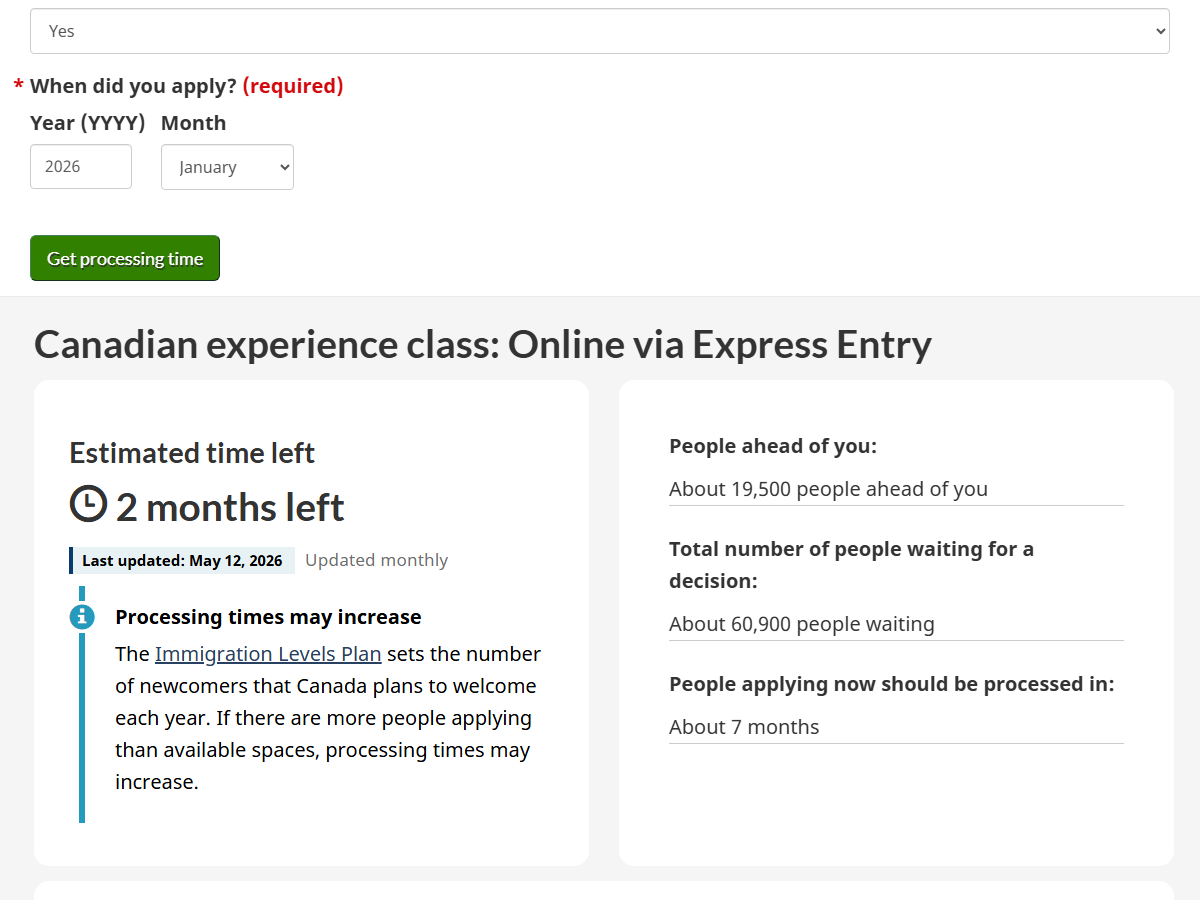
As of May 12, 2026: people applying now should be processed in about 7 months. There are approximately 19,500 people ahead of applicants from January 2026, with 60,900 total applications waiting for a decision.
What the 7 Months Actually Includes
The 7-month clock starts on your Acknowledgement of Receipt (AOR) date, which is the date IRCC received and logged your complete application. It does not start from your ITA date or from when you began preparing your documents.
Between AOR and a final decision, your file goes through several stages.
Biometrics and medical exam. If you have not provided biometrics recently, you will receive instructions shortly after AOR. Your medical exam must also be valid at the time of the final decision. If your exam was done more than 12 months before your expected decision date, you may need to redo it.
Background and security checks. IRCC runs criminal record checks and CSIS security screening on all PR applicants. For most applicants this happens automatically in the background. For a small percentage, it triggers a longer manual review. There is no way to know in advance whether your file will require extended screening.
Document review. An officer reviews your employment records, language test results, NOC classification, and supporting documents. This is the stage where inconsistencies or missing information cause delays or additional documentation requests.
COPR issuance. A Confirmation of Permanent Residence is generated and you are instructed to activate your landing. This is the final step before you become a permanent resident.
The 60,900-Person Queue
The IRCC tool currently shows 60,900 applications waiting for a decision across all CEC applicants. This is a meaningful number because Express Entry processing depends not only on IRCC capacity but on Canada's Immigration Levels Plan, which sets how many permanent residents can land each year.
When IRCC issues more ITAs in a draw, the queue grows. When they pause draws or reduce draw sizes, the queue shrinks. The 7-month figure assumes IRCC maintains its current processing pace and draw volume. If either changes, your individual wait time may be shorter or longer than the tool suggests.
The tool updates monthly. Checking it once a month gives you a reasonably accurate picture of where your file stands.
What Can Push Your File Past 7 Months
Most straightforward CEC applications are decided within the 7-month window. The cases that take longer almost always fall into one of these categories.
Medical hold. A finding from your medical exam requires follow-up, a specialist report, or re-examination. IRCC will contact you. Respond immediately and follow the instructions precisely.
Criminal record in any country. Even minor convictions or charges can trigger extended background review. Full disclosure at the application stage is required. Omitting criminal history is misrepresentation.
NOC inconsistency. Your claimed NOC TEER level does not match the duties and responsibilities in your employment letter. A letter that describes mostly administrative support work will not sustain a TEER 1 classification.
Employment gaps or employer changes. If you changed employers after submitting and did not update IRCC, the officer reviewing your file may flag the discrepancy. You are required to notify IRCC of material changes using the web form.
Incomplete police certificates. CEC does not require foreign police certificates by default, but if your background check flags something or you declared a conviction, IRCC may request them.
Your Work Permit During the 7-Month Wait
Most CEC applicants are in Canada on a work permit when they apply. If your work permit expires before you receive your PR decision, you have two options.
Renew your existing permit. Apply before it expires. Implied status allows you to keep working under your current conditions while the renewal is pending.
Apply for a Bridging Open Work Permit (BOWP). If you have a valid PR application in process and your current work permit has less than 6 months remaining, you may be eligible for a BOWP. This is an open work permit that gives you more flexibility than an employer-specific permit while you wait for PR.
Do not let your work permit expire without taking one of these steps. Losing status while your PR application is pending creates serious complications.
The ITA-to-AOR Gap Most People Underestimate
You have 60 days from the date you receive your ITA to submit your complete PR application. The 7-month processing clock starts at AOR, not at ITA. If you received an ITA on January 15 and submitted on March 14, your 7 months counts from March 14.
Rushing the submission to get an earlier AOR date is a false shortcut. A rushed application with missing documents, an outdated medical, or employment letters that do not match your NOC description will either get returned or get refused. The 7-month timer only runs on a complete application.
Applied through Up Immigration? We're already watching.
Our team monitors every active application on a regular basis. If IRCC requests documents, updates your portal status, or issues a decision, you will hear from us first.
Why Getting the File Right Before AOR Matters
CEC has a high approval rate overall. The applications that run into trouble are almost always ones where the document package at submission did not match the claimed work experience or NOC classification. Once a misrepresentation flag is raised, it does not go away quietly. A finding of misrepresentation in a PR application carries a 5-year bar from all Canadian immigration applications.
The 7-month wait is real time. Getting a refusal at month 6 and starting over means another 7 months from scratch, plus the permanent record of a refusal and potentially a misrepresentation finding. The cost of that outcome is far higher than the cost of getting the application built correctly the first time.
If you want a second set of eyes on your CEC application before you submit, or if you want to understand whether your employment documentation fully supports your NOC claim, book a consultation with Larissa. She has reviewed hundreds of Express Entry applications and can tell you exactly where a file is strong and where it has gaps.