
Federal Skilled Worker (FSW) applications submitted through Express Entry are currently being processed in about 7 months from the date IRCC receives the complete application. That is the live figure from the IRCC processing times tool as of May 12, 2026.
FSW is the Express Entry pathway for applicants whose primary qualification is foreign skilled work experience, as opposed to Canadian work experience (which goes to CEC). This article covers what the 7-month figure includes, how FSW differs from CEC at the application stage, and what commonly delays FSW files in 2026.
FSW vs. CEC: Which Stream Are You In?
Both FSW and CEC process through Express Entry and currently show the same 7-month timeline. The difference is in what qualifies you and where your work experience is from.
Federal Skilled Worker is for applicants whose qualifying work experience is primarily outside Canada. You score points on the CRS grid for foreign work experience, education, language scores (IELTS or equivalent), age, and adaptability. You do not need to be in Canada when you apply.
Canadian Experience Class is for applicants with at least one year of skilled work experience in Canada within the last three years. If you are currently inside Canada on a work permit and have enough Canadian hours, IRCC may route you toward CEC even if you entered the pool under FSW.
If you are not sure which stream your ITA is under, check your IRCC online account. The stream is listed on your ITA letter.
How to Check Your FSW Processing Time
- Go to the IRCC processing times tool.
- Select Economic immigration.
- Select Skilled workers (Federal).
- Select Yes under "Have you already applied?"
- Enter the year and month you submitted your application.
- Click "Get processing time."
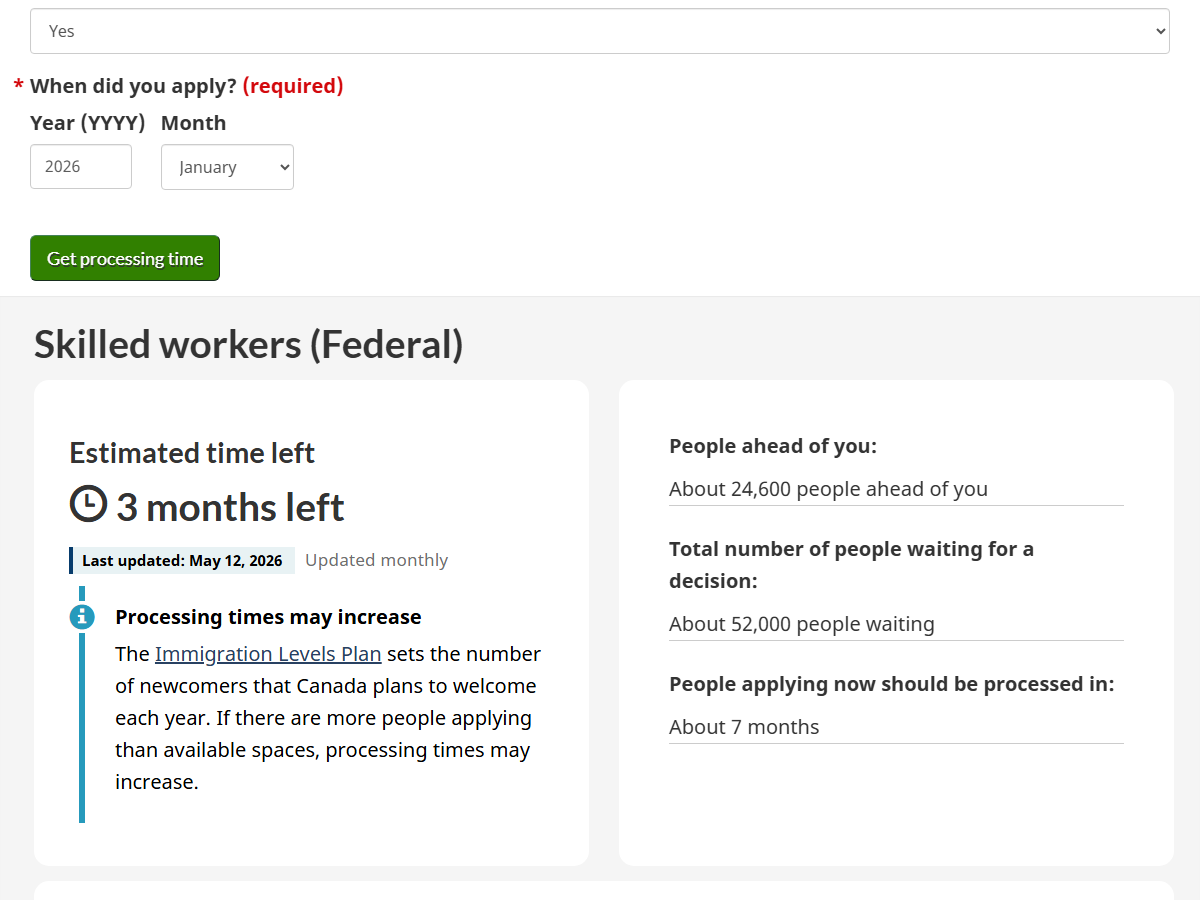
As of May 12, 2026, FSW applications submitted in January 2026 have about 3 months remaining. People applying now should expect approximately 7 months from their AOR date to a decision.
What the 7-Month Clock Covers
The clock starts on your Acknowledgement of Receipt (AOR) date, the day IRCC confirmed they received your complete application. The stages between AOR and decision are the same for FSW and CEC: biometrics (if needed), medical review, background and security checks, document review by an officer, and final COPR issuance.
For FSW specifically, the document review stage often takes longer than for CEC because FSW applications typically include foreign employment records, Educational Credential Assessments (ECAs), police certificates from multiple countries, and language test scores from non-Canadian institutions. Each of those documents has its own verification process.
The Total FSW Timeline: Pool to Landing
The 7-month figure covers only the PR application stage after your ITA. The full FSW journey is longer.
In the Express Entry pool. How long you wait for an ITA depends on your CRS score. Some applicants receive ITAs within weeks of creating a profile if their score is above the current cutoff. Others wait months or need to improve their score through a job offer, provincial nomination, or additional language testing.
ITA to submission. You have 60 days from the ITA date to submit your complete application. Most FSW applicants need this time to gather foreign documents, renew medical exams, and prepare employment evidence.
AOR to decision. About 7 months at current pace.
Decision to landing. Once your COPR is issued, you have until the expiry date on the document to activate your landing. Most people land within a few months of receiving COPR.
From ITA to permanent residence, FSW applicants typically spend 8 to 10 months total, assuming no complications. From pool entry to landing, the timeline is highly variable and depends almost entirely on when you receive an ITA.
What Makes FSW Files More Complex Than CEC
FSW applications have more moving parts than CEC applications. Each additional document is an opportunity for something to be wrong, expired, or inconsistent.
Educational Credential Assessment (ECA). Your foreign degree must be assessed by a IRCC-approved organization (WES, IQAS, ICES, CES, or others depending on your profession). The ECA must be current at the time of application and the NOC it supports must match your claimed work experience.
Police certificates from every country. You need police certificates from every country where you lived for 6 months or longer since age 18. For applicants who have lived and worked across multiple countries, this can mean 3 to 5 separate certificates. Some countries take weeks to issue them. If one arrives after your 60-day submission window, you either rush or defer your ITA.
Language test validity. Your IELTS, CELPIP, or TEF results must have been taken within the last 2 years of your profile creation date. If your test is about to expire, you need to re-test before submitting. Submitting with an expired language test is a ground for return of application.
Foreign employment documentation. Each job in your work history requires an employment letter on company letterhead, signed by an authorized representative, stating your title, duties, and dates. Foreign employers are not always familiar with Canadian immigration requirements and letters are often missing key information.
What Can Push Your File Past 7 Months
Medical hold. A finding from your upfront medical exam requires specialist review or re-examination. IRCC will contact you with instructions.
Background check flags. Criminal history in any country, even convictions that are expired or pardoned in your home country, can trigger extended review. Full disclosure is required on the application.
ECA inconsistency. Your credential assessment classifies your degree differently from the NOC you claimed, or the occupational description in your employment letters does not match the NOC TEER level.
Missing or expired documents at submission. Returning an application for incomplete documents restarts your submission window and loses your AOR date.
Name matching delays. Discrepancies between your name on the application and your name on official documents (passport, certificates, employment records) can flag the file for manual identity verification.
If You Are Outside Canada Waiting on FSW
Unlike CEC applicants who are typically already working in Canada, many FSW applicants are outside Canada when they apply. You do not need to be in Canada during the 7-month processing period. You can remain in your home country and arrive to activate your permanent residence once your COPR is issued.
If you plan to travel to Canada before your PR is finalized, you will still need the appropriate temporary status (visitor visa, work permit, or eTA depending on your nationality). Your PR application does not give you temporary entry rights.
Applied through Up Immigration? We're already watching.
Our team monitors every active application on a regular basis. If IRCC requests documents, updates your portal status, or issues a decision, you will hear from us first.
Getting the FSW Application Right the First Time
FSW refusals are more common than CEC refusals, largely because FSW files have more documents that can be wrong. A refusal for misrepresentation, even an unintentional one where employment duties were described inaccurately, carries a 5-year ban from all Canadian immigration applications. That is a very high cost for a correctable error.
If you want a qualified review of your FSW document package before you submit, or if you are unsure whether your NOC classification is supportable based on your actual job duties, book a consultation. Larissa has reviewed hundreds of Express Entry applications and will tell you clearly where your file is strong and where it has gaps before IRCC sees it.