
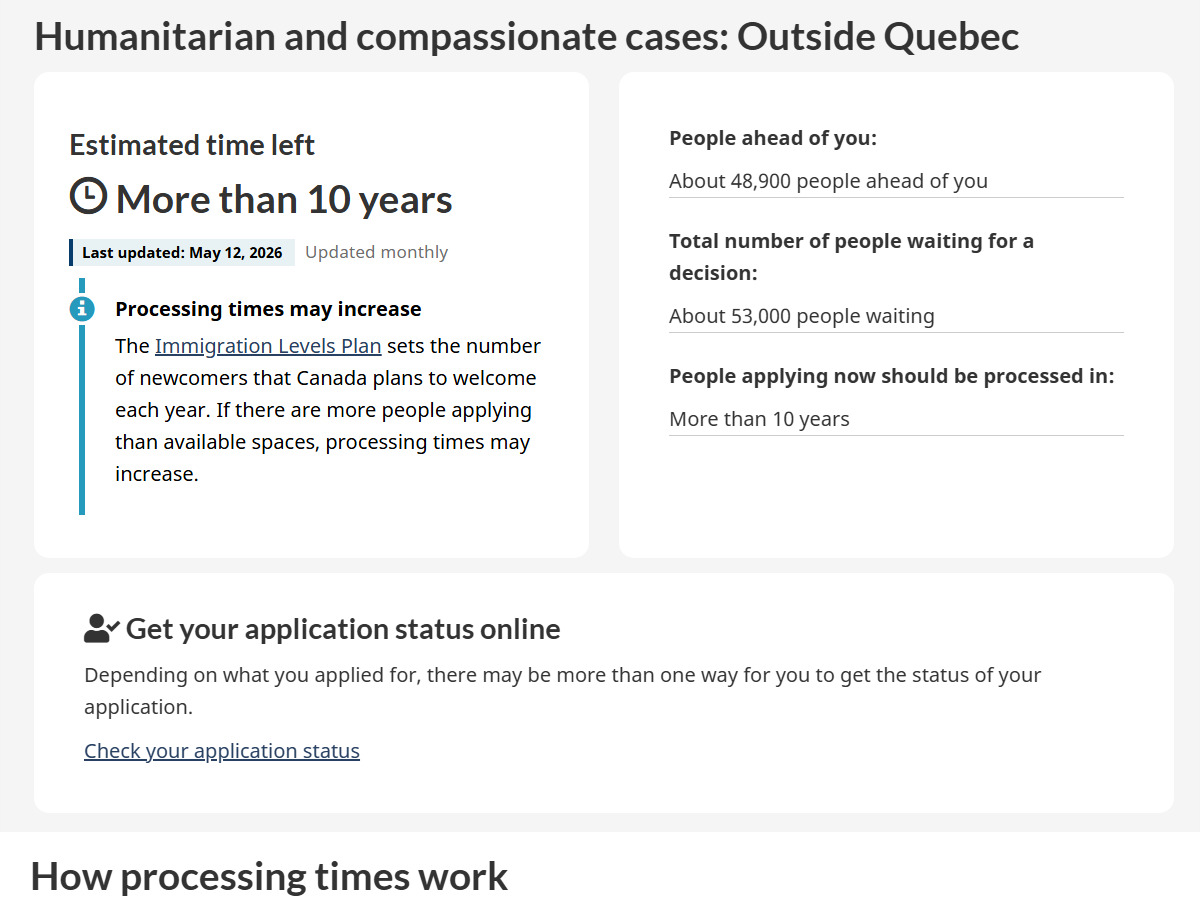
The IRCC processing times tool currently shows "more than 10 years" for humanitarian and compassionate (H&C) applications submitted from outside Quebec. That figure tells you something important before you file anything: H&C is not a fast track to permanent residence. It is a last-resort option with a decade-long queue attached to it.
What Is a Humanitarian and Compassionate Application?
A humanitarian and compassionate application is a request to the Minister of Immigration, Refugees and Citizenship Canada to grant permanent residence or an exemption from inadmissibility requirements on the basis of humanitarian and compassionate considerations. The authority comes from Section 25 of the Immigration and Refugee Protection Act (IRPA).
It is a discretionary remedy. There is no checklist of qualifications that automatically results in approval. An immigration officer weighs the totality of your circumstances and decides whether the hardship you would face, combined with your ties to Canada, justifies a positive outcome.
The grounds an officer considers include:
- Establishment in Canada: How long you have been here, whether you are employed, your community ties, financial stability, and integration into Canadian society.
- Best interests of a directly affected child (BIOC): If children are involved, the officer must consider how the decision would affect them. This is a separate and significant consideration under the law.
- Degree of hardship if required to leave: What would actually happen to you if you returned to your country of origin. This is not the same as a refugee claim, but serious hardship does carry weight.
- Family ties in Canada: Particularly Canadian citizen or permanent resident family members who depend on you or whom you depend on.
One important clarification: an H&C application is not an appeal of a previously refused visa or study/work permit. It is a separate, standalone application based on humanitarian grounds. Filing H&C does not undo or reverse a prior refusal.
How to Check H&C Processing Times on the IRCC Tool
IRCC publishes current processing times at canada.ca/processing-times. To find the H&C figure, follow these steps:
- Select Humanitarian and compassionate cases from the application type list.
- Select Outside Quebec (or "In Quebec" if applicable).
- Answer Yes to the question about whether you have already applied.
- Enter the month and year you applied: for example, January 2026.
- Click Get processing time.
For an application submitted in January 2026, the tool currently returns more than 10 years.
What "More Than 10 Years" Actually Means
IRCC processes a limited number of H&C applications per year relative to the total demand. The backlog has been growing for years, and the queue reflects that. When the tool shows "more than 10 years," it means IRCC is currently working through applications that were filed roughly a decade ago. An application submitted in 2026 is at the back of that line.
A few things the processing time figure does not mean:
- It is not a guaranteed decision date. Some files move faster because the evidence is unusually clear or an officer picks up the file sooner.
- It is not fixed. If IRCC increases staffing or changes its approach to H&C, the number could shift in either direction.
- It does not reflect interim steps. IRCC may send you acknowledgment of receipt, a biometrics request, or other correspondence long before making a final decision.
For someone filing in 2026 with no other pending status in Canada, "more than 10 years" effectively means years of uncertain status while waiting. That has real implications for work authorization, travel, and family reunification.
Is H&C the Right Approach for Your Situation?
H&C is appropriate in a narrow set of circumstances: when a person has no viable pathway through any standard immigration program and has built meaningful ties to Canada that would make departure genuinely harsh. Both conditions need to be present.
If you qualify for any economic immigration program (Express Entry, a Provincial Nominee Program, a work permit leading to permanent residence) or any family class pathway, that route will almost certainly be faster and more predictable than H&C. The processing times for those programs are measured in months, not decades.
H&C is not a backup plan for people who do not want to go through the regular process. Officers are aware of applicants who file H&C as a delay tactic, and that context can affect how a file is reviewed.
Approval is not guaranteed even when someone has strong grounds. It is a discretionary decision. Two applications with similar facts can produce different outcomes depending on the officer, the completeness of the submissions, and how the hardship arguments are framed.
A refused H&C application also carries consequences. It can affect how future applications are assessed, particularly if you later attempt a different pathway. This is not a reason to never file, but it is a reason to be certain before you do.
H&C While in Removal Proceedings
Filing an H&C application does not automatically stop a removal order. IRCC and the Canada Border Services Agency (CBSA) operate on separate tracks. A pending H&C does not prevent enforcement, though it is a factor CBSA officers may consider when scheduling removals.
There is a mechanism called "deferred enforcement" that allows CBSA to delay removal in some circumstances, including pending H&C applications, but it is entirely discretionary. There is no right to deferral, and it is not available to everyone.
A Pre-Removal Risk Assessment (PRRA) is sometimes confused with H&C. They are different processes. A PRRA assesses the risk of persecution, torture, or cruel treatment if you return to your country. An H&C application is broader and includes establishment, BIOC, and hardship grounds beyond risk. In some cases, both may be relevant, but they are filed and assessed separately.
If you are subject to a removal order and considering an H&C, the timing and sequencing of what you file matters significantly.
A Note on Quebec Applicants
The processing time figure above applies to applications from outside Quebec. Quebec administers its own immigration selection process under a federal-provincial agreement, and H&C applications for people living in Quebec go through a separate process involving both IRCC and the Quebec government. Additional delays apply, and the pathway involves different steps than the federal stream.
If you are in Quebec, the IRCC tool has a separate selection for "In Quebec." The processing time shown there reflects the Quebec-specific track.
Applied through Up Immigration? We're already watching.
Our team monitors every active application on a regular basis. If IRCC requests documents, updates your portal status, or issues a decision, you will hear from us first.
The Quality of Your Submission Is What Officers Act On
Because H&C decisions are discretionary, the strength of your file depends almost entirely on how well your circumstances are documented and presented. An officer cannot approve grounds that are not clearly supported by evidence. Vague claims of hardship, missing documents, or a poorly organized submission make it harder for an officer to rule in your favor, even when the underlying facts are genuinely compelling.
The submissions for an H&C application typically include personal statements, country condition evidence, supporting letters, proof of establishment, financial records, children's school records, and more. Preparing this correctly takes time and a clear understanding of what officers look for.
If you are considering an H&C application, whether because you have no other options or because you are evaluating your situation alongside other pathways, the decision to file and how to file it should be made carefully. Book a consultation with Larissa before submitting anything. A single filing error or a missed ground in your submission can affect the outcome of a process that takes more than a decade to reach a decision.