
The International Experience Canada (IEC) processing time for the current 2026 season is 5 weeks, according to the IRCC processing times tool updated May 13, 2026. That figure covers all three IEC streams: Working Holiday, Young Professionals, and International Co-op Internship. Before you put five weeks in your calendar, there is an important distinction to understand. The IEC process has two separate phases, and IRCC's published number only applies to one of them.
This article explains what the 5-week figure actually measures, how the full IEC timeline works from pool registration through work permit in hand, what each stream covers, and what to expect after you receive your Letter of Introduction.
The IEC process has two phases. The 5-week figure applies to Phase 2 only.
This is the most misunderstood part of the IEC timeline, and getting it wrong leads to serious planning errors.
Phase 1 — Pool and invitation: You register in the IEC pool for your stream and country. IRCC reviews your eligibility, and if you qualify, you wait in the pool to receive an Invitation to Apply (ITA). How long this takes depends on how many spots your country has in each stream, how many applicants are in the pool, and when IRCC runs selection rounds during the season. There is no published timeline for Phase 1. Some applicants receive an invitation within days. Others wait weeks or months. Pool wait time is not captured in the 5-week IRCC figure at all.
Phase 2 — Letter of Introduction application: Once you receive an invitation, you have a limited window to submit your IEC application. IRCC then reviews that application and, if approved, issues a Letter of Introduction (LOI). This is the step the 5-week figure describes. Five weeks is the 80th percentile processing time for complete, eligible IEC applications during the current season.
Your LOI is not a work permit. It is the document you bring to a Canadian port of entry or use to apply online for your actual work permit. The LOI has an expiry date, and you must enter Canada (or complete your online application) before it expires.
How to check the current IEC processing time
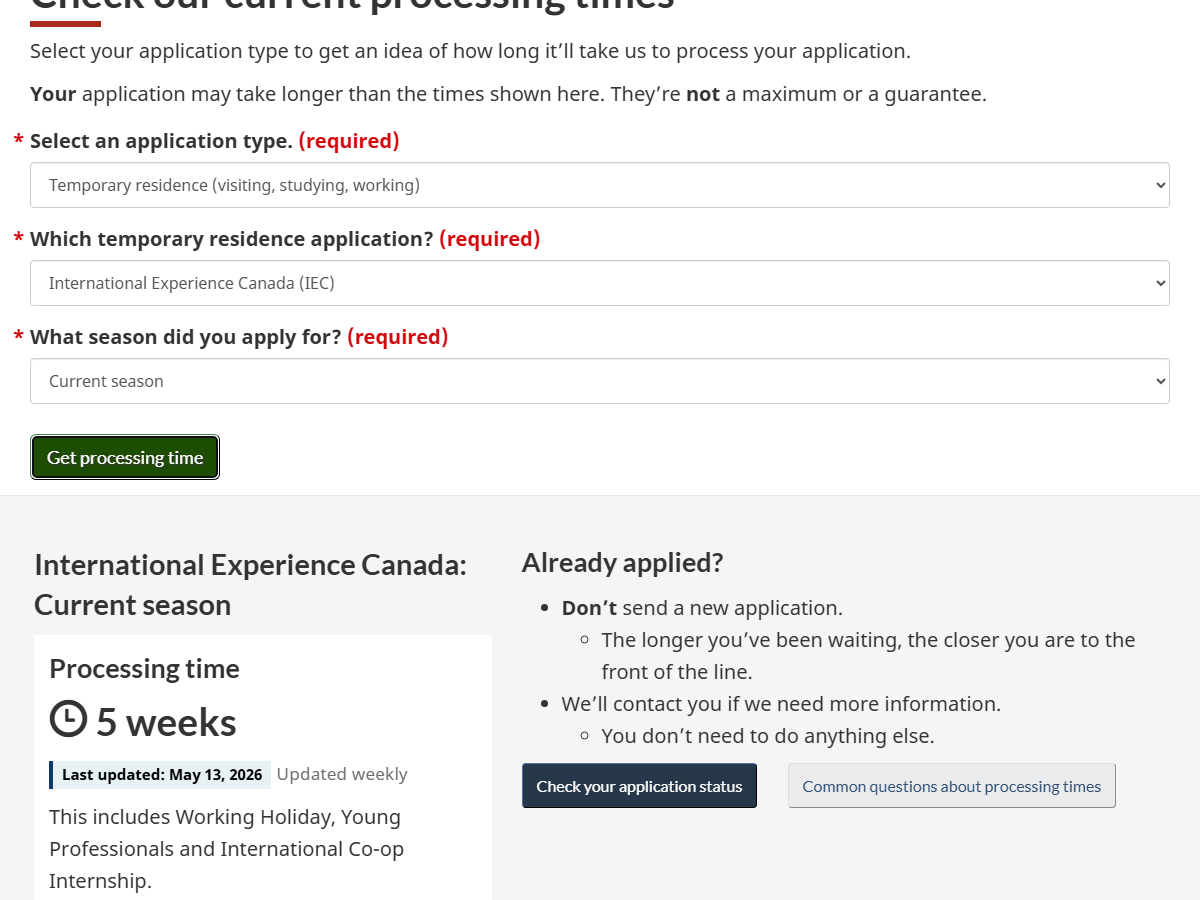
IRCC updates processing times weekly. The number can shift with application volumes and seasonal patterns. The steps to check the current figure:
- Go to the IRCC processing times tool.
- Under "What type of application is it?", select Temporary residence (visiting, studying, working).
- Under "What application are you checking?", select International Experience Canada (IEC).
- Under "What season did you apply for?", select Current season.
- Click "Get processing time."
There is no country filter for IEC. The processing time applies across all participating countries for the current season. The result as of May 13, 2026: 5 weeks.
What "5 weeks" actually means
Five weeks is the 80th percentile benchmark. IRCC calculates it from actual processing data: 80% of complete, eligible IEC applications submitted during the current season were processed within that window. The remaining 20% took longer, sometimes considerably longer.
The clock starts when IRCC receives a complete application. An application is only complete when all required documents are submitted, biometrics have been provided (if applicable), and the forms contain no errors requiring follow-up. A missing document, a form inconsistency, or biometrics not yet on file can add weeks to your effective timeline beyond what the tool shows.
For planning purposes, a five-week timeline from the date you submit your IEC application means your LOI could arrive around six to seven weeks after you hit submit, accounting for normal administrative processing and delivery into your IRCC account.
The three IEC streams
Working Holiday is the most widely used stream. It issues an open work permit, meaning you can work for almost any employer in Canada without a job offer in hand. The permit length depends on your country agreement, typically one to two years. Applicants must generally be between 18 and 35 years old, though the upper age limit varies by country. This is the stream most people mean when they say "Working Holiday Canada."
Young Professionals is an employer-specific stream. You must have a job offer in a skilled occupation before applying, and the work permit issued ties you to that employer and role. The occupation must fall under specific TEER categories. It is intended for young professionals who have already secured employment and want to gain Canadian work experience in their field. Age limits apply and vary by country agreement.
International Co-op Internship requires current enrollment in a post-secondary program outside Canada. The internship must be a mandatory or elective component of your academic program, and the work permit is tied to a specific employer. It is designed for students who need Canadian work experience as part of their degree requirements, not as a general work authorization pathway.
IRCC's published 5-week figure applies to all three streams combined under the IEC category in the current season.
After you receive your Letter of Introduction
An LOI is issued for a specific validity period. The exact duration is stated on the document. You must use it before it expires. There are two ways to proceed once you have your LOI in hand.
Port of entry (most common for Working Holiday): You travel to Canada and present your LOI to the border services officer on arrival. The officer reviews your LOI and, if everything is in order, issues your work permit at the port of entry. Your permit start date is generally the date you enter. Plan your arrival carefully, as entering too close to the LOI expiry date leaves no margin if your travel is disrupted.
Online application (available in some cases): Some IEC participants apply for their work permit online through the IRCC portal rather than at the border. If you go this route, confirm that your stream and country combination qualifies for an online work permit application before booking anything. Online applications have their own processing time that adds to your overall timeline.
Do not let your LOI expire. An expired LOI cannot be reinstated. If it expires before you enter Canada or complete your online application, you lose that IEC spot entirely. Getting a new invitation from the pool is not guaranteed, and depending on the season status, it may not be possible in the same year.
What can slow things down
Several factors can extend your IEC timeline beyond the published 5-week figure:
- Biometrics not collected before applying. If you have not provided biometrics recently (within 10 years), IRCC will request them after you submit your application. The application will not move forward until biometrics are collected and received. Schedule your biometrics appointment as early as possible, ideally before you submit your IEC application.
- Medical exam required. Depending on your country of residence or intended occupation, IRCC may require a medical exam before processing your LOI. This adds weeks to your timeline. Check whether your situation triggers a medical exam requirement before you receive the invitation.
- Incomplete or inconsistent application. Forms with errors, missing documents, or discrepancies between your application and supporting materials prompt IRCC requests for clarification, pausing the processing clock.
- Unclear employment details for Young Professionals or International Co-op. These streams require specific documentation about the job offer and the nature of the employment. Vague or incomplete employer letters are a common source of delay and refusals in these streams.
- LOI expired before entry. If you receive your LOI but then delay travel or your online application past the expiry date, your IEC authorization ends. This is not a processing delay in the technical sense, but it ends your pathway for the season.
After the Working Holiday: what IEC participants do next
IEC is a temporary work authorization. It is not a permanent residence pathway on its own. But for many participants, it is the first step toward one.
Working Holiday participants who spend their time in Canada in skilled occupations (TEER 0, 1, 2, or 3) accumulate Canadian work experience that counts toward the Canadian Experience Class (CEC) stream of Express Entry. CEC requires at least one year of skilled work experience in Canada in the three years before you apply for permanent residence. A one-year or two-year Working Holiday can, with the right occupation and language scores, produce enough experience to enter the Express Entry pool with a competitive CRS score.
Participants who want to stay beyond their IEC permit need to transition to a different work authorization before their IEC permit expires. Options depend on your situation: a new employer-specific work permit, a different open work permit category, or in some cases a PR application filed before the IEC permit expires. IEC permits cannot be extended.
The path from IEC to PR is real, but it requires planning. The IEC permit length, the occupation you work in, your language scores, and your timing relative to Express Entry draw cycles all affect whether and when PR becomes achievable. Arriving in Canada with a Working Holiday and no plan for what comes after is a common mistake.
Applied through Up Immigration? We're already watching.
Our team monitors every active application on a regular basis. If IRCC requests documents, updates your status, or issues a decision, you will hear from us. If there is news, you will hear from us first.
Book a consultation to plan your IEC timeline
Five weeks is a fast processing time by IRCC standards, but the full IEC journey, from pool registration through work permit in hand, involves more moving parts than the published number suggests. Getting your biometrics done ahead of time, having your documents ready the moment your invitation arrives, and knowing exactly what you will do after your LOI is issued makes the difference between a smooth process and a stressful scramble.
If you want to go through your IEC eligibility, stream options, and next steps after your Working Holiday with a regulated consultant, book a consultation with our team. We work with IEC participants at every stage, from first application through the transition to more permanent status.