
The current PGWP processing time is 209 days, according to IRCC data from May 13, 2026. That is roughly seven months between the day you submit your application and the day a decision lands in your account. This article explains exactly what that number means for your graduation timeline, your right to work while you wait, your travel plans, and the permanent residence clock that starts ticking the moment your permit is issued.
The PGWP is processed under the "Work permit from inside Canada (initial and extension)" category in the IRCC tool. There is no country filter because the application is filed from within Canada regardless of your nationality. The 209-day figure applies to all graduates applying from inside Canada as of May 2026.
How to Check the Current PGWP Processing Time
IRCC updates processing times weekly. The number can shift by weeks in either direction depending on application volumes, staffing, and policy changes. The only reliable source is the official tool.
- Go to the IRCC processing times tool.
- Under "What type of application is it?", select Temporary residence (visiting, studying, working).
- Under "What application are you checking?", select Work permit from inside Canada (initial and extension).
- Click "Get processing time."
The PGWP is included in this category alongside other inside-Canada work permit applications. There is no separate PGWP filter in the tool.
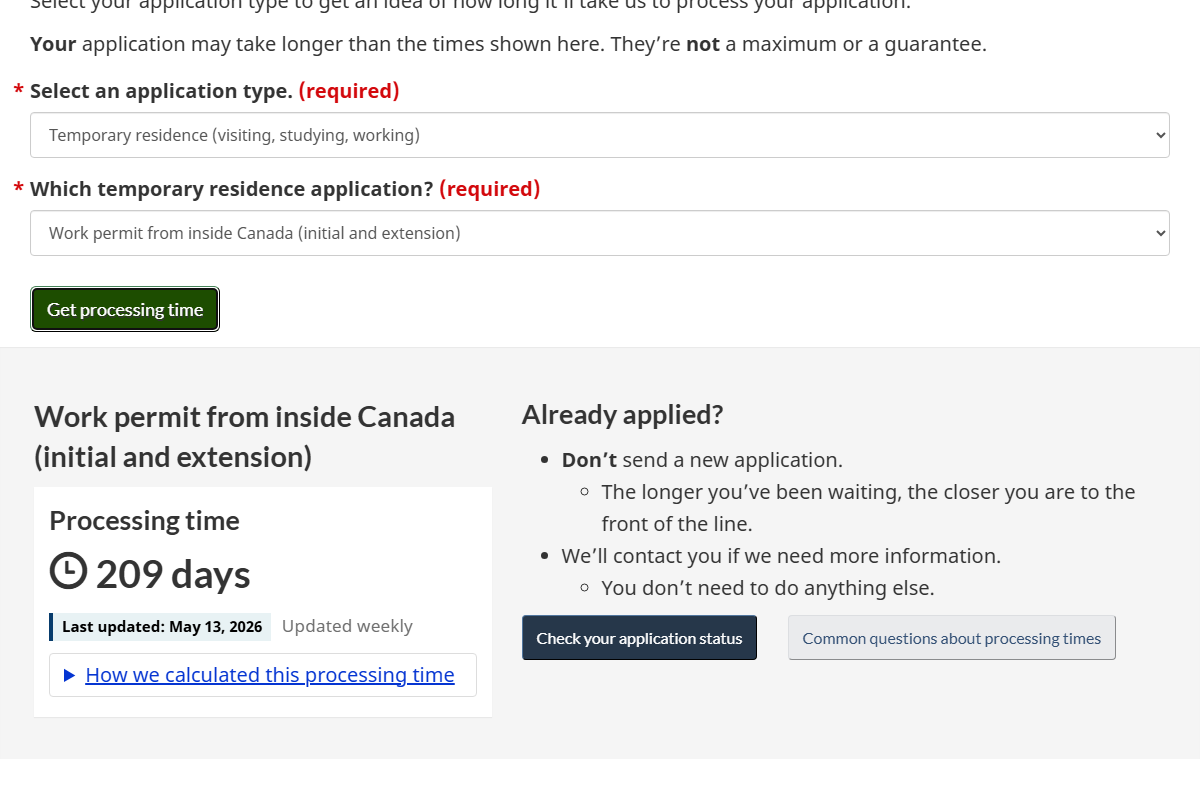
The result: 209 days for work permits from inside Canada, including PGWP, as of May 13, 2026.
What "209 Days" Actually Means
209 days is the 80th percentile benchmark. IRCC calculates it based on how long it took to process 80% of complete, eligible inside-Canada work permit applications during a recent window of data. One in five applicants will wait longer, and a portion will wait considerably longer.
The clock starts when IRCC receives a complete application. If your application is missing a document, contains an error on a form, or requires follow-up, the effective timeline extends beyond what the tool shows.
For planning purposes, 209 days translates to approximately seven months from the date IRCC receives your complete submission. A graduate who applies in June 2026 should expect a decision around January 2027 under normal conditions.
That seven-month stretch is not dead time. Under implied status rules, you remain legally authorized to work in Canada while your application is pending, subject to important conditions covered in the next section.
Implied Status After Graduation: The Rule Every Graduate Must Know
Your study permit expires either on the date printed on the permit or, in most cases, 90 days after your program end date. Once your study permit expires, you cannot simply stay in Canada and wait for your PGWP. You need to have applied before that deadline.
The rule is this: you must apply for your PGWP while your study permit is still valid. If your study permit has already expired, you may still be eligible to apply within 90 days of receiving written confirmation of your program completion, provided you meet the other PGWP eligibility requirements. Confirm the exact deadline that applies to your situation with a regulated consultant before assuming the 90-day window covers you.
Once you submit a complete PGWP application, you are on implied status. Implied status means:
- You may continue working in Canada under the same conditions as your study permit, which typically allows part-time work during the academic year and full-time work during breaks.
- Your legal status is maintained while IRCC processes your application.
- You do not need to do anything further to maintain that status. It is automatic once your application is received.
With 209 days of processing ahead of you, implied status is not a technicality. It is the mechanism that allows you to work for seven months while your permit is in the queue.
Travel warning: do not leave Canada on implied status
If you leave Canada while your PGWP application is pending and you are on implied status, your implied status ends the moment you depart. You will not be able to return on the same basis. Re-entry requires either a valid permit or authorization that permits re-entry. If you need to travel during the processing period, speak with a regulated consultant before booking your flight. This is not a situation where it is safe to assume things will work out at the border.
If your PGWP application is refused, implied status ends immediately.
A refusal does not give you time to appeal, gather documents, or reapply while still working. The moment a refusal letter is issued, your authorization to work ends. This is one of the reasons getting the PGWP application right on the first submission matters as much as it does.
PGWP Eligibility: Quick Check
Before applying, confirm you meet every requirement. A PGWP refusal closes the pathway entirely because you cannot hold a second PGWP.
- Graduated from a PGWP-eligible program at a Designated Learning Institution (DLI). Not all programs at DLIs are eligible. Confirm your specific program on the DLI list.
- Program was at least 8 months long. Shorter programs do not qualify.
- You were a full-time student for the duration of the program (with limited exceptions for the final semester).
- You have not previously held a PGWP. This permit is issued once in a lifetime, regardless of how many degrees you complete in Canada.
- Duration is tied to program length. Programs of 8 months to 2 years result in a PGWP of equal duration. Programs of 2 years or longer result in a 3-year PGWP. A PGWP cannot be extended once issued.
The fact that a PGWP cannot be extended and cannot be issued a second time means the decision to apply must be made carefully. If your first application is refused for an eligibility reason, that is the end of the PGWP pathway for you.
209 Days and Your PR Timeline
For most graduates, the PGWP is not the end goal. It is the bridge to permanent residence, most commonly through the Canadian Experience Class (CEC) stream of Express Entry.
CEC requires at least one year of skilled work experience in Canada in the 3 years before you apply. That experience must be at CLB 7 or higher language level (for TEER 0 and 1 occupations) or CLB 5 or higher (for TEER 2 and 3). You accumulate that experience while working on your PGWP.
Here is how the math works for a May 2026 graduate:
- May 2026: Submit PGWP application. Begin working on implied status.
- December 2026 (approximate): PGWP issued after 209 days of processing.
- Work accumulates on implied status starting in May 2026. Hours worked on implied status count toward CEC eligibility, as long as you were legally authorized to work.
- May 2027 (approximately): One year of eligible work experience accumulated since submitting the PGWP application in May 2026.
- CEC Express Entry profile can be submitted once you have 12 months of eligible experience and a valid Express Entry profile.
A graduate who applies for the PGWP in May 2026 and works full-time in a skilled occupation from the day they submit could be eligible to submit a CEC profile around May 2027, assuming language scores and other CRS factors are in place. The CEC processing time for a PR application after an ITA is typically 5 to 6 months, placing a potential PR landing around late 2027 or early 2028.
None of that math works if the PGWP application is refused, delayed by an incomplete submission, or filed past the deadline.
What Can Disqualify a PGWP Application
PGWP refusals follow recognizable patterns. These are the most common disqualifying situations:
- Applied after the study permit expired and outside the 90-day window. Once both deadlines have passed, there is no PGWP pathway available regardless of academic record.
- Applied from outside Canada. The PGWP must be applied for from inside Canada. Applying while abroad is not permitted.
- Program or institution is not PGWP-eligible. Some programs at otherwise DLI-listed schools are excluded. Language schools, flight schools, and some continuing education divisions are common examples.
- Program was shorter than 8 months. The 8-month minimum is a hard threshold.
- Previously held a PGWP. Completing a second degree in Canada does not entitle you to a second PGWP.
- Did not maintain full-time enrollment. Dropping below full-time student status during the program, outside of permitted exceptions, is a disqualifier. IRCC can request enrollment records.
Most of these are situations that can be identified before applying. A review of your eligibility before submission costs much less than a refusal.
Applied through Up Immigration? We're already watching.
Our team monitors every active application on a regular basis. If IRCC requests documents, updates your status, or issues a decision, you will hear from us. If there is news, you will hear from us first.
Why the PGWP Requires Getting It Right the First Time
Most immigration applications, if refused, can be resubmitted with corrections. The PGWP is different. It is a one-time permit. If it is refused for an eligibility reason, the pathway closes. If it is refused because you filed after the deadline, the pathway closes. If you accumulate disqualifying time outside Canada during the application period, it can affect your eligibility for certain PR streams. There are no do-overs.
Seven months of processing time is also seven months of your PR clock running. Every week the application sits in the queue before approval is a week where you are working on implied status but cannot yet plan with certainty around your permit's expiry date. The later you apply after graduation, the shorter your eventual PGWP will be, because its duration is fixed at the time of issuance and does not extend to compensate for processing time.
Apply as close to graduation as your documents allow. Do not wait until your study permit is about to expire. Do not assume the 90-day window is a soft deadline. And do not file without confirming that every eligibility requirement is met.
If you want a second set of eyes on your PGWP application before it goes to IRCC, our team reviews files specifically for this permit. Given what is riding on it, a short review is worth the time.
Read our complete PGWP guide for eligibility details, required documents, and how the permit connects to your PR options. Or book a consultation to go through your specific situation with an RCIC.