
PR card renewal is currently taking about 27 days according to the IRCC processing times tool as of May 2026. That is faster than many permanent residents expect. Even so, there are real reasons not to leave this until the last minute, particularly if you travel internationally or have spent significant time outside Canada in recent years.
Your PR Card Expires. Your PR Status Does Not.
This distinction matters and is worth stating clearly. When your permanent resident card expires, your status as a permanent resident does not expire with it. You remain a permanent resident of Canada. The card is a document that proves that status, not the status itself.
The practical problem is that many situations require the card. Airlines will not board you on a flight to Canada without a valid PR card or a PR Travel Document (PRTD). This is a regulatory requirement, not airline policy: carriers that board passengers without the right documentation face fines, so they check before boarding.
At a land border crossing from the United States, the situation is different. CBSA officers can verify your permanent residence status in their systems without requiring a physical card. Driving across the border with an expired PR card is generally not the same problem as flying with one. But you will still want to carry your passport and be prepared to have your status verified at the booth.
In daily life inside Canada, a PR card is commonly used to prove status to employers, banks, and government agencies. An expired card creates friction even when your status is completely intact.
The Physical Presence Requirement Before You Apply
Before submitting a PR card renewal application, you must confirm that you meet the residency obligation. The requirement is 730 days physically present in Canada within the 5 years immediately before applying. This works out to roughly two of every five years.
The count is straightforward but requires real documentation. Days are counted as calendar days, including the day you arrive and the day you depart. If you travel frequently, a complete travel log is essential. Useful records include passport stamps, airline boarding passes, credit card statements showing transactions in Canada, T4s and Notice of Assessment documents from the CRA, and lease agreements or utility bills that confirm you were living in Canada during a given period.
Two situations allow days outside Canada to count toward the 730-day requirement:
- Accompanying a Canadian citizen spouse or common-law partner: If your spouse or partner is a Canadian citizen and you were travelling or living abroad together, those days can count toward your residency obligation.
- Working abroad for a Canadian employer: If you were employed full-time by a Canadian business or the federal or provincial government and were posted abroad in that capacity, those days may also count. The employment relationship must be genuine and documented.
If you do not meet the 730-day threshold, submitting a renewal application does not go unnoticed. IRCC reviews your travel history as part of the renewal process, and a file that shows non-compliance can trigger a formal residency obligation determination. That process can put your permanent residence at risk. It is not a situation to walk into without understanding where you stand.
How to Check PR Card Processing Time on the IRCC Tool
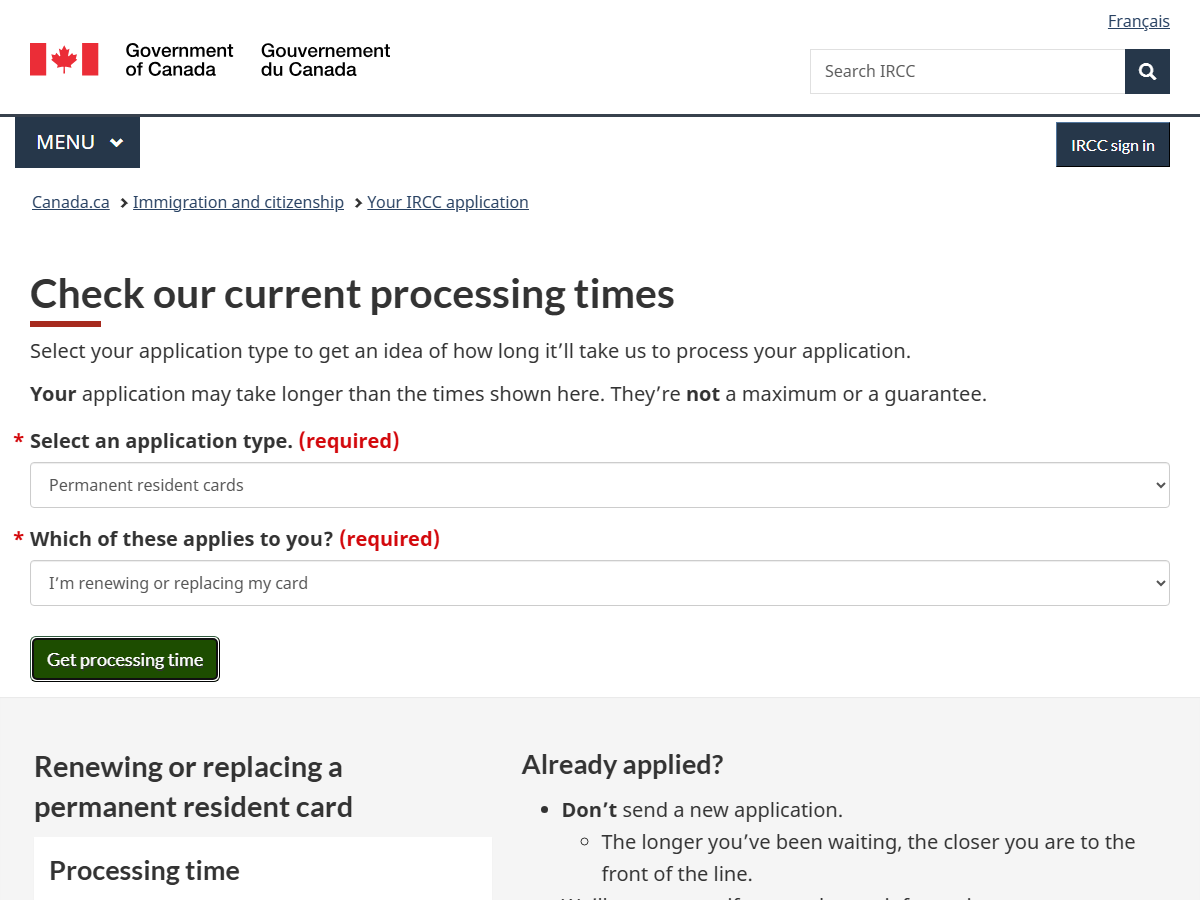
IRCC publishes current processing times at canada.ca/processing-times. PR card renewal does not require you to enter an application date. The steps are:
- Select Permanent resident cards from the application type list.
- Select I'm renewing or replacing my card.
- Click Get processing time.
The tool currently returns 27 days for PR card renewal and replacement.
When to Apply for Renewal
The 27-day processing time is the median for straightforward files. Some applications take longer if IRCC requests additional documentation, if there are discrepancies in your travel history, or if the application is incomplete. Building in a buffer is the sensible approach.
A reasonable target is to apply 6 to 9 months before your current card expires. This gives you the 27-day processing window plus meaningful room for follow-up requests from IRCC, postal delays, and any administrative issues that come up. If you are planning international travel in the months ahead, confirm that your card will be valid for the return trip before you leave.
One scenario that comes up regularly: a permanent resident realizes the card has expired a few weeks before an international trip. At that point, 27 days is a tight window. Processing times are averages, not guarantees. Applying under deadline pressure is avoidable with enough lead time.
IRCC does not charge an additional fee for applying well before expiry. The application process and cost are the same regardless of how far out you apply.
If Your PR Card Expires While You Are Outside Canada
This is where the card expiry problem becomes genuinely difficult. If you are abroad and your PR card expires before you return, you cannot board a flight back to Canada without obtaining a PR Travel Document (PRTD) first.
A PRTD is applied for at the nearest Canadian visa office or embassy in the country where you are located. The process requires you to demonstrate that you still meet the residency obligation, or that humanitarian and compassionate grounds justify issuing the document despite non-compliance.
The processing time for a PRTD is not covered by the 27-day figure. It varies significantly depending on the visa office, the volume of applications they are handling, and the complexity of your situation. Some applicants wait weeks. Others wait months. There is no central published median for PRTD processing the way there is for card renewal.
A PRTD is issued for a single entry. Once you return to Canada on a PRTD, you apply for the actual renewed PR card from within Canada. The PRTD is not a multi-entry document and does not substitute for the card on an ongoing basis.
If you know you will be outside Canada for an extended period and your card is approaching its expiry date, the time to act is before you leave, not after.
Replacing a Lost or Stolen PR Card
IRCC's processing times tool shows the same 27-day figure for replacement as for renewal. The application process, however, uses a different form and has different requirements than a standard renewal.
For a stolen card, you are generally expected to include a police report with your application. Failing to report the theft and include documentation can slow the process. For a lost card, IRCC requires a statutory declaration explaining the circumstances of the loss.
The replacement application form (IMM 5539) is distinct from the renewal form (IMM 5444). Using the wrong form or submitting incomplete documentation are common reasons applications are returned without processing, which resets the timeline entirely.
If your card was lost or stolen while you were abroad, you face the same PRTD requirement described above before you can return to Canada. The fact that the card was lost rather than simply expired does not change the boarding requirement.
Applied through Up Immigration? We're already watching.
Our team monitors every active application on a regular basis. If IRCC requests documents, updates your portal status, or issues a decision, you will hear from us first.
Before You Submit Your Renewal
For most permanent residents who have been living in Canada continuously, the renewal process is straightforward. The 27-day processing time reflects that. But if your situation involves extended absences, time outside Canada with a Canadian employer or citizen spouse, or any period where you are uncertain about the count, the calculation is worth reviewing carefully before you apply.
Submitting a renewal application when you do not meet the residency obligation is not a neutral act. It initiates a process that can lead to a formal finding against your permanent residence. Understanding where you stand before filing protects your status.
If you have questions about your physical presence count, upcoming travel, or what to do if your card expires while abroad, book a consultation with Larissa before submitting your renewal application. Getting the calculation right the first time matters.