
Your study permit is expiring and you need to extend it to keep studying in Canada. How long will IRCC take? The current published processing time for a study permit extension is 76 days, as of May 13, 2026. Here is what that number means, the rule that keeps you legally enrolled while you wait, and the mistakes that slow applications down.
A study permit extension is the application you file when you are already in Canada on a valid study permit and you need to continue studying beyond the current expiry date. This is one of the most time-sensitive immigration applications a student in Canada will face, because the deadline to file is fixed: your current study permit's expiry date. Miss it, and the protection that kept you legal during processing disappears.
How to Check the Current Processing Time
IRCC publishes its processing time estimates publicly, and the study permit extension estimate does not vary by country of citizenship. Anyone extending their study permit from inside Canada is subject to the same estimate.
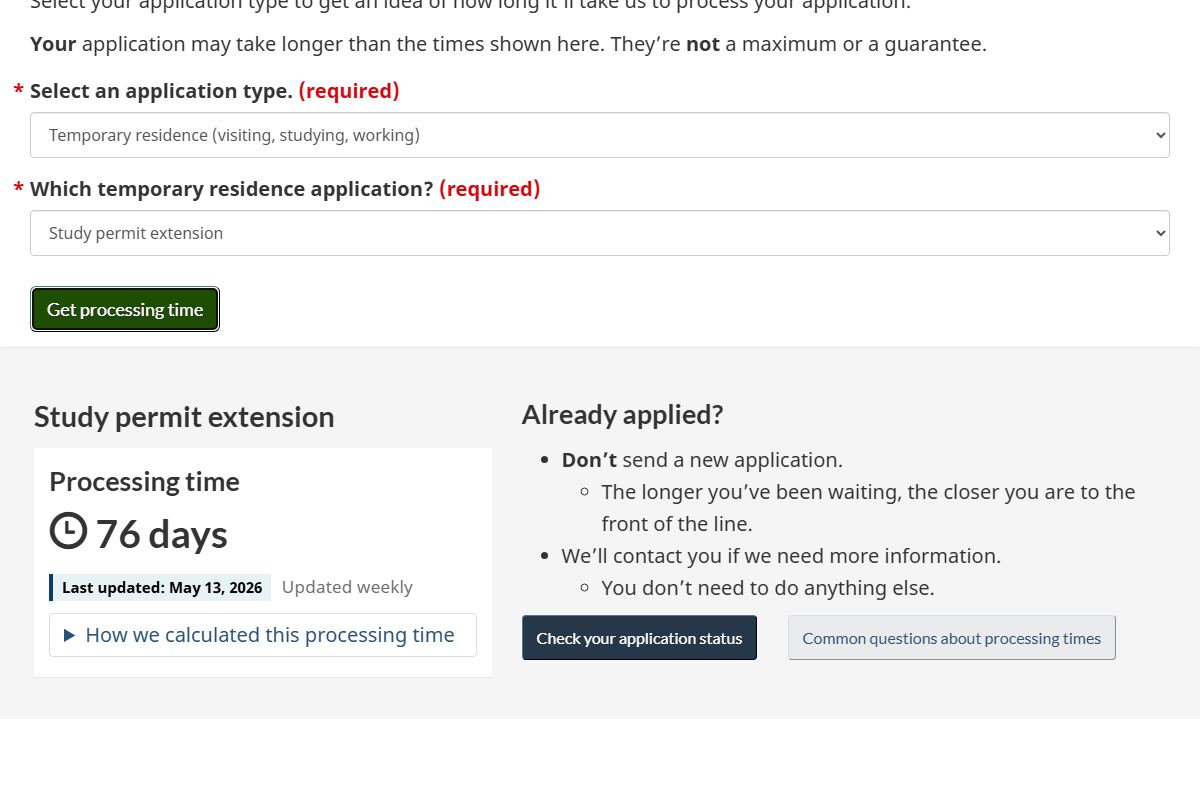
To check the current figure yourself:
- Go to the IRCC processing times tool.
- Under "What type of application is it?", select Temporary residence (visiting, studying, working).
- Under "What application are you checking?", select Study permit extension.
- Click Get processing time. No country filter is required.
- As of May 13, 2026, the result is 76 days.
What "76 Days" Actually Means
The number IRCC publishes is not a guaranteed turnaround. It is an 80th percentile figure, meaning 80 percent of complete applications received a decision within that window. One in five applicants waited longer.
Two things determine whether your application falls inside or outside that window. First, whether your application is complete. An incomplete submission, one that is missing a required document, has an expired acceptance letter, or lacks sufficient financial evidence, does not count toward the 76-day calculation in any meaningful way. IRCC may put the file on hold, request the missing information, and only resume the clock once they receive a satisfactory response. If that process drags on, your actual wait time can significantly exceed 76 days.
Second, IRCC's current workload. Processing times shift throughout the year based on volume. The figure published today reflects applications submitted recently. If you are filing at a peak intake period, such as after a major DLI enrollment deadline, the queue may be longer than the published estimate suggests.
Use 76 days as a planning benchmark, not a firm commitment from IRCC.
Implied Status: The Rule That Keeps You Enrolled While You Wait
Seventy-six days is a long time to wait if your study permit expires before a decision comes. This is where implied status, also called maintained status, becomes the most important concept in this entire process.
Under Canadian immigration law, if you submit your study permit extension application before your current study permit expires, you are allowed to remain in Canada and continue studying while IRCC processes your new application. You do not need a valid study permit in hand to keep attending classes. Your legal authorization to study continues under implied status until IRCC makes a decision.
To be clear about what implied status permits:
- You can continue attending your DLI and completing coursework toward your current program.
- You can remain in Canada for the duration of the processing period.
- You cannot travel outside Canada and return. If you leave Canada while on implied status, you lose that status, and you cannot re-enter without a valid study permit or new entry authorization.
- You cannot change schools or programs while on implied status without first receiving a decision on your extension and then filing any necessary amendment.
If IRCC refuses your extension application, implied status ends immediately. You would need to either leave Canada or apply for restoration of status before you can legally remain and study again.
Critical: Apply before your current study permit expires.
Implied status only activates if you file your extension application while your current permit is still valid. If your permit expires before you submit, there is no implied status. You will be out of status in Canada, unable to study legally, and will need to apply for restoration of status before your extension can move forward. Restoration adds cost, time, and risk. File early.
What IRCC Reviews in a Study Permit Extension
An extension is not a formality. IRCC reviews the full application, and the standard they apply is similar to the one used for an initial study permit, with some additional focus on your track record as a student in Canada.
Continuing at the same DLI and in the same program. If you are simply extending your permit because you need more time to complete the same program at the same school, this is the most straightforward type of extension. IRCC will verify your current enrollment, confirm the DLI remains in good standing, and check that your acceptance or enrollment letter covers the period you are requesting.
Financial sufficiency for the remaining duration. Your financial documents must demonstrate that you can cover tuition and living expenses for the remaining length of your program, not just the next semester. Bank statements, scholarship letters, and any funding documentation should reflect the full remaining cost of study.
Compliance with your current permit conditions. IRCC will review whether you have complied with the conditions of your existing study permit. This includes confirming that you have been enrolled full-time at your authorized DLI, that you have not worked beyond permitted hours, and that your program and school have not changed without authorization.
No change of conditions. A study permit extension covers the same program, at the same DLI, without any material change in conditions. If you are transferring to a new school, switching programs, or changing your level of study, you need an amendment or a new permit application, not a standard extension. Filing an extension when what you actually need is an amendment is a common mistake that leads to refusals.
What Can Slow Down Your Extension
The 76-day estimate reflects a well-prepared, complete application. The following are the most common reasons study permit extensions take longer or are refused outright.
Applying too late. Filing your extension one or two weeks before your permit expires leaves almost no buffer. If IRCC requests additional documents, you may not have time to gather and submit them before your permit expires and implied status becomes the only thing keeping you legal. Aim to file at least eight to ten weeks before your expiry date.
Expired or outdated acceptance letter. Your enrollment or acceptance letter from your DLI must be current and must clearly cover the extension period you are applying for. A letter from the start of your program that does not reference ongoing enrollment for the new term is not sufficient.
Changed DLI or program without authorization. If you transferred schools or switched programs without amending your study permit, IRCC will see a discrepancy between the conditions on your existing permit and your actual situation. This creates a compliance question that requires explanation and documentation, and it can result in a refusal if not handled carefully.
Financial documentation that is too old or too thin. Bank statements from six months ago do not reflect your current financial position. IRCC expects recent documentation, typically within the last three to six months, and the figures need to support the remaining cost of your studies with a reasonable buffer for living expenses.
Enrollment inconsistencies. If you enrolled part-time at any point during your study permit without authorization, or if there are gaps in your academic record that are not explained, IRCC may view these as non-compliance with your permit conditions. Unexplained gaps are among the top triggers for a closer review or a refusal on extension applications.
Already Applied and Waiting?
Applied through Up Immigration? We're already watching.
Our team monitors every active application on a regular basis. If IRCC requests documents, updates your status, or issues a decision, you will hear from us. If there is news, you will hear from us first.
If you applied on your own, log in to your IRCC secure account to check your file status. All IRCC correspondence, including document requests and final decisions, will appear there and in the email address associated with your account.
If 76 days have passed without a decision or any communication from IRCC, you can submit a web form inquiry through the IRCC website. Have your application number and payment receipt available before submitting.
While you are waiting on implied status, stay enrolled at your current DLI and in your current program. Do not travel outside Canada. Keep your financial records current in case IRCC requests an update. Implied status is protective as long as you continue meeting the conditions it is based on.
Why Getting the Extension Right Matters
A refused study permit extension has consequences that extend well beyond the inconvenience of having to leave Canada. A refusal creates an immigration record that IRCC will consider in any future application you submit, including applications for a Post-Graduation Work Permit, a work permit, or permanent residence. The reason for the refusal, whether it was a financial gap, a compliance issue, or a documentation problem, will need to be addressed in every subsequent application.
The stakes are not just administrative. Students on implied status who receive a refusal must stop studying immediately. If the refusal comes mid-semester, this can mean withdrawing from courses, losing tuition already paid, and losing progress toward a credential that may have taken years to build.
A Regulated Canadian Immigration Consultant (RCIC) reviews your current permit conditions, your enrollment history, your financial documentation, and any compliance concerns before the application is submitted. The goal is to identify and resolve problems before IRCC sees them, not after a refusal letter arrives.
Ready to Extend Your Study Permit?
If your study permit is expiring and you need to extend it, Up Immigration's regulated consultants can prepare your application and keep you informed throughout the process.
Learn more about study permit services →
Book a consultation with Up Immigration →
Information current as of 2026. Always verify at the IRCC processing times tool or with a regulated immigration consultant.