
You are already in Canada and you need a study permit, or you need to extend or change the one you already have. How long will IRCC take to decide? Here is the current data, what that number means in practice, and the one rule you cannot afford to get wrong while you wait.
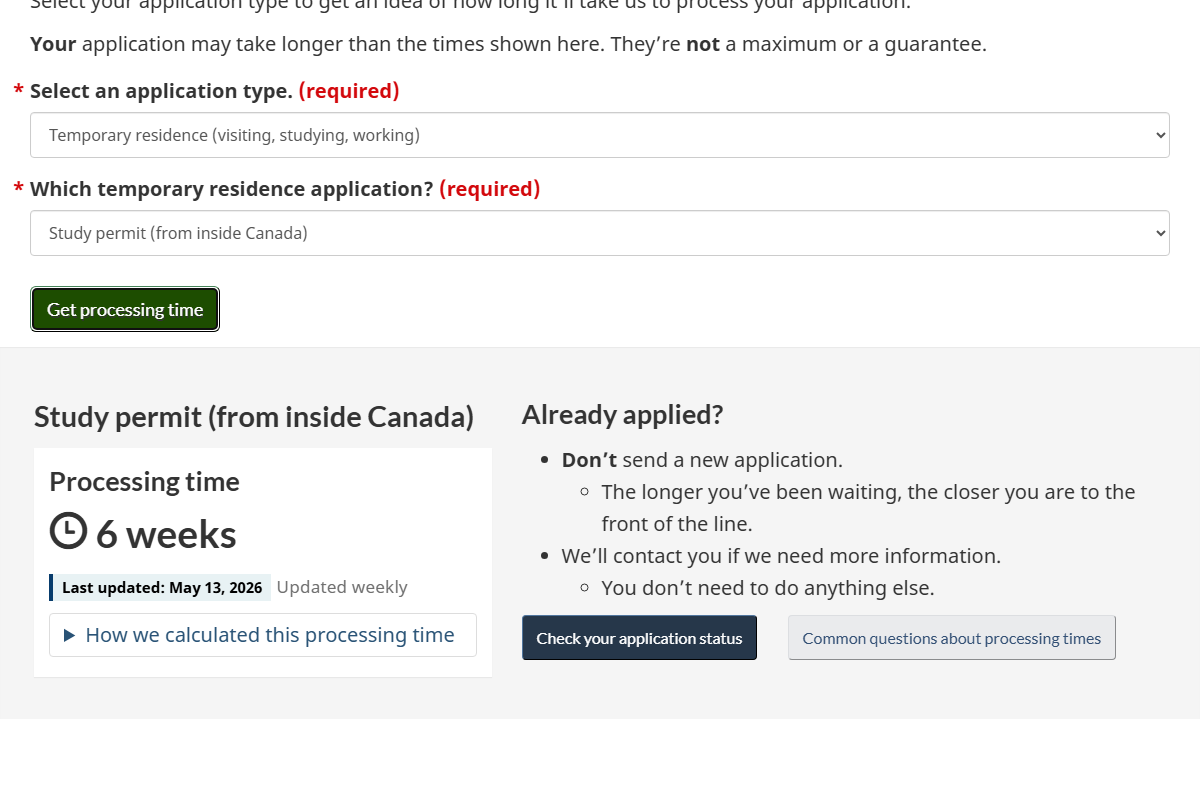
Applying for a study permit from inside Canada is a different process from applying abroad. You submit online through your IRCC account, you do not give up your spot in Canada to wait, and the processing time reflects a slightly different set of workload factors at IRCC. The current published processing time for study permit applications from inside Canada is 6 weeks, as of May 13, 2026.
Who Applies for a Study Permit from Inside Canada
Not everyone applying for a study permit is coming from abroad. A significant number of applicants are already in Canada under a different status and need to make a change before they can legally start studying.
Work permit holders switching to student status. If you are on a work permit and you have been accepted to a Designated Learning Institution (DLI) for a program that would normally require a study permit, you need to apply from inside Canada before your work permit expires. Studying under your work permit authorization alone is not permitted for most full-time programs.
Visitors who received a DLI acceptance letter. If you entered Canada as a visitor and then received an acceptance letter from a DLI, you can apply for a study permit from inside Canada rather than leaving to apply abroad. This is a practical option that avoids travel costs and keeps you close to your future school while the application is processed.
Study permit holders extending or changing their program. If your current study permit is expiring and you are continuing your studies, or if you are changing programs at the same DLI or transferring to a new one, you must apply to extend or amend your permit. These are also in-Canada applications and fall under the same 6-week processing time.
Students whose permit conditions changed. If you completed one level of study and are moving to a different program, or if you need to update the DLI or program name on your permit, an amendment application is required. This is one of the most commonly missed filing requirements among students who assume their existing permit covers any studies at any level.
6 Weeks vs. Applying from Outside Canada
The processing time for a study permit applied from outside Canada currently sits at 5 weeks for most countries. The in-Canada application takes one week longer on average, and the reason is straightforward.
When you apply from abroad, IRCC reviews your application alongside your entry eligibility. When you apply from inside Canada, IRCC still needs to verify all the same documentation, including your acceptance letter, proof of financial support, PAL or student authorization, and identity documents. The review workload is essentially the same, but the in-Canada stream involves an additional check of your current immigration status and the transition from one permit type to another. That coordination adds processing time.
The one week difference is not a significant concern for most applicants, but it matters for planning. If your current permit expires in six weeks, you are already at the edge of the window.
Implied Status: The Rule That Keeps You Legal While You Wait
The most important concept for anyone applying for a study permit from inside Canada is implied status, also called maintained status.
If you submit your study permit application before your current permit expires, Canadian immigration law allows you to remain in Canada and continue doing what your current permit authorizes while IRCC processes your new application. You are not in legal limbo. You are on implied status, which is a recognized and protected status under the Immigration and Refugee Protection Regulations.
For students extending their study permit, this means you can continue attending your DLI and studying while waiting for the new permit. For work permit holders switching to student status, this means you can continue working under your work permit until a decision is made on your study permit application.
Implied status does not give you new rights. It maintains your existing ones. If your work permit authorized you to work for a specific employer, implied status does not expand that authorization while you wait.
Critical: Apply before your permit expires.
If your current permit expires before you submit your study permit application, you lose implied status entirely. You will be out of status in Canada, which means you cannot legally study or work while waiting, and you will need to apply for restoration of status before your application can proceed. Restoration adds cost, time, and complexity to your case. Do not let your permit expire before filing.
The PAL Requirement Still Applies
A Provincial Attestation Letter (PAL) is required for most study permit applications, including those submitted from inside Canada. This requirement was introduced by the federal government in 2024 as part of reforms to manage international student volumes, and it remains in effect in 2026.
A PAL is a letter issued by the provincial or territorial government where your DLI is located, confirming that your enrollment falls within that province's allocated international student quota. Your DLI or its admissions office typically handles the process of obtaining the PAL and will include it with your acceptance documentation.
There are limited exemptions. Master's and doctoral programs, elementary and secondary school students, and a small number of other categories are exempt from the PAL requirement. If your program falls into one of these categories, your acceptance letter from the DLI will reflect that, and you do not need a separate PAL.
If you are unsure whether your program requires a PAL, confirm with your DLI before submitting your application. Submitting without a required PAL will result in a refusal.
What Slows Down an In-Canada Study Permit Application
The 6-week timeline applies to complete, well-prepared applications. These are the most common causes of delays and refusals for in-Canada applications.
Applying too close to your current permit's expiry. Even if you file one day before your permit expires and gain implied status, you are creating unnecessary pressure on your timeline. If IRCC requests a document or additional information, you need time to respond. Apply with as much lead time as your situation allows, ideally six to eight weeks before your permit expires.
Missing or expired acceptance letter. Your Letter of Acceptance from a DLI must be current and clearly show the program name, start date, and DLI designation number. Acceptance letters with expired start dates or programs that have already begun are a common reason for refusals on in-Canada applications.
Financial support documentation that does not cover the full program. IRCC requires proof that you can support yourself financially for the duration of your program, not just the first year. Bank statements, scholarship letters, sponsorship letters, or a combination must account for tuition plus living expenses for the full program length.
Unclear transition from your current permit. When you are changing from a work permit to a study permit, or switching programs mid-study, IRCC wants to see a clear and consistent story. A gap in your timeline, a program that does not connect logically to your stated purpose, or conditions on your current permit that appear inconsistent with full-time study can trigger a closer review or a refusal.
Missing PAL for a program that requires it. As noted above, a missing PAL on an application that requires one is a straightforward refusal. There is no opportunity to submit it after the fact without starting a new application.
How to Check Your Own Processing Time
IRCC's published processing time for study permits from inside Canada does not vary by country of origin the way visitor visa times do. The 6-week estimate applies regardless of your citizenship. However, the IRCC processing times tool is still worth checking periodically because the estimate does change as IRCC's workload shifts across the year.
To check the current estimate:
- Go to the IRCC processing times tool.
- Under "What type of application is it?", select Temporary residence (visiting, studying, working).
- Under "What application are you checking?", select Study permit (from inside Canada).
- No country filter is required. The result shows the current estimate for 80% of complete applications.
As of May 13, 2026, the result is 6 weeks.
Already Applied and Waiting?
Applied through Up Immigration? We're already watching.
Our team monitors every active application on a regular basis. You do not need to log in daily or wonder if something has changed. If IRCC updates your file, requests a document, or issues a decision, we will contact you right away. No need to reach out just to ask "any news?" If there is news, you will hear from us first.
If you applied on your own, log in to your IRCC secure account to check your file status. Any correspondence from IRCC, including requests for additional documents and final decisions, will appear there and in the email associated with your account.
If the 6-week window has passed without a decision or any communication from IRCC, you can submit a web form inquiry through the IRCC website. Have your application number and receipt confirmation ready before submitting.
One important note: if you are on implied status while waiting, make sure you understand exactly what your current permit authorized you to do and stay within those limits. Implied status maintains your existing conditions, it does not expand them.
Why Professional Guidance Matters for In-Canada Applications
In-Canada study permit applications carry unique risks that outside-Canada applications do not. When you apply from abroad and something goes wrong, you wait longer. When you apply from inside Canada and something goes wrong, you may fall out of status. That is a much higher-stakes outcome.
A Regulated Canadian Immigration Consultant (RCIC) reviews your current permit conditions, your transition scenario, your financial documentation, and the specific requirements of your DLI's program before your application is submitted. They identify problems before IRCC does, not after.
The most common avoidable errors on in-Canada study permit applications are errors that a professional review would catch: a missing PAL, a financial shortfall for the second or third year of a long program, an unclear transition narrative between permit types, or a timing mistake that leaves implied status too thin for comfort.
If you are switching from a work permit to a study permit, extending a permit that is already close to expiry, or transferring between programs, working with a regulated professional is not a formality. It is the practical way to protect your status in Canada.
Ready to Apply?
If you are in Canada and need a study permit, an extension, or a change to your existing permit, Up Immigration's regulated consultants can prepare your application correctly and keep you informed throughout the process.
Learn more about study permit services →
Book a consultation with Up Immigration →
Information current as of 2026. Always verify at the IRCC processing times tool or with a regulated immigration consultant.