
You have your acceptance letter from a Canadian school and you want to know how long the study permit application is going to take. Here is exactly what the current IRCC data shows for applicants from Brazil, what that number actually means in practice, and how to plan your timeline so you arrive before classes start.
A Canadian study permit is required for most international students who want to study full-time at a Designated Learning Institution (DLI) in Canada for six months or longer. Applications from outside Canada are processed by IRCC's international offices, and timelines vary by country and application volume.
The short answer for applicants from Brazil in 2026: IRCC's current published processing time is 5 weeks. But that number requires context before you can use it to plan anything reliably.
How to Check Your Own Processing Time
Processing times vary by country and IRCC updates them on an ongoing basis. The only reliable source is the official IRCC tool.
- Go to the IRCC processing times tool.
- Under "What type of application is it?", select Temporary residence (visiting, studying, working).
- Under "What application are you checking?", select Study permit (from outside Canada).
- Under "What country are you applying from?", select your country.
- The result shows the estimated processing time for 80% of complete applications from that country.
Below is a screenshot of the tool taken in May 2026, showing the result for applicants from Brazil.
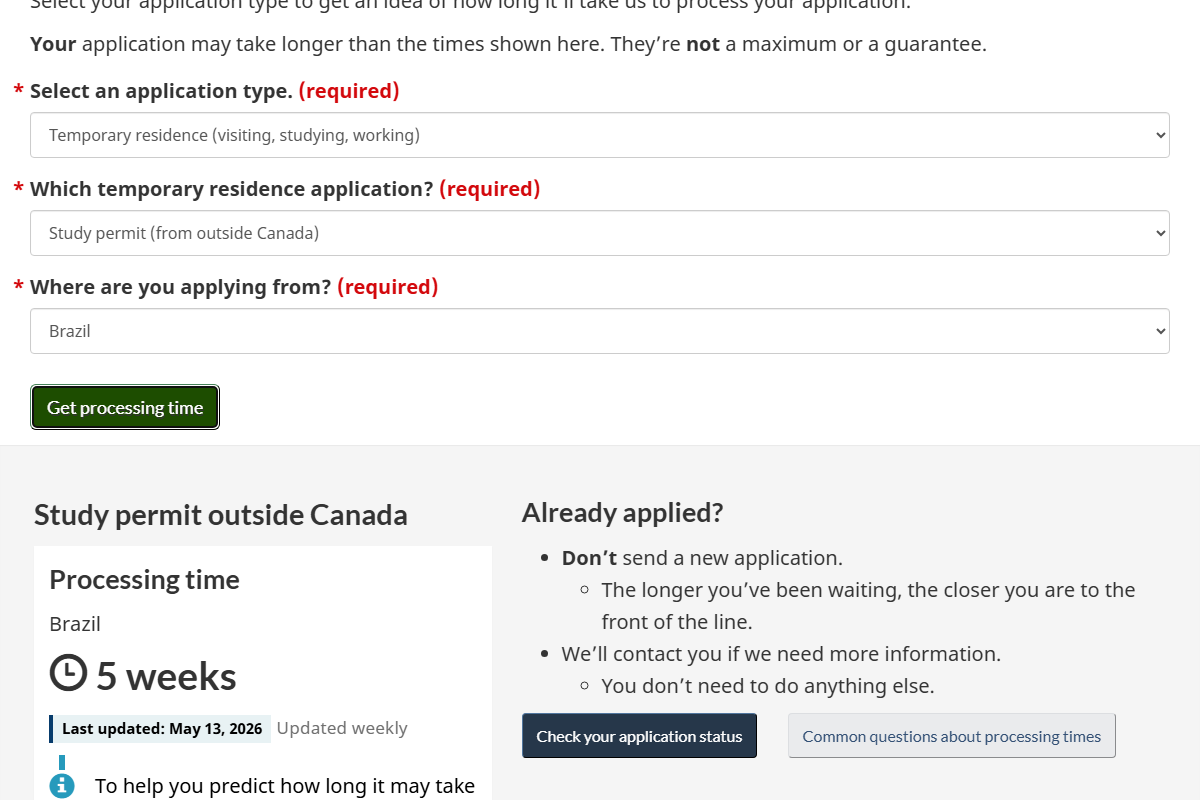
The result: 5 weeks for study permit applications from Brazil as of May 13, 2026.
If you are applying from a different country, your result will differ. Application volumes, bilateral agreements, and the location of the processing centre that handles your country all affect the timeline you will see in the tool.
What "5 Weeks" Actually Means
Five weeks is the 80th percentile benchmark. IRCC calculates it based on how long it took to process 80% of complete, eligible applications from Brazil in a recent period. That means one in five applicants will wait longer than 5 weeks, and some will wait considerably longer.
More importantly, that 5-week clock starts only after your application is complete and all required documents have been received. It does not account for biometrics delays, incomplete document packages, or the time it takes to obtain a Provincial Attestation Letter before you can even submit.
A realistic planning target for a study permit application from Brazil in 2026 is 8 to 10 weeks end to end, factoring in document preparation time, biometrics, and normal queue movement. Students with complex situations, prior refusals, or who need additional time to gather financial documentation should plan for the longer end of that range.
The PAL Requirement: What It Is and Why It Matters
The single most important change to the Canadian study permit process in recent years is the Provincial Attestation Letter requirement. As of 2024, most applicants from outside Canada must include a PAL from the province where their school is located before IRCC will process their application.
A PAL is a letter issued by the provincial or territorial government confirming that the school you are attending falls within that province's allocation of international study permits. IRCC introduced this requirement to manage the total number of new study permits issued nationally each year.
Here is what this means in practice: your school's international admissions team is responsible for obtaining the PAL on your behalf. Your school will notify you when a PAL has been issued for your application. You cannot apply for a PAL yourself, and IRCC will not issue you a study permit without one.
A missing PAL is a refusal, not a delay. If you submit your study permit application without a PAL (and you are not in one of the exempt categories), IRCC will refuse your application outright. Exempt categories include master's and doctoral students, elementary and secondary school students, and a few other specific situations. For most undergraduate and college applicants, the PAL is mandatory.
The practical implication: once you receive your acceptance letter from a DLI, contact the school's international office immediately to confirm whether a PAL has been or will be issued for your enrollment. Do not submit your study permit application until you have it in hand.
Planning Around September and January Intakes
The two major intake periods in Canada are September and January, and both have application deadlines that create predictable crunch periods for IRCC processing.
For a September intake, most advisors recommend submitting your complete study permit application no later than late June, and earlier is better. That gives you roughly 10 to 12 weeks before the semester starts, which is enough buffer to absorb a biometrics delay or a document request from IRCC without missing orientation.
For a January intake, the equivalent window is late October to early November. Applications submitted in December for a January start are high-risk. If anything slows your file, you may not receive a decision before classes begin.
These timelines assume your PAL is already in hand when you submit. If your school has not yet confirmed PAL status, factor in additional lead time before the submission date.
Arriving in Canada without your study permit in hand and relying on the port-of-entry process to resolve things is not a recommended strategy. Plan ahead so that you have your permit, your study authorization, and your travel arrangements confirmed well before your program start date.
What IRCC Reviews in Your Application
A study permit application is more document-intensive than a visitor visa. The reviewing officer is assessing whether you are a genuine student with the means to complete your program and the intention to return home afterward. The five areas IRCC scrutinizes most closely are:
Study plan. You must submit a written statement explaining why you chose this school, this program, and Canada specifically. The officer is looking for a logical connection between your academic background, your program choice, and your career goals back in your home country. Vague or generic study plans are a significant refusal trigger.
Proof of funds. IRCC's current guideline for living costs in Canada is $22,895 per year for a single student, on top of your first year's tuition. You must demonstrate that you have access to these funds, either through personal savings, family sponsorship, or a scholarship. Bank statements should be recent, consistent over several months, and clearly in your name or your sponsor's name.
Provincial Attestation Letter. As discussed above, this document from your province is a prerequisite for most applicants. It must accompany your application.
Acceptance letter from a Designated Learning Institution. Your school must be on Canada's official DLI list. The acceptance letter should clearly state your program name, start date, duration, and tuition amount.
Ties to your home country. IRCC must be satisfied that you intend to leave Canada when your studies are complete. Demonstrating family ties, employment prospects, property, or other obligations at home strengthens this part of your application. For younger applicants without established careers, this is often the most difficult element to document convincingly.
What Happens After You Submit
Once your application is submitted online, the first step for most applicants is a biometrics request. If you have not provided biometrics to IRCC in the last 10 years, you will receive an instruction letter shortly after submission. You then have 30 days to visit a Visa Application Centre in your country to provide fingerprints and a photo.
Book your biometrics appointment immediately when you receive that letter. In major cities, VAC slots are often available within a week. In smaller cities, slots may be limited and a delay here directly extends your overall timeline.
After biometrics, your file moves to the substantive review stage, where an officer assesses all of your documents. If anything requires clarification, you will receive an additional documents request. Respond completely and promptly. Any partial response or delay extends your total processing time by exactly as long as you take to reply.
Once the review is complete, IRCC issues a decision. If approved, you will receive a Port of Entry Letter of Introduction, which you present to the border officer when you arrive in Canada. The actual study permit document is issued at the port of entry, not by mail.
Study Permit Refusals Are Common
Study permit refusals from outside Canada happen at a much higher rate than most applicants expect. The most common reasons are a weak study plan that does not convincingly connect the program to the applicant's background and goals, insufficient proof of funds, a missing or invalid PAL, or an unconvincing demonstration of ties to the home country.
A refusal creates a record that must be addressed in any future application. Reapplying with the same materials almost never produces a different result. If your application was refused, the refusal letter identifies the officer's reasons, and those reasons must be directly addressed before you submit again.
If you have already received a refusal or if your situation involves any complicating factors, working with a Regulated Canadian Immigration Consultant before your next submission is the practical step. An RCIC reviews your study plan, your financial documentation, your PAL status, and your ties to home country before submission, which is the point where preparation actually affects the outcome.
Applied through Up Immigration? We're already watching.
Our team monitors every active application on a regular basis. You do not need to log in daily or wonder if something has changed. If IRCC updates your file, requests a document, or issues a decision, we will contact you right away.
Ready to Apply?
If you are planning to apply for a Canadian study permit and want to make sure your application is prepared correctly the first time, Up Immigration's regulated consultants can help. We review your study plan, confirm your PAL status, assess your financial documentation, and prepare a complete application that addresses all of the areas IRCC examines.
Study permit refusals are avoidable with the right preparation. Learn more about our study permit services or book a consultation with our team.
Information current as of 2026. Always verify at the IRCC processing times tool or with a regulated immigration consultant.