
You are already in Canada and you need to extend your work permit, change employers, or switch from a different status to a work permit. How long will IRCC take to decide? The current published figure is 209 days, as of May 13, 2026. That is roughly seven months, and there is one rule that determines whether you can keep working throughout that entire wait.
This article covers what the 209-day figure actually means, who applies for a work permit from inside vs outside Canada, the implied status rules that govern whether you can legally keep working while waiting, what causes delays and refusals, and what to do once your application is submitted.
How to Check Your Processing Time
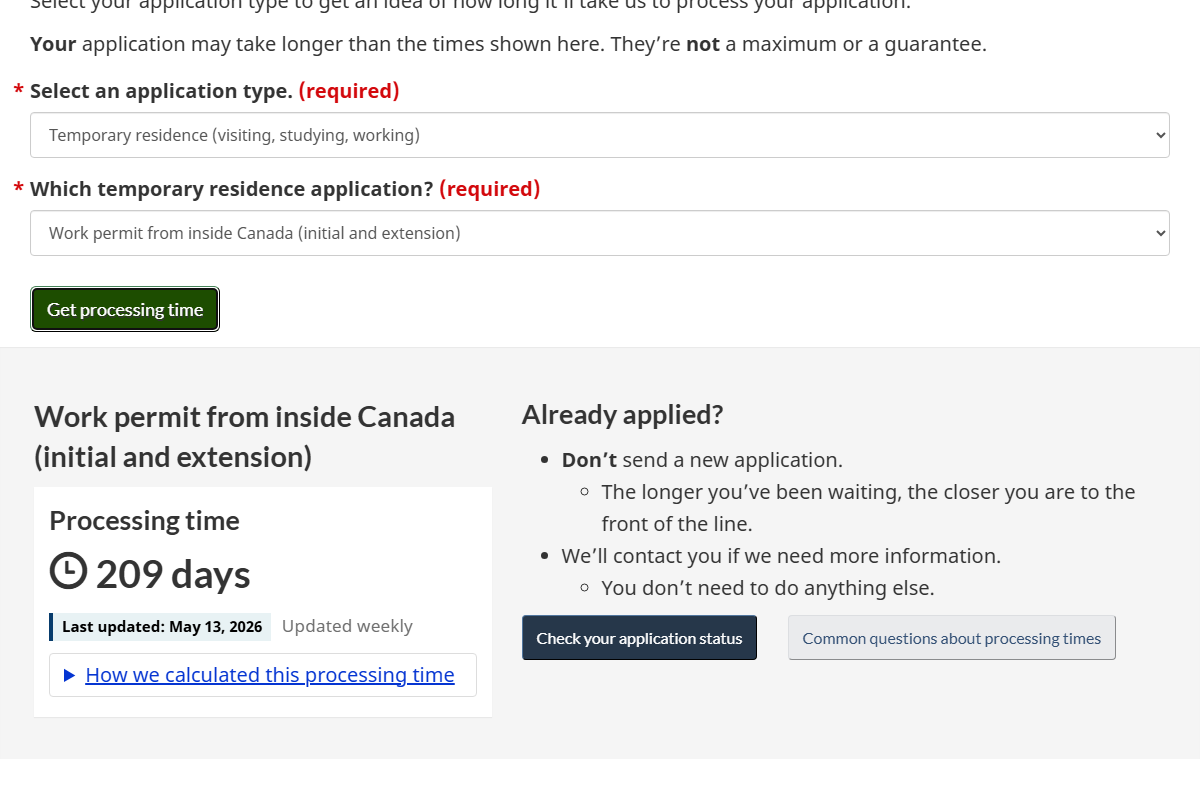
IRCC's processing times tool lets you check the current estimate for your application type directly. For work permits from inside Canada, no country filter applies. The 209-day figure is universal across all nationalities for this application type.
To confirm the current estimate for yourself:
- Go to the IRCC processing times tool.
- Under "What type of application is it?", select Temporary residence (visiting, studying, working).
- Under "What application are you checking?", select Work permit from inside Canada (initial and extension).
- Click Get processing time. No country filter is needed.
- As of May 13, 2026, the result is 209 days.
The tool updates periodically as IRCC's workload changes. If your application is already submitted, the estimate at the time you filed is the more relevant reference point, but checking the current figure gives you a sense of where things stand.
What "209 Days" Actually Means
The 209-day figure is not a guaranteed timeline. It is the 80th percentile processing time, meaning that 80 percent of complete, accurate applications for work permits from inside Canada receive a decision within 209 days. The remaining 20 percent take longer, sometimes significantly longer, depending on the specifics of the application.
In practical terms, 209 days is just under seven months. For context, applying for a work permit from outside Canada takes considerably less time for most categories. The in-Canada stream is slower because IRCC is processing the application alongside a review of your current Canadian status and the legal transition from one permit type to another. That adds a layer of work that outside-Canada applications do not require.
The timeline also assumes your application is complete and consistent from the start. Missing documents, inconsistencies between your LMIA and your job offer letter, or a passport nearing expiry can move your case into a slower queue or trigger a refusal.
Who Applies for a Work Permit from Inside Canada
Several groups submit in-Canada work permit applications, and the 209-day processing time applies to all of them.
Workers changing employers with a new LMIA. If you are on a closed work permit and you have accepted a job with a different employer who has obtained a Labour Market Impact Assessment, you need a new work permit before you can legally start with that employer. You apply from inside Canada if you are currently in the country and want to remain here during the process.
Workers extending the same permit. Closed work permits are tied to a specific employer, position, and duration. When the permit term is ending and your employer wants to continue your employment, you apply for an extension. This is one of the most common in-Canada applications and falls under the same 209-day figure.
Spouses transitioning to a spousal open work permit. If a spouse or common-law partner sponsored under a family class or temporary residence application needs to start working while their own permit is being processed, they may be eligible for a spousal open work permit. When the sponsoring partner is already in Canada, the application is submitted in-Canada.
International students switching to a work permit. Students who have completed their program and are moving to a post-graduation work permit (PGWP) or another work permit category, and who do not leave Canada between graduation and applying, may apply from inside Canada depending on their situation. These applications may have different timing rules, so confirming eligibility before filing is important.
Implied Status: The Rule That Governs Your Right to Work While Waiting
With a 209-day processing time, the question of what you can legally do while waiting is not an afterthought. It is the central issue for most applicants. The answer depends entirely on implied status.
Implied status, also called maintained status, is a provision under the Immigration and Refugee Protection Regulations that allows you to remain in Canada and continue doing what your current permit authorized while IRCC processes a new application. If you apply to extend or change your work permit before your current permit expires, you are on implied status from the moment your current permit expires until a decision is made.
You can keep working under the same conditions. If your current work permit authorized you to work for a specific employer in a specific role, implied status lets you continue doing exactly that. You are not in legal limbo. Your work authorization is actively maintained under the regulations.
You cannot change employers or change roles during the wait. Implied status maintains your existing conditions. It does not expand them. If your current permit is tied to Employer A, you cannot start working for Employer B while waiting for a decision, even if Employer B's LMIA has been approved. The new authorization does not exist until IRCC issues the new permit.
Implied status does not survive a refusal. If IRCC refuses your application, implied status ends at the point the refusal is issued. You would then be in a period of authorized stay but without work authorization, and depending on your circumstances you may need to leave Canada or apply for restoration of status. A refusal is not a recoverable situation to navigate casually.
Critical: You must apply before your current permit expires.
If your work permit expires before you submit your application, you lose implied status entirely. You will be out of status in Canada, which means you cannot legally work while waiting, and you will need to apply for restoration of status before anything else can proceed. Restoration adds cost, time, and legal complexity. The 209-day processing time matters a great deal less than the date you file. File well before your permit expires.
What Can Slow Down or Derail Your Application
The 209-day figure applies to complete, accurate applications. Several issues consistently extend timelines or lead to refusals on in-Canada work permit applications.
Applying too late before expiry. Filing your application with less than 30 days before your permit expires is a common and avoidable problem. If IRCC sends a request for additional documents and you have only a few weeks of status remaining, your ability to respond without stress is already compromised. Apply with as much lead time as possible, ideally two to three months before your permit expires.
Expired or expiring LMIA. An LMIA has a validity period, typically 18 months from the date it was issued. If your LMIA expires before your work permit application is decided, your application may be refused or returned. Confirm the expiry date of your employer's LMIA before you file and confirm that it will still be valid when a decision is expected.
Inconsistencies between the LMIA and your job offer letter. The position title, wages, hours, and duties in your offer letter must match what is listed in the LMIA. Even minor discrepancies, such as a slightly different job title or a wage that differs from the LMIA wage rate, can trigger a refusal or a request for further documentation that adds months to your timeline.
Medical exam required but not completed. Some work permit categories require a medical examination, particularly for positions in healthcare, childcare, or roles that involve working with vulnerable populations. If your application requires a medical and you have not completed one with a Designated Medical Practitioner, your application will be delayed until the results are received. Check whether your occupation or intended province triggers a medical requirement before you file.
Passport expiring before the proposed new permit would end. IRCC will not issue a work permit that extends beyond the expiry date of your passport. If your passport expires in eight months and you are applying for a two-year extension, IRCC will issue the permit only to your passport expiry date, or refuse the application outright if your passport is too close to expiring for any meaningful authorization. Renew your passport before filing if you have any concern about its validity window.
Already Applied and Waiting?
Applied through Up Immigration? We're already watching.
Our team monitors every active application on a regular basis. If IRCC requests documents, updates your status, or issues a decision, you will hear from us. If there is news, you will hear from us first.
If you applied on your own, log in to your IRCC secure account to monitor your file. Any correspondence from IRCC, including document requests, biometrics instructions, and final decisions, will appear there and in the email address associated with your account. Check both regularly.
If more than 209 days have passed without a decision or any communication from IRCC, you can submit a web form inquiry through the IRCC website. Have your application number and payment receipt available before you submit the inquiry.
While you are waiting on implied status, keep doing exactly what your current permit authorized. Do not change employers, take on a second job outside your permit conditions, or change your role without first receiving the new permit. Implied status is contingent on you remaining within the conditions of the permit that was in effect when you applied.
Why the Margin for Error Is So Small
A 209-day processing time means your legal right to work in Canada is resting on an application that IRCC will not decide for approximately seven months. That is a long time for something to go wrong.
When an in-Canada work permit application is refused, the applicant does not simply reapply and try again from the same position. Implied status ends when the refusal is issued. Depending on how long after the original permit expiry the refusal comes, the applicant may have been working on implied status for months under an authorization that no longer exists. That has downstream consequences for future applications, including any path toward permanent residence.
A Regulated Canadian Immigration Consultant (RCIC) reviews your LMIA validity, your offer letter consistency, your passport window, any medical exam requirements, and the timing of your filing before the application goes in. Problems that would cause a refusal seven months from now are identifiable today. That is the practical value of professional preparation at this stage, not a formality but a protection for the status you already have.
Ready to Apply?
If you are in Canada and need to extend, change, or obtain a work permit, Up Immigration's regulated consultants prepare applications correctly and monitor them throughout the process.
Book a consultation with Up Immigration →
Information current as of May 2026. Processing times change as IRCC workloads shift. Always verify the current figure at the IRCC processing times tool or with a regulated immigration consultant.