
According to the IRCC processing times tool, applicants from Brazil applying for a work permit from outside Canada are currently looking at 5 weeks (data pulled May 13, 2026). That number answers one question and raises several others. What does "5 weeks" actually count? Does it include the time your employer spends getting their paperwork ready? What can push your file past that window? This article answers all of it.
If you have a job offer lined up in Canada and you are applying from abroad, here is everything you need to know about the timeline before your work permit arrives.
How to check your processing time on the IRCC tool
IRCC publishes a publicly accessible tool where you can look up current processing times by application type and country of residence. The steps are straightforward:
- Go to the IRCC processing times tool
- Select "Temporary residence (visiting, studying, working)"
- Select "Work permit (from outside Canada)"
- Select your country of residence (Brazil = 5 weeks as of May 2026)
- Click "Get processing time"
The number you see will be specific to your country of residence, not your nationality. If you live in another country, run the tool with that country selected instead of Brazil.
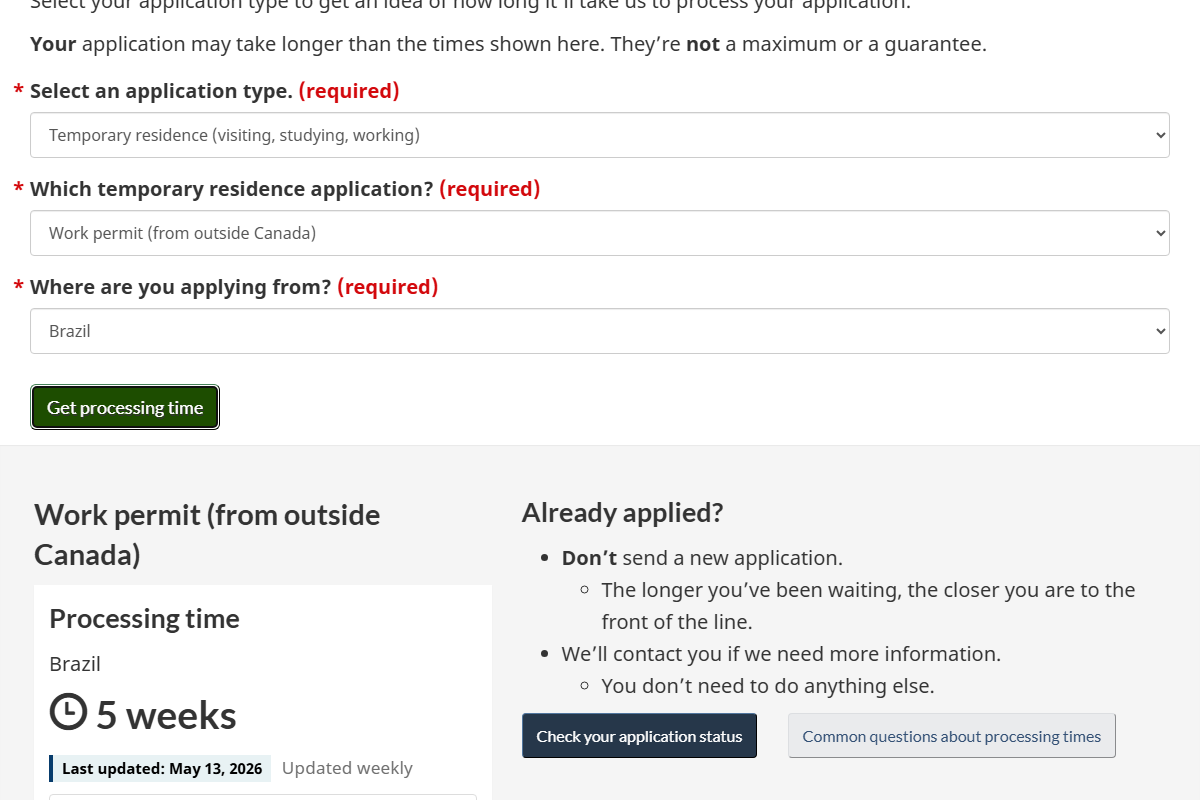
Processing times are updated weekly. The figure can move up or down as IRCC inventory shifts, so check the tool again close to when you plan to submit your application.
What "5 weeks" actually means
Before you put that number in your calendar, understand exactly what it measures.
The IRCC processing time represents the time it took IRCC to finalize 80% of applications in that category over a recent historical window. It is not an average, not a median, and it is not a guarantee. One in five applicants will wait longer, sometimes significantly longer, and that is entirely normal within the published standard.
More importantly, the clock only starts when IRCC considers your application complete. That means:
- All required forms are uploaded and correctly filled out
- Government fees are paid
- Supporting documents (passport, photos, job offer letter, LMIA or LMIA-exemption documentation) are all present
- Biometrics have been submitted, if required
If any of those pieces are missing or incorrect, your application is not yet in the processing queue. The 5-week clock has not started.
Equally important: this figure covers only the work permit itself, the step where IRCC reviews your application and issues the permit. It does not include any of the employer-side steps that must happen before you can even submit. More on that below.
Types of work permits from outside Canada
Not every work permit from outside Canada is the same. The category your application falls into affects both the process and the documents your employer needs to provide before you apply.
Employer-specific (closed) work permits
Most work permits issued from outside Canada are employer-specific, meaning the permit names your employer, your job title, your work location, and the duration of your employment. You cannot switch employers without obtaining a new permit. These are issued under two main streams:
LMIA-backed permits (Temporary Foreign Worker Program, TFWP). Your employer applies to Employment and Social Development Canada (ESDC) for a Labour Market Impact Assessment before you apply for the work permit. The LMIA confirms that no qualified Canadian worker was available for the role. Only after the LMIA is approved do you submit your work permit application to IRCC.
LMIA-exempt permits (International Mobility Program, IMP). These permits are covered by an exemption from the LMIA requirement. Common exemption categories include:
- CUSMA (Canada-United States-Mexico Agreement) professionals and intra-company transferees
- Intra-company transferees under other free trade agreements
- International agreements and reciprocal employment arrangements
- Significant benefit to Canada (certain researchers, artists, and specialists)
- Charity and religious workers
For LMIA-exempt permits, your employer generally files an Offer of Employment through the IRCC Employer Portal and pays a compliance fee before you submit your application.
Open work permits
Some applicants applying from outside Canada qualify for an open work permit, which is not tied to a specific employer. The most common categories for applicants outside Canada include:
- Spouses and common-law partners of eligible Canadian workers or international students (spousal open work permit)
- International Experience Canada (IEC) participants from eligible countries (Working Holiday, Young Professionals, International Co-op)
- Certain other exempted categories
If you are applying under one of these categories, the process is different from a standard employer-specific permit, and the LMIA consideration below does not apply to you directly.
LMIA processing is separate from work permit processing
This is one of the most commonly misunderstood parts of the Canadian work permit timeline. The 5-week figure from the IRCC tool applies to the work permit application stage only. It does not include the time it takes to get an LMIA.
If your permit requires an LMIA, your employer must apply for and receive it from ESDC before you can submit your work permit application to IRCC. Current LMIA processing by ESDC adds time on top of the 5-week IRCC figure, and that additional time varies by stream:
- High-wage stream LMIA: Typically 3 to 9 weeks depending on occupation and current ESDC volumes
- Low-wage stream LMIA: Similar range, with additional scrutiny in some sectors
- Global Talent Stream (specific tech occupations): 2-week service standard from ESDC when conditions are met
- Agriculture and seasonal streams: Faster processing for priority agriculture employers
The full timeline for an LMIA-backed work permit looks like this: employer prepares LMIA application, then waits for ESDC approval, then you submit your work permit application, then IRCC processes it in approximately 5 weeks. The 5 weeks is the last step, not the whole race.
For LMIA-exempt categories, the employer's Offer of Employment through the portal is typically completed within a few days, so the IRCC processing time is much closer to the total timeline.
What can delay your application
Being in the 20% of applicants who wait longer than the published time is not random. There are specific, predictable factors that push files past the service standard.
Biometrics. If this is your first application to Canada or your biometrics on file are more than 10 years old, you will receive a biometrics instruction letter (BIL) after submitting your application. You have 30 days to attend a Visa Application Centre (VAC) and provide your fingerprints and photo. IRCC will not continue processing until biometrics are received. In Brazil, VACs operate in São Paulo, Rio de Janeiro, Brasília, Recife, and Porto Alegre. Factor in travel time and VAC appointment availability. In practice, biometrics add approximately 30 days to the total timeline for first-time applicants.
Medical examination. Some work permit categories require an upfront immigration medical exam (IME) before the permit is issued. Occupations in healthcare, childcare, and work with vulnerable populations almost always trigger this requirement. If your job falls into one of these categories and you have not completed the medical before applying, expect delays. Proactively checking whether your occupation requires an upfront IME, and completing it before submitting, is one of the easiest ways to protect your timeline.
Incomplete LMIA package. Even after the LMIA is approved, the job offer letter you include with your work permit application must accurately reflect the LMIA. Mismatches between the LMIA job title, NOC code, wage, hours, or location and what appears in your offer letter can trigger IRCC requests for additional information or, in some cases, a refusal.
Quebec Certificate of Acceptance (CAQ). If your job is in Quebec, you need both a provincial CAQ from the Ministère de l'Immigration, de la Francisation et de l'Intégration (MIFI) and a federal work permit. These are two separate applications processed by two separate governments. You cannot submit the federal work permit application until the CAQ is issued. Quebec CAQ processing adds its own timeline, currently several weeks for most categories, before the IRCC clock even starts.
Missing or incorrect job offer letter details. A job offer letter that omits the NOC code, lists the wrong wage, does not specify the work location, or lacks the LMIA number (when required) will create problems. Officers reviewing work permit applications check these details carefully, and a letter that does not align with what was approved will stall your file.
Prior refusals or immigration history. If you have a prior refusal to Canada or have overstayed a previous permit, additional officer review is likely. This does not disqualify you, but it adds time as the officer works through the history of your file.
Already applied?
Applied through Up Immigration? We're already watching.
Our team monitors every active application on a regular basis. If IRCC requests documents, updates your status, or issues a decision, you will hear from us. If there is news, you will hear from us first.
If you applied independently and want to check your status, log into your IRCC secure account at canada.ca. Your application status and any officer messages appear there. The contact centre cannot tell you more than the tracker shows, so calling in will not speed things up.
Where an RCIC makes the difference
A work permit from outside Canada, taken at face value, looks like a straightforward process: employer gets LMIA, you apply, IRCC processes in 5 weeks. The published timeline encourages that reading. The reality is more nuanced.
The path to that 5-week processing window involves employer compliance, LMIA preparation, occupation and wage verification, Quebec CAQ considerations if applicable, biometrics timing, and a job offer letter that holds up to officer scrutiny. Each of those steps is a place where incomplete or incorrect information causes delays or refusals. Once a refusal is on file, subsequent applications carry additional scrutiny.
Working with a Regulated Canadian Immigration Consultant (RCIC) does not only mean having someone fill out forms. It means having someone who reviews the LMIA package before it goes to ESDC, ensures the job offer letter matches what was approved, flags biometrics and medical exam requirements before submission, and catches document issues before they reach an IRCC officer. The 5 weeks is what happens when the file is right. Getting the file right is the work that happens before those 5 weeks begin.
If you are at the early stages, figuring out whether your job offer qualifies, which LMIA stream applies, or how to structure your application, a consultation is the logical first step. Book a consultation with Up Immigration and we will map out your specific situation and timeline.
Frequently asked questions
Can I start working before my work permit arrives?
No. For most applicants outside Canada, you must wait until the permit is issued and you have entered Canada before beginning work. There is no equivalent of implied status for applicants abroad. Do not make commitments to an employer about a start date until the permit is in hand.
Does the 5-week figure apply to both LMIA-backed and LMIA-exempt permits?
The IRCC tool does not separate them. In practice, LMIA-exempt applications sometimes process faster than LMIA-backed ones, but both are grouped under the same published service standard. The bigger variable is employer preparation time, which precedes the IRCC stage for LMIA-backed permits.
What if I move to a different country before my application is decided?
You need to notify IRCC of your change of address and country of residence. Your application continues to be processed, but country of residence can affect officer assignment and processing times. Inform your representative immediately if you relocate during an active application.
My permit was approved but I have not entered Canada yet. Does it expire?
Yes. A work permit approval letter (port of entry letter of introduction) is typically valid for up to one year from the date of issue. You must enter Canada before that expiry date. At the port of entry, a CBSA officer issues the actual work permit, usually matching the end date of your employment or the permit validity, whichever is shorter.
Processing time data sourced from the IRCC processing times tool, May 13, 2026. Times are updated weekly and subject to change. This article does not constitute legal advice. Verify current figures at canada.ca before making decisions.