
If you are a Colombian citizen planning to visit Canada in 2026, IRCC's current processing time for visitor visa applications from Colombia is 27 days. That figure comes directly from the official IRCC processing times tool, last checked May 2026. This article explains what that number means in practice, how biometrics affect your total timeline, and what officers specifically examine when reviewing Colombian applications.
Colombia is a major source of visitor visa applications to Canada. Canadian passport holders can visit Colombia without a visa, but the reverse is not true. Colombian citizens need a Temporary Resident Visa (TRV) for every trip to Canada, whether for tourism, to visit family, to attend a business meeting, or to join a wedding or graduation. Understanding the process and what makes an application strong is the first step toward a smooth experience.
How to Check the Current Processing Time
Processing times are country-specific and IRCC updates them regularly. The 27-day figure above reflects data from May 2026. By the time you read this, the number may have changed. The only reliable source is the official IRCC tool.
Here are the exact steps:
- Go to the IRCC processing times tool.
- Under "What type of application is it?", select Temporary residence (visiting, studying, working).
- Under "What application are you checking?", select Visitor visa (from outside Canada).
- Under "What country are you applying from?", select Colombia.
- Click "Get processing time" to see the current estimate.
Below is a screenshot taken from the tool in May 2026, with Colombia selected.
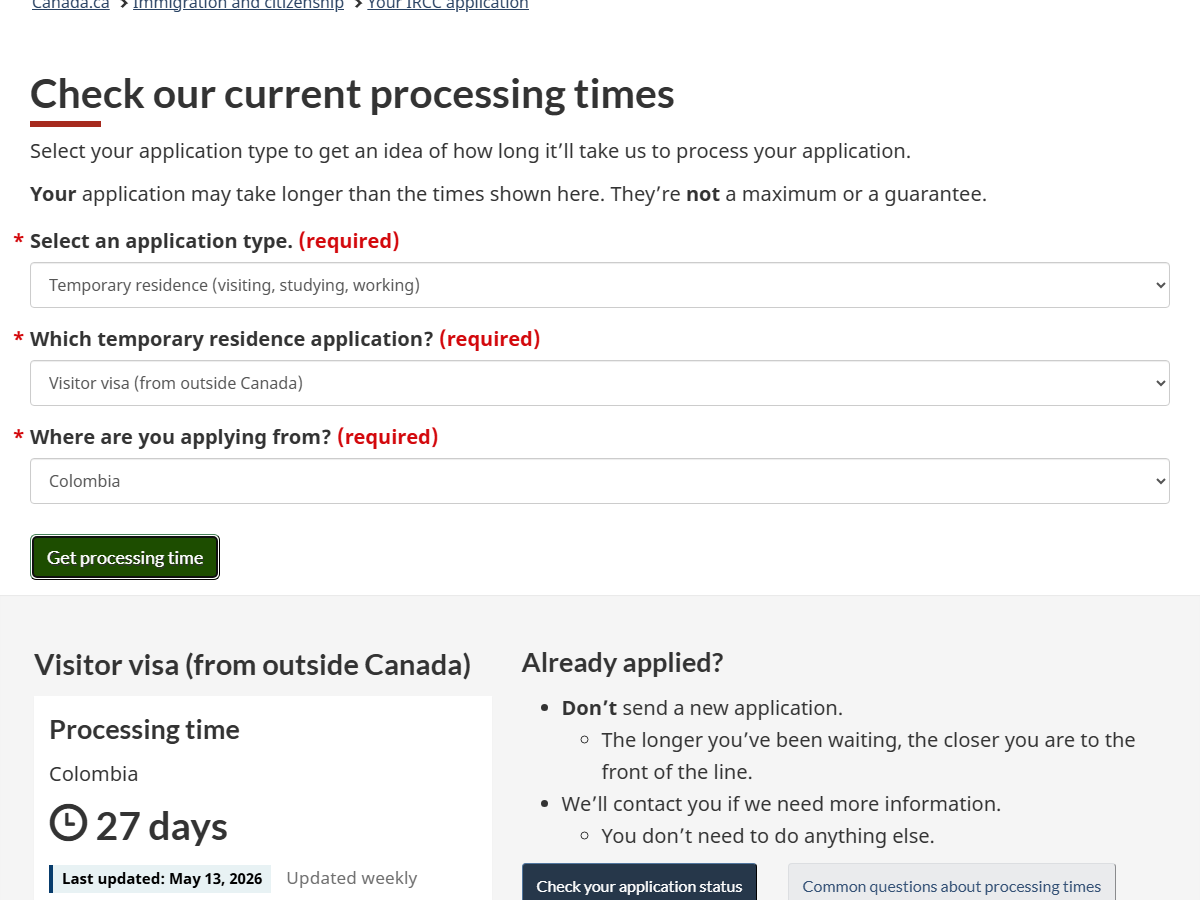
The result: 27 days for visitor visa applications from Colombia as of May 2026.
What "27 Days" Actually Means
The published processing time is not a deadline and it is not a guarantee. IRCC calculates it based on how long it took to process 80% of complete applications from Colombia during a recent reference period. That means roughly one in five Colombian applicants will wait longer than 27 days. In some cases, that gap is significant.
Three factors shape which side of that average your application lands on.
Completeness at the time of submission. The 27-day clock starts only when IRCC has a complete application. If a document is missing, a form is inconsistent, or IRCC sends a request for additional information, the file pauses. That waiting time is not included in the published figure, but it extends your real timeline by however long you take to respond.
The estimate is Colombia-specific. Figures quoted for other countries do not apply to your application. The 27-day estimate reflects the volume of Colombian applications, the offices that review them, and any specific verification steps that apply to Colombian nationals. Treat it as your reference point for Colombia only.
File complexity and officer scrutiny. Even complete applications from the same country move at different speeds. A file with clear documentation, strong ties to Colombia, and a well-defined purpose of visit typically moves through faster than one that raises questions requiring closer examination. The quality of your application has a direct impact on where in that 27-day range your decision falls.
Biometrics: The Step That Extends Your Real Timeline
Most Colombian applicants applying for a Canadian visa for the first time, or for the first time in more than 10 years, are required to provide biometrics. Biometrics is a separate step that happens after you submit your online application, and it adds meaningful time to your total timeline beyond the 27-day IRCC estimate.
After submitting your application online, you will receive a Biometric Instruction Letter (BIL) from IRCC. You then have 30 days to attend an appointment at a Visa Application Centre (VAC) in Colombia to provide your fingerprints and photograph. The VAC serving Colombian applicants is located in Bogotá.
Appointment availability at the Bogotá VAC depends on the time of year and overall demand. During busy periods, appointments can fill up quickly. Once you receive your biometrics instruction letter, book your appointment promptly rather than waiting. The 30-day window sounds comfortable, but popular slots disappear faster than applicants expect.
After your biometrics appointment, your application continues processing. In practice, when you account for the time to book and attend a biometrics appointment and then wait for the 27-day IRCC review, your total timeline from application submission to a final decision is closer to 6 to 8 weeks.
If you provided biometrics to Canada within the last 10 years, you will not need to repeat the step. Check the date on your previous Canadian application to confirm whether your biometrics are still valid.
Building Your Trip Timeline
If you are planning a visit to Canada from Colombia, here is a practical timeline to work from.
Add together: time to book and attend a biometrics appointment at the Bogotá VAC (up to 2 weeks in some periods), a few days for biometrics to process after your appointment, 27 days for IRCC visa review after biometrics are received, and a buffer of 1 to 2 weeks for any document requests or unexpected delays. The realistic total is 8 to 10 weeks from application submission to a decision.
Working backwards from your intended travel date, submit your application at least 10 weeks in advance. For peak travel seasons, including summer (July and August) when many Colombian families travel to visit relatives in cities like Toronto and Ottawa, and the December holiday period, apply earlier. Volumes rise during those windows and the VAC typically becomes busier at the same time.
Avoid booking non-refundable flights or accommodations until after your visa is approved. A 27-day processing estimate is an average, not a maximum, and an application under review is not a confirmed trip.
What Officers Look for in Colombian Visitor Visa Applications
Colombian applicants face thorough review, and officers have extensive experience with the patterns common in Colombian files. Understanding what they examine helps you build an application that addresses those points clearly.
Strong ties to Colombia. The central question in every visitor visa review is whether the applicant will leave Canada at the end of their authorized stay. For Colombian applicants, officers look for concrete evidence of ties: stable employment with an employer letter, a business you own or manage, property in Colombia, close family members who depend on you and who are not in Canada, and ongoing financial commitments that require your presence at home. The more specific and documented these ties, the stronger your application.
Financial documentation that holds up to scrutiny. Officers reviewing Colombian applications pay close attention to financial records, given remittance patterns common in the region. Large unexplained deposits in bank statements shortly before application, income that does not match your employment documentation, or financial records that are unclear or inconsistent all raise credibility concerns. Present your financial situation with clean, well-organized records. If you are self-employed or own a business, include supporting documentation that explains your income clearly.
Clear purpose of visit. Your application must explain specifically why you are going to Canada and what you plan to do there. If you are visiting family, include an invitation letter with proof of their Canadian status and a clear itinerary. If you are attending a conference or event, document it. Officers assessing high-volume countries look for clarity and specificity in the purpose of visit, not general statements about wanting to travel.
Prior US visa as supporting context. Colombian applicants who hold a valid US visa or who have documented a history of travel to the United States with timely departures can reference that record. It helps support the argument that you travel internationally and comply with authorized stay conditions. It does not substitute for a strong ties-to-Colombia argument, but it adds useful context to your file.
Proper disclosure of prior refusals. Canadian immigration forms ask explicitly about prior visa refusals from any country. Omitting this information is treated as misrepresentation, which carries far more serious consequences than the original refusal and can result in a multi-year bar from Canada. Disclose all prior refusals accurately and address what has changed since they occurred.
Already Applied and Waiting?
Applied through Up Immigration? We're already watching.
Our team monitors every active application on a regular basis. If IRCC requests documents, updates your status, or issues a decision, you will hear from us first.
If you applied on your own and want to check your status, log in to your IRCC secure account. All correspondence from IRCC, including your biometrics instruction letter, any document requests, and the final decision, will appear there and will also be sent to the email address on your account.
If the published processing time for Colombia has passed without any communication from IRCC, you can submit a web form inquiry through the IRCC website. Have your application number and payment confirmation ready before submitting.
When Working with an RCIC Makes Sense
A significant number of Colombian applicants apply for a visitor visa without professional assistance and receive approval. But refusals in this category are also common, and most of them come down to the same preventable issues: a ties-to-Colombia argument that was not documented clearly enough, financial records that raised questions, or a purpose of visit that was not explained with sufficient specificity.
A Regulated Canadian Immigration Consultant (RCIC) reviews your specific situation before your application goes to IRCC. They assess how your ties to Colombia will appear to an officer, identify gaps in your supporting documents, flag any disclosure requirements you may have missed, and prepare a covering letter that presents your case in a clear, organized way.
Professional review makes the most difference when you have had a prior refusal from Canada or another country, when your financial situation involves elements that need context, when family members in Canada could affect the officer's assessment of your intent, or when the purpose of your trip requires careful documentation to explain clearly.
A refusal creates a record you must disclose in every future Canadian application and can affect eligibility for other immigration programs. Addressing potential issues before submission is far more straightforward than managing a refusal after the fact.
Ready to Apply?
If you are planning a trip to Canada from Colombia and want to make sure your application is built correctly from the start, Up Immigration's team of regulated consultants can help. We review your documents, assess your situation, and prepare a complete application tailored to your specific circumstances.
Book a consultation with Up Immigration →
Processing time data sourced from IRCC's official tool, May 2026. Always verify the current figure at the IRCC processing times tool before submitting your application, as times are updated regularly.