
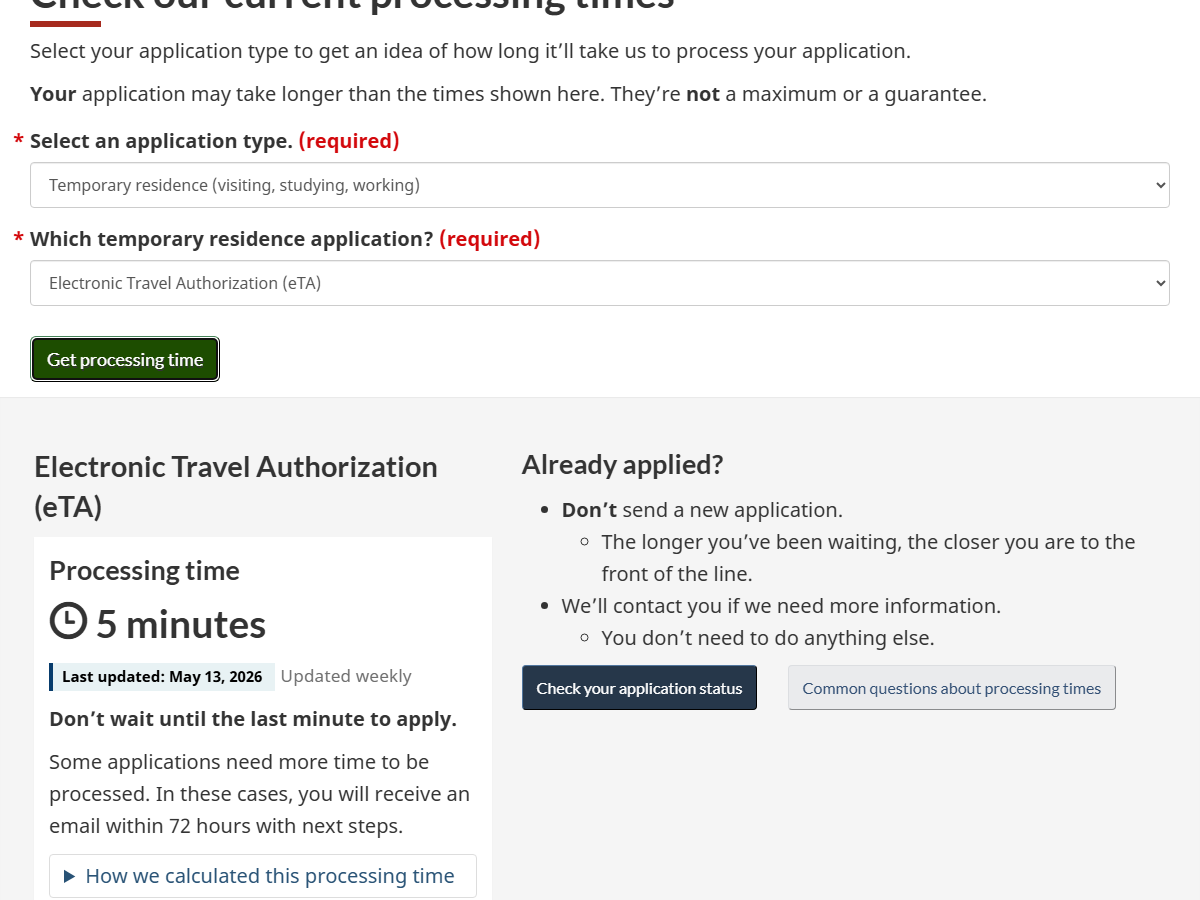
If you are a French citizen searching for "Canada visitor visa processing time," here is the key fact: you do not need a visitor visa. France is a visa-exempt country for Canada. When flying to Canada, French passport holders need an Electronic Travel Authorization (eTA), not a Temporary Resident Visa (TRV). The eTA costs C$7 and the processing time published by IRCC is 5 minutes. This applies to all French citizens, including those from French overseas territories such as French Guiana, Martinique, and Guadeloupe, who travel on a French passport. This article explains what the eTA is, how to apply, and what to expect.
eTA vs. Visitor Visa: What French Citizens Actually Need
Canada divides the world's passport holders into two groups when it comes to temporary entry as a visitor:
Visa-exempt nationals do not need a visitor visa. France is in this category. French citizens can enter Canada without going through the Temporary Resident Visa (TRV) process, which involves detailed documentation, weeks of processing, and a much higher fee.
Visa-required nationals must apply for a TRV before entering Canada. Citizens of Brazil, India, China, the Philippines, and most countries in Africa and the Middle East fall into this group. The TRV requires financial documentation, proof of ties to the home country, and a processing time measured in weeks.
Because France is visa-exempt, the correct document for a French citizen flying to Canada is an eTA. The eTA and the TRV both authorize temporary entry to Canada as a visitor, but they are for different passport holders. French citizens are not eligible for, and do not need to apply for, a TRV.
One note on French territories: French citizens from mainland France, Martinique, Guadeloupe, French Guiana, Reunion, and other French overseas territories all hold French passports issued by the French Republic. The visa-exempt status applies to the French passport, not the location of residence. If you travel on a French passport, the eTA rules apply to you regardless of where you live.
The situation where visa-exempt nationals including French citizens do not need an eTA is when entering Canada by land or sea. If you are driving across from the United States or arriving at a Canadian port, your French passport is sufficient. The eTA requirement applies specifically to air travel.
How to Apply for an eTA
The eTA application is an online form on the Government of Canada website. Here is what you need and how it works.
What you need:
- A valid French passport
- A credit or debit card (the fee is C$7)
- An email address
How to apply:
- Go to the official eTA application at canada.ca. Use only the official government website. Third-party sites that charge more and claim to process the same application are not official.
- Enter your passport details exactly as they appear in your passport. Typos in your name, date of birth, or passport number are the most common cause of delayed applications.
- Pay the C$7 fee by credit or debit card.
- Submit the form and wait for the confirmation email.
For most French applicants, the confirmation arrives within a few minutes. The email contains your eTA reference number. There is no physical document: the eTA is linked electronically to your passport number. When you check in for your flight to Canada, the airline's system reads your passport and confirms the eTA automatically. You do not need to print anything or present a separate document at the airport.
IRCC recommends applying at least 72 hours before departure. For most applicants the 5-minute processing time holds, but a small share of applications require additional review. Applying a few days in advance removes any time pressure.
What Your eTA Authorizes
An approved eTA does several things that are worth understanding before you travel.
Multiple entries. The eTA is not single-use. It allows you to travel to Canada as many times as you like during its validity period. You do not need to apply again for each trip.
Valid for 5 years or passport expiry. The eTA remains valid for 5 years from the date it was issued, or until your passport expires, whichever comes first. If you renew your French passport, you will need to apply for a new eTA linked to the new passport number, even if your previous eTA has not yet expired.
Up to 6 months per visit. Each time you enter Canada, a border officer at the port of entry determines how long you may stay. The standard is up to 6 months, but the officer has discretion to grant a shorter period. The authorized period is recorded in your entry documents. That is the date by which you must leave or apply to extend your status.
The eTA is not a guarantee of entry. The eTA authorizes you to board a flight to Canada and present yourself at the border. The border officer at the airport makes the final decision on whether you are admitted and for how long. A valid eTA is required, but it does not by itself guarantee entry.
Traveling by Land or Sea
French citizens entering Canada by land from the United States, or arriving at a Canadian seaport, do not need an eTA. A valid French passport is sufficient for land and sea crossings. The eTA requirement is tied to air travel only.
For French travelers combining a US visit with a trip into Canada: if you fly into the United States and then drive north across the border, no eTA is needed for the land crossing. But if at any point you board a flight bound for a Canadian airport, including connecting flights that transit through Canada, the eTA is required. Applying before you leave France covers all scenarios and costs only C$7.
A note for NEXUS and Global Entry holders: these programs have their own entry procedures at certain crossings. If you hold a US NEXUS card or Global Entry membership, check the relevant program guidance for French citizens before your trip.
If Your eTA Application Goes to Additional Review
The vast majority of French eTA applications clear the automated system within minutes. But a small percentage are flagged for manual review. This is not a refusal. It simply means a border services officer is taking a closer look before the authorization is issued.
Common reasons an application might be flagged: a typo in passport data entered on the form, travel history that triggers secondary screening, a previous immigration matter involving Canada, or a criminal record that intersects with Canadian inadmissibility rules.
If your application goes to additional review, IRCC will send an email within 72 hours with next steps. That email may ask you to upload documents or provide more information. Follow the instructions in that email and wait for a decision. Do not submit a new application while one is already pending. Filing a second application does not speed up the first, and it creates duplicate records that can create confusion.
If 72 hours have passed and you have received no email at all, check your spam or junk folder first. IRCC correspondence is sometimes filtered there. If the email is genuinely absent, contact IRCC through their web form and reference your application number.
Working or Studying in Canada as a French Citizen
The eTA and tourist entry status do not authorize work or study in Canada. This is a common misunderstanding for visitors from visa-exempt countries, where easy entry sometimes creates the impression of broad authorization once inside Canada.
If you want to work in Canada, you need a work permit. French citizens have access to specific pathways: the International Experience Canada (IEC) program includes a working holiday category for French nationals, and the Canada-European Union Comprehensive Economic and Trade Agreement (CETA) creates intra-company transfer and other work permit options. These require a separate application and cannot be substituted by tourist entry.
It is also worth noting that Canada's strong French-language immigration streams, particularly in the Express Entry system and several Provincial Nominee Programs, give French-speaking applicants from France a meaningful advantage when pursuing permanent residence. An eTA is not a path to any of these programs, but it can give you the opportunity to visit and explore your options in person.
If you want to study in Canada for more than 6 months, a study permit is required. Programs or courses shorter than 6 months may be permitted on visitor status under certain conditions, but confirm the specific rules with IRCC before enrolling.
Entering Canada as a tourist and then working or studying without authorization is a status violation with serious long-term consequences for future immigration applications. If your plans involve work or study, obtain the right permit before you travel.
Extending Your Stay Beyond 6 Months
If you are already in Canada and want to stay longer than the period authorized at entry, you can apply for a Visitor Record extension from inside Canada. The application must be submitted before your current authorized period expires.
Applying for an extension before your status expires is not optional if you want to stay legally. If you remain in Canada past your authorized date without having submitted an extension application, you fall out of status. Restoring status after it has lapsed is a separate and more difficult process.
The extension application is submitted online through your IRCC secure account. Have your eTA confirmation and entry record available when you apply. If IRCC approves the extension, they will issue a Visitor Record indicating your new authorized period.
Applied through Up Immigration? We're already watching.
Our team monitors every active application on a regular basis. If IRCC requests documents, updates your portal status, or issues a decision, you will hear from us first.
When a Consultation Makes Sense
For most French citizens, the eTA is a simple self-serve process. Apply online, receive the confirmation email, travel to Canada. Most applicants need nothing more.
But certain situations are more complicated. If you have a criminal record, even from many years ago, Canadian inadmissibility rules may affect your ability to enter as a visitor. If you have a prior refusal from Canada or were turned back at the border, that history appears in the system and will be relevant to any future application. If your longer-term plans involve working, studying, or eventually pursuing permanent residence in Canada, particularly through French-language pathways where French nationals have a genuine competitive advantage, starting with a clear picture of your options is a worthwhile first step.
Book a consultation with Up Immigration →
Information current as of May 2026. Always verify entry requirements at the official IRCC eTA page before traveling.