
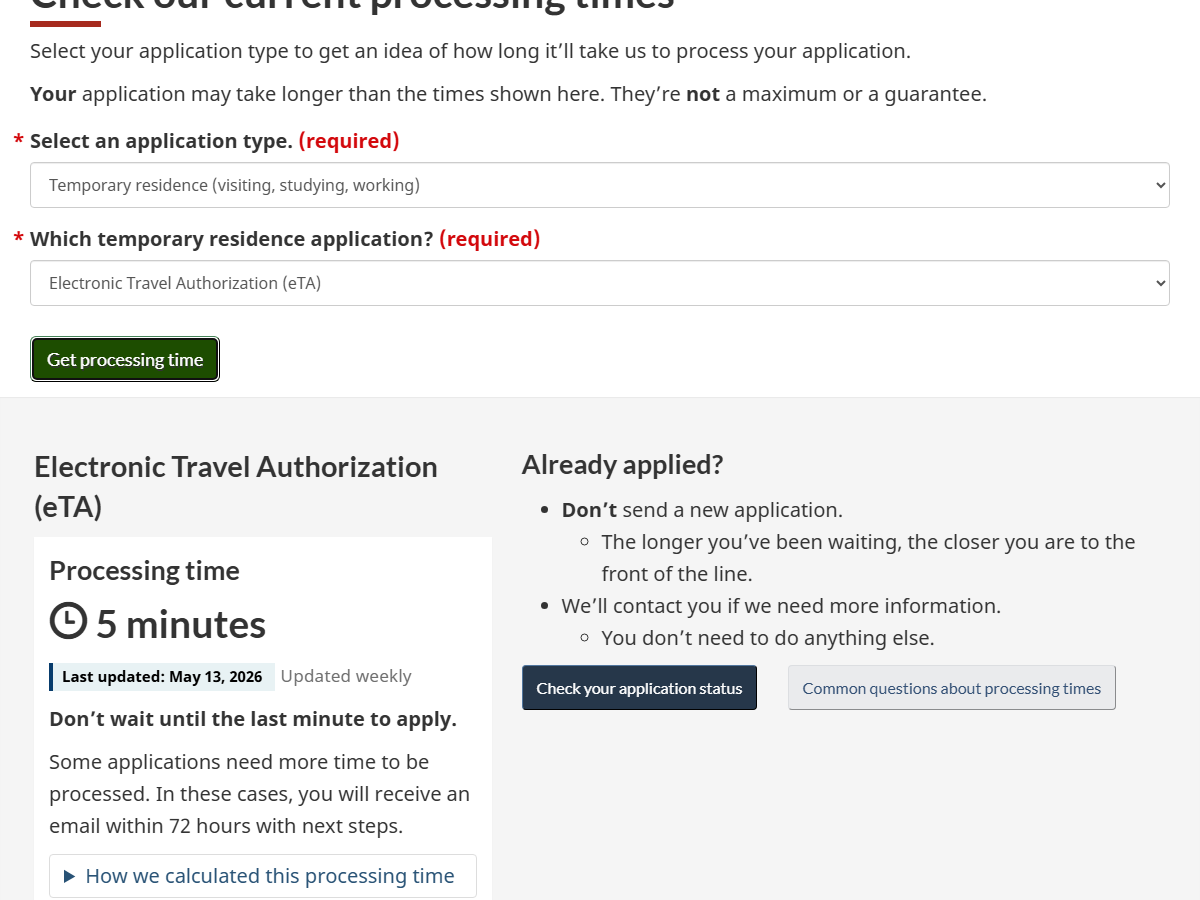
If you are a German citizen searching for "Canada visitor visa processing time," here is the short answer: you do not need a visitor visa. Germany is one of the original countries whose citizens have visa-free access to Canada. When flying to Canada, German passport holders need an Electronic Travel Authorization (eTA), not a Temporary Resident Visa (TRV). The eTA costs C$7 and the processing time published by IRCC is 5 minutes. This article explains the difference between the two documents, how to apply for an eTA, and what to do in the uncommon cases where an application takes longer.
eTA vs. Visitor Visa: What German Citizens Actually Need
Canada divides the world's passport holders into two groups when it comes to temporary entry:
Visa-exempt nationals do not need to apply for a visitor visa. Germany is in this category. German citizens can enter Canada as visitors without going through the Temporary Resident Visa (TRV) process, which involves detailed documentation, weeks of processing, and a much higher fee.
Visa-required nationals must apply for a TRV before entering Canada. Citizens of Brazil, India, China, the Philippines, and most countries in Africa and the Middle East fall into this group. The TRV process involves financial documentation, proof of ties to the home country, and a processing time measured in weeks, not minutes.
Because Germany is visa-exempt, the correct document for a German citizen flying to Canada is an eTA. The eTA and the TRV both authorize temporary entry to Canada as a visitor, but they are not interchangeable. German passport holders are not eligible for, and do not need to apply for, a TRV.
The one situation where even visa-exempt nationals like German citizens do not need an eTA is when entering Canada by land or sea. If you are driving across from the United States or arriving at a Canadian seaport, your German passport is sufficient. The eTA requirement applies specifically to air travel.
How to Apply for an eTA
The eTA application is an online form on the Government of Canada website. Here is what you need and how it works.
What you need:
- A valid German passport
- A credit or debit card (the fee is C$7)
- An email address
How to apply:
- Go to the official eTA application at canada.ca. Use only the official government website. Third-party sites that charge more and promise the same result are not official and provide no added value.
- Enter your passport details exactly as they appear in your passport. Typos in your name or passport number are the most common cause of delayed applications.
- Pay the C$7 fee by credit or debit card.
- Submit the form and wait for the confirmation email.
For most German applicants, the confirmation arrives within a few minutes. The email contains your eTA reference number. There is no physical document: the eTA is linked electronically to your passport number. When you check in for your flight to Canada, the airline's system reads your passport and confirms the eTA automatically.
IRCC recommends applying at least 72 hours before your departure. For most applicants the 5-minute processing time is accurate, but a small percentage of applications require additional review. Applying several days before you travel avoids the risk of cutting it close.
What Your eTA Authorizes
An approved eTA does several things that are worth understanding before you travel.
Multiple entries. The eTA is not single-use. It allows you to travel to Canada as many times as you like during its validity period. You do not need to apply again for each trip.
Valid for 5 years or passport expiry. The eTA remains valid for 5 years from the date it was issued, or until your passport expires, whichever comes first. If you renew your German passport, you will need to apply for a new eTA linked to the new passport number, even if your previous eTA has not yet expired.
Up to 6 months per visit. Each time you enter Canada, a border officer at the port of entry determines how long you may stay. The default is up to 6 months, but the officer has discretion to grant a shorter period. The date stamped in your passport (or the date on your entry record) is the date by which you must leave or extend your status.
The eTA is not a guarantee of entry. The eTA authorizes you to board a flight to Canada and present yourself at the border. The border officer at the airport makes the final decision on whether you are admitted and for how long. Having a valid eTA is required but does not by itself guarantee entry.
Traveling by Land or Sea
German citizens entering Canada by land from the United States, or arriving at a Canadian seaport, do not need an eTA. A valid German passport is sufficient for land and sea crossings. The eTA requirement is tied specifically to air travel.
A practical note for German travelers doing a multi-destination North America trip: if you are flying into the United States and then driving north into Canada, you will not need your eTA for the border crossing itself. But if at any point during that trip you board a flight bound for a Canadian airport, even for a connecting flight transiting through Canada, the eTA is required. Apply before you leave Germany to cover all scenarios.
One exception worth noting: holders of a valid US NEXUS card or Global Entry membership have different entry procedures at some crossings. If you hold one of these, consult the relevant program documentation before your trip.
If Your eTA Application Goes to Additional Review
Germany has one of the strongest visa-exempt track records with Canada. The vast majority of German eTA applications clear the automated system within minutes. But a small percentage are flagged for manual review. This is not a refusal, and it is not specific to German nationals. Any eTA application can be routed to additional review based on the data in the form.
Common reasons an application might be flagged include: a typo in the passport data, travel history that triggers secondary screening, a previous immigration issue with Canada, or a criminal record that requires a closer look under Canadian inadmissibility rules.
If your application goes to manual review, IRCC will send an email within 72 hours explaining the next steps. That email may ask you to upload documents or provide additional information. Follow those instructions and wait for a decision. Do not submit a new application while one is already pending.
If 72 hours have passed with no communication, check your spam folder first. IRCC emails occasionally filter there. If the email is genuinely missing, contact IRCC through their web form with your application number.
Working or Studying in Canada as a German Citizen
The eTA and tourist entry status do not authorize work or study in Canada. This is a common point of confusion for visitors from visa-exempt countries who assume that easy entry means broad authorization once inside Canada.
If you want to work in Canada, you need a work permit. The type of work permit depends on your situation: whether you have a job offer, whether your occupation falls under an international agreement such as the Canada-European Union Comprehensive Economic and Trade Agreement (CETA), or whether you are applying under a specific program. German citizens are eligible to apply for International Experience Canada (IEC) working holiday permits, which allow temporary work in Canada. But that is a separate process from the eTA.
If you want to study in Canada for more than 6 months, you need a study permit. Short courses or programs under 6 months may be permitted on visitor status, but there are conditions. Confirm the rules with IRCC before enrolling.
Entering Canada on a tourist entry and then working or studying without authorization is a status violation with serious consequences for future immigration applications. If your plans involve work or study, sort out the right permit before you travel.
Extending Your Stay Beyond 6 Months
If you are already in Canada and want to stay longer than the period authorized at entry, you can apply for a Visitor Record extension from inside Canada. This is an application to IRCC to extend your authorized stay as a visitor, and it must be submitted before your current authorized period expires.
Applying for an extension before your status expires is critical. If you remain in Canada past your authorized date without having applied for an extension, you fall out of status. Restoring status after it expires is a separate, more complicated process.
The extension application is submitted online through your IRCC secure account. Keep your eTA confirmation and entry record on hand when you apply. IRCC will issue a Visitor Record if the extension is approved, which specifies the new authorized stay period.
Applied through Up Immigration? We're already watching.
Our team monitors every active application on a regular basis. If IRCC requests documents, updates your portal status, or issues a decision, you will hear from us first.
When a Consultation Makes Sense
For most German citizens, the eTA is a self-serve process that takes minutes. Apply online, get your confirmation email, travel to Canada. No immigration consultant required.
But some situations are more complicated. If you have a prior criminal record, even from decades ago, Canadian inadmissibility rules may affect your ability to enter as a visitor. If you have had a previous Canadian visa refusal or were denied entry at the border, that history follows your passport and will come up again. If your plans involve staying in Canada long-term, transitioning to work or study, or eventually pursuing permanent residence, starting with an informed assessment of your options is worth your time.
Book a consultation with Up Immigration →
Information current as of May 2026. Always verify entry requirements at the official IRCC eTA page before traveling.