
If you are a Peruvian citizen applying for a Canadian visitor visa in 2026, IRCC's current processing time for applications from Peru is 28 days. That figure comes directly from the official IRCC processing times tool, last updated May 20, 2026. This article explains what that number means, how biometrics factor into your total timeline, and what Peruvian applicants can do to put together a strong application.
Peru is not a visa-exempt country for Canada. Whether you are visiting family, attending a wedding, doing business, or planning a trip to see Niagara Falls, you need a Temporary Resident Visa (TRV) before boarding your flight. IRCC processes Peruvian applications within a predictable window, but the 28-day figure only tells part of the story.
How to Check the Current Processing Time
Processing times are specific to your country of application and are updated weekly by IRCC. The 28-day figure reflects data from May 20, 2026. By the time you read this, the number may have changed. Checking it takes under two minutes.
- Go to the IRCC processing times tool.
- Select Temporary residence (visiting, studying, working).
- Select Visitor visa (from outside Canada).
- Select Peru.
- Click Get processing time.
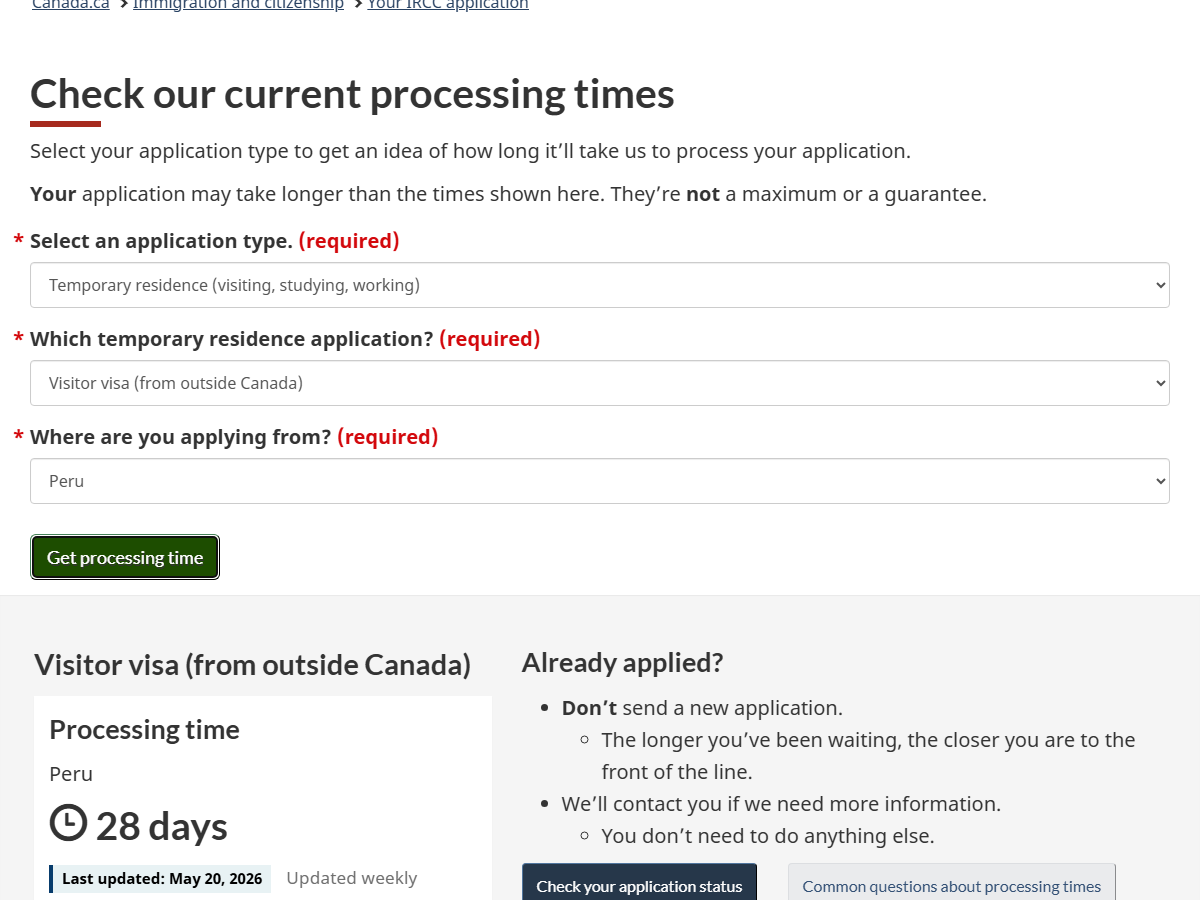
The result as of May 20, 2026: 28 days for visitor visa applications from Peru.
What "28 Days" Actually Means
The published processing time is not a deadline, a guarantee, or an average. IRCC calculates it based on the time it took to finalize 80% of complete applications from Peru in a recent reference window. That means one in five Peruvian applicants will wait longer than 28 days, sometimes considerably longer, and that is within the normal range.
Three things determine how your application performs against that benchmark.
Completeness. The 28-day clock applies only to applications that arrive at IRCC with all required documents, fully completed forms, and no inconsistencies. If IRCC sends a request for additional documents, the clock pauses while you gather and upload them. Your actual total processing time grows by however long you take to respond.
Country-specific handling. The 28-day estimate reflects processing of Peruvian applications specifically: the volume of applications from Peru, the offices that review them, bilateral screening requirements, and historical approval patterns. Do not rely on times you see quoted for other nationalities.
File complexity. A straightforward application from a salaried professional with documented employment, clear finances, and a well-defined trip purpose moves faster than one that requires closer review. Prior refusals, gaps in travel history, inconsistent financial documentation, or family members in Canada can all prompt additional scrutiny and extend your timeline.
Biometrics: The Step That Extends Your Total Timeline
Most Peruvian applicants applying for a Canadian visa for the first time, or for the first time in more than ten years, need to provide biometrics. This is a separate step from submitting your online application, and it adds real time to your total wait.
Here is how it works. Shortly after you submit your application online, IRCC sends a Biometric Instruction Letter (BIL). You then have 30 days to attend an appointment at a Visa Application Centre (VAC) in Peru to provide your fingerprints and photograph.
The VAC in Peru currently operates in Lima. Appointment availability varies. During peak periods, slots can be booked out several days in advance. Book as soon as your BIL arrives rather than waiting until the last week.
Once biometrics are submitted, your application continues processing. The practical implication is that your total timeline from submitting your online application to receiving a decision is closer to 7 to 10 weeks when biometrics are included, not just 28 days. If you have already provided biometrics to IRCC within the last ten years, you will not need to provide them again.
Building Your Trip Timeline
If you are planning a trip to Canada from Peru, here is a realistic framework for building your timeline.
Add together: time to book and attend your biometrics appointment (up to two weeks), IRCC processing after biometrics are received (28 days), a buffer for document requests or unexpected delays (one to two weeks). The total from the day you submit your application to the day you receive a decision is roughly eight to ten weeks.
Working backwards: if you want to be in Canada by a specific date, submit your visitor visa application at least ten weeks in advance. For high-demand travel periods, including July and August and the December holidays, apply earlier. VAC appointment availability tightens and IRCC volumes increase during those times.
Do not book non-refundable flights or accommodation before your visa is approved. The 28-day figure is an estimate for complete applications, not a guarantee, and an application under review does not mean approval is assured.
Common Reasons Peruvian Visitor Visa Applications Are Refused
Understanding why applications from Peru are refused helps you address those issues before submission rather than after a refusal.
Insufficient ties to Peru. This is consistently the leading cause of refusals from Latin American countries. Officers need to believe you will leave Canada when your authorized stay ends. Your application must show compelling reasons to return to Peru: employment, a business, property, financial obligations, or family members who depend on your presence. A vague statement of intent is not sufficient.
Financial documentation that is incomplete or inconsistent. Officers want to see that you can support yourself in Canada without working illegally. Consistent, well-organized bank statements that match your employment income, and a realistic budget for your trip, strengthen your application. Recent large deposits that do not match your income raise credibility concerns and require explanation.
Purpose of visit not clearly documented. If you are visiting family in Canada, provide an invitation letter from your relative, proof of their status in Canada, and a clear itinerary. If you are a tourist, show that your plans are concrete. Officers want to understand specifically why you are going and what you will do there.
Limited international travel history. Applicants who have not traveled outside Peru face more scrutiny. Your application needs to compensate through strong ties to home and a clearly documented trip purpose. If you have a valid US or Schengen visa or prior travel history to visa-exempt countries, include that documentation.
Prior Canadian or other visa refusals not disclosed. Canadian forms ask directly about prior refusals. Omitting this history is treated as misrepresentation, which is far more serious than the original refusal and can result in a multi-year ban. Always disclose prior refusals accurately and explain what has changed since then.
Already Applied and Waiting?
Applied through Up Immigration? We're already watching.
Our team monitors every active application on a regular basis. If IRCC requests documents, updates your status, or issues a decision, you will hear from us first.
If you applied on your own, log in to your IRCC secure account to check your application status. Correspondence from IRCC, including biometrics instruction letters, document requests, and the final decision, will appear there and will also be sent to the email address linked to your account.
If the published processing time for Peru has passed with no communication, submit a web form inquiry through the IRCC website. Have your application number and receipt ready before submitting.
When Working with an RCIC Makes Sense
Many Peruvian applicants apply for a visitor visa without professional assistance and succeed. But the applicants who end up with a refusal, or who submit files that stall for weeks because of missing documents, typically share one thing: nobody reviewed their application before it was sent.
A Regulated Canadian Immigration Consultant (RCIC) reviews your specific situation before anything goes to IRCC. They identify gaps in your ties-to-Peru argument, flag inconsistencies in supporting documents, catch disclosure issues with prior refusals, and prepare a covering letter that frames your case clearly for the reviewing officer.
Professional assistance makes the most difference when you have had a prior refusal from Canada or another country, your financial history is complex or irregular, a family member in Canada has a pending or recent immigration file that could complicate the officer's assessment, or the purpose of your visit is difficult to explain without proper documentation.
A refusal adds months to your timeline, creates a record that must be addressed in every future Canadian application, and in some cases affects eligibility for other immigration programs. The cost of a professional review is modest compared to that outcome.
Ready to Apply?
If you are planning a trip to Canada from Peru and want to give your application the best possible chance of approval, Up Immigration's team of regulated consultants can review your documents, assess your ties to Peru, and prepare a complete application.
Book a consultation with Up Immigration →
Processing time data sourced from IRCC's official tool, May 20, 2026. Always verify the current figure at the IRCC processing times tool before submitting your application, as times are updated weekly.