
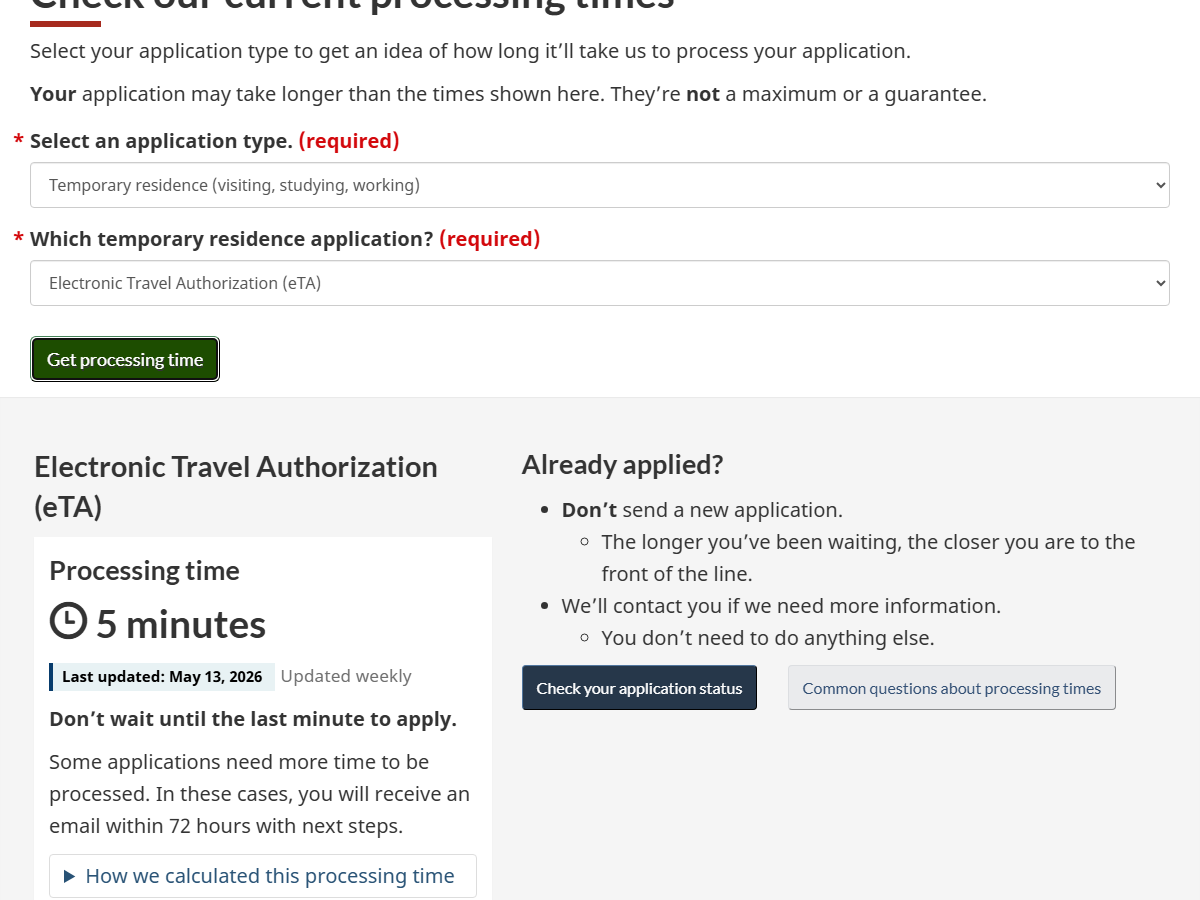
If you are a Portuguese citizen looking up the Canada visitor visa processing time, there is important news: you do not need a visitor visa. Portugal is a visa-exempt country, which means Portuguese passport holders do not apply for a Temporary Resident Visa (TRV) to travel to Canada. When traveling by air, you need an Electronic Travel Authorization (eTA) instead. It costs C$7 and processes in approximately 5 minutes.
This distinction matters because applying for the wrong document wastes time and money. A visitor visa application takes weeks and involves extensive documentation. An eTA is a short online form that most people complete and receive approval for before their browser session even times out.
eTA vs. Visitor Visa: What Portuguese Citizens Actually Need
Canada divides foreign visitors into two categories: those whose countries have a visa-exempt agreement with Canada, and those who do not. Citizens of visa-exempt countries skip the visitor visa entirely. Portuguese citizens fall into the visa-exempt category.
The Temporary Resident Visa (TRV), often called a visitor visa, is the document required by citizens of countries like Brazil, India, China, and the Philippines. It involves a detailed application with financial documentation, evidence of ties to your home country, and processing times measured in weeks. It is not what Portuguese citizens need.
The Electronic Travel Authorization is the correct document for Portuguese citizens flying to Canada. It serves a similar function at a fraction of the time and cost. It is linked electronically to your passport, verified automatically when you check in for your flight, and requires no visits to a visa application centre or embassy.
The one situation where neither document is required: if you enter Canada by land or sea (for example, driving across the border from the United States), a valid Portuguese passport is sufficient on its own. The eTA requirement applies only to air travel.
How to Apply for an eTA
The eTA application is completed entirely online through the Government of Canada's official website. There is no separate app, no third-party portal, and no in-person component. Here is what the process looks like.
Go to canada.ca/eTA to start the application. You will need your Portuguese passport, an email address, and a credit or debit card to pay the C$7 fee. The form asks for basic personal information: your name as it appears on your passport, date of birth, passport number, expiry date, and country of citizenship. There are also a small number of eligibility questions covering topics such as criminal history and prior immigration refusals.
After submitting, most applicants receive an approval email within minutes. The email contains your eTA reference number. Keep it. You will not need to show this at the airport (the eTA is linked to your passport and verified automatically), but having the reference number on hand is useful if any questions arise at check-in or at the border.
IRCC recommends applying at least 72 hours before your departure. While most approvals arrive in minutes, a portion of applications go to additional review and can take longer. Applying a few days early eliminates any risk of a last-minute delay.
What the eTA Allows
An approved eTA is valid for 5 years from the date of issue, or until your passport expires, whichever comes first. If you renew your passport, you will need to apply for a new eTA linked to the new passport, even if the original eTA has not yet expired.
During its validity, the eTA allows multiple entries to Canada. You do not apply again for each trip. Each time you fly to Canada, the airline reads your passport at check-in and confirms that a valid eTA is linked to it.
Each individual stay in Canada is authorized for up to 6 months, unless the border officer at the port of entry grants a different period. The officer has discretion to admit you for less than 6 months if there are reasons to do so, or to grant an extension in certain circumstances. You do not need to declare a specific departure date when you arrive.
One clarification worth noting: the eTA authorizes you to travel to a Canadian port of entry and request admission. The CBSA officer at the airport makes the final determination on whether you are admitted and for how long. The eTA itself does not guarantee entry.
Traveling by Land or Sea: No eTA Required
The eTA is an air-travel requirement. If you are entering Canada by land (for example, driving from the United States) or by sea (arriving by cruise ship or ferry), you do not need an eTA. Your valid Portuguese passport is the only travel document required at the land or sea border crossing.
If your trip involves both flying to the United States and then driving into Canada, the eTA is not required for the land crossing into Canada. However, if at any point you take a domestic or connecting flight that lands at a Canadian airport, the eTA applies to that flight.
If Your eTA Application Goes to Additional Review
The eTA system processes the majority of applications automatically. When the system flags an application for a closer look, IRCC routes it to a manual review. In those cases, IRCC advises applicants to expect an email within 72 hours, either approving the eTA or requesting additional information.
Reasons an application may go to additional review include passport data inconsistencies, prior refusals or immigration enforcement history, certain travel history patterns, or inadmissibility questions raised by the eligibility questions on the form.
If your application is under review, do not submit a second application. Duplicate applications do not accelerate the review and can create complications with your file. Wait for the 72-hour email from IRCC. If 72 hours pass with no communication, check your spam folder before taking any other action.
A manual review is not a refusal. Most applications that enter review are ultimately approved.
Working or Studying in Canada: eTA Is Not Enough
The eTA authorizes tourism, visiting family or friends, short business trips, and similar temporary activities. It does not authorize you to work or study in Canada.
If you want to work in Canada, you need a work permit. The type of work permit you would need depends on your situation: whether you have a job offer, the NOC code of the position, whether the employer has an LMIA, and other factors.
One pathway worth knowing about for Portuguese citizens: Canada and Portugal participate in the International Experience Canada (IEC) program. If you are a Portuguese citizen under 35 (in some categories under 30), you may be eligible for a Working Holiday visa, which allows you to live and work in Canada for up to 24 months. This is a separate program from the eTA and requires its own application. IEC applications open in pools throughout the year.
If you want to study in Canada, you need a study permit. Short courses of 6 months or less may be exempt from the study permit requirement, but any program longer than 6 months requires a permit regardless of your eTA status.
If your plans go beyond tourism, book a consultation to understand what permits apply to your situation before you travel.
Extending Your Stay Inside Canada
If you are already in Canada and want to stay beyond the period authorized at entry, you can apply for a visitor record extension from inside Canada. This must be submitted before your current authorized stay expires.
The application is submitted online through your IRCC secure account. You will need to show that you have maintained valid status throughout your stay, that you have sufficient funds to support yourself, and that you have reasons to remain in Canada temporarily rather than permanently. The same ties-to-home considerations that apply to visitor visa applicants apply here as well.
If you apply for an extension before your current status expires, you are generally allowed to remain in Canada while the application is pending, even if the original authorized period ends. This is called "maintained status." Do not let your status lapse before applying.
Portuguese Citizens and Canada: A Note on Connections
Canada has one of the largest Portuguese diaspora communities in the world, concentrated primarily in Ontario. The Toronto area, particularly areas like Mississauga and the Kiiwanis Park neighbourhood, has deep-rooted Portuguese communities that have been established for generations. Many Portuguese citizens traveling to Canada are visiting family members who settled here decades ago or who immigrated more recently.
This is relevant to your eTA application only in that having family in Canada is a neutral factor, not a negative one. Officers reviewing eTA applications do not treat family connections in Canada as a reason to flag an application. The eTA process is automated and does not involve an officer reviewing your purpose of visit in the same way a visitor visa application does.
Already Applied and Waiting?
Applied through Up Immigration? We're already watching.
Our team monitors every active application on a regular basis. If IRCC requests documents, updates your portal status, or issues a decision, you will hear from us first.
If you applied on your own and your eTA has not arrived, check your spam folder first. IRCC emails can be filtered by some providers. If the email is not there and 72 hours have passed since submission, you can contact IRCC directly through the IRCC web form with your application number and the email address used on the form.
Summary: What Portuguese Citizens Need to Travel to Canada
Portuguese citizens flying to Canada need an eTA. It costs C$7, is applied for online, and is approved in approximately 5 minutes for most applicants. It is valid for 5 years and allows multiple entries with stays of up to 6 months each. No visitor visa is required. No embassy visit. No biometrics for the eTA itself.
Apply at least 72 hours before your flight to account for the possibility of additional review. Keep the confirmation email with your eTA number. And if your plans involve working or studying rather than visiting, separate permits are required.
If you have questions about your specific situation, including prior immigration history, work or study plans, or extending a current stay, book a consultation with our team.
Information current as of May 2026. Always verify at the IRCC processing times tool or with a regulated immigration consultant before traveling.