
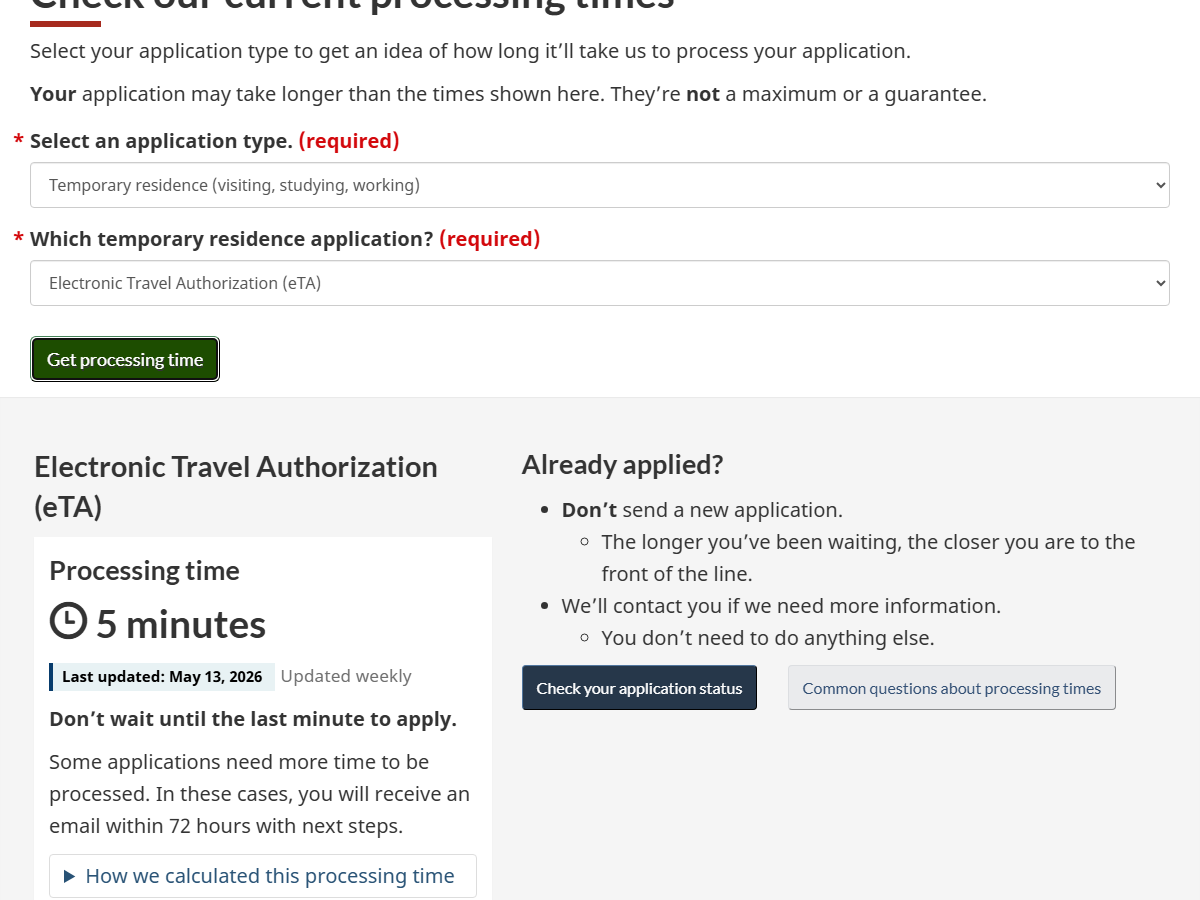
If you are a Spanish citizen searching for the Canada visitor visa processing time, here is what you need to know first: you do not need a visitor visa. Spain is a visa-exempt country, which means Spanish passport holders are not required to apply for a Temporary Resident Visa (TRV) to travel to Canada. When flying to Canada, you need an Electronic Travel Authorization (eTA) instead. It costs C$7 and processes in approximately 5 minutes for most applicants.
Applying for a visitor visa when you only need an eTA means going through a weeks-long process unnecessarily. Understanding which document applies to you before you start saves time, money, and confusion.
eTA vs. Visitor Visa: What Spanish Citizens Actually Need
Canada's entry requirements divide foreign nationals into two groups: citizens of visa-exempt countries, and citizens of countries that require a Temporary Resident Visa. Spanish citizens are in the visa-exempt group.
The Temporary Resident Visa (TRV) is the document required by citizens of countries such as Brazil, India, China, Mexico, and the Philippines. It involves a full application with financial documentation, evidence of ties to your home country, and processing times that can stretch to several weeks or months. Spanish citizens do not go through this process.
The Electronic Travel Authorization is what Spanish citizens need when flying to Canada. It is linked electronically to your passport and verified automatically when you check in for your flight. There is no embassy appointment, no biometrics requirement, and no document package to assemble.
One exception applies: if you travel to Canada by land (driving across from the United States) or by sea, you do not need an eTA. A valid Spanish passport is sufficient at land and sea border crossings. The eTA requirement is specific to air travel.
How to Apply for an eTA
The entire eTA application is completed online through the Government of Canada's official website. There is no third-party portal and no in-person step. Here is how the process works.
Go to canada.ca/eTA to begin. You will need your Spanish passport, an email address, and a credit or debit card to pay the C$7 fee. The form collects basic information from your passport: your name, date of birth, passport number, expiry date, and country of citizenship. It also includes a small set of eligibility questions covering topics such as criminal history and prior immigration refusals from Canada or other countries.
Once submitted, most applicants receive an approval email within minutes. That email contains your eTA reference number. Keep it. The eTA itself is linked to your passport and is verified automatically at check-in, so you do not need to print or present the email at the airport. But having the reference number available is useful if questions arise.
IRCC recommends applying at least 72 hours before your flight. Although approvals typically arrive in minutes, some applications go to additional review and can take longer. Applying a few days before you travel removes any risk of a delay affecting your departure.
What the eTA Allows
An approved eTA is valid for 5 years from the date of issue, or until your passport expires, whichever comes first. If your passport expires in 2 years, your eTA expires then too. When you renew your passport, you will need to apply for a new eTA tied to the new passport number, even if the old eTA still has years remaining on it.
The eTA permits multiple entries to Canada within its validity period. You apply once and use it for every flight to Canada until it expires. There is no per-trip renewal.
Each stay in Canada is authorized for up to 6 months, unless the border officer at the airport grants a different period at the time of entry. Officers have discretion to admit you for less than 6 months if circumstances warrant, or to authorize a shorter period based on the trip you describe. You are not required to declare a specific departure date when you arrive.
The eTA is an authorization to travel to a Canadian port of entry and request admission. The CBSA officer at the airport makes the final decision on whether you are admitted and for how long. An approved eTA does not guarantee entry into Canada.
Traveling by Land or Sea: No eTA Required
If you are entering Canada by land, such as driving from the United States, or by sea, such as arriving on a cruise ship or ferry, the eTA is not required. A valid Spanish passport is the only travel document you need at land and sea border crossings.
If your itinerary involves flying to the United States and then crossing into Canada by car, the eTA requirement does not apply to that land crossing. If, however, any part of your travel involves a flight that lands in Canada, including a connection through a Canadian airport on your way to another destination, the eTA applies to that air segment.
If Your eTA Application Goes to Additional Review
Most eTA applications process automatically and arrive in minutes. A portion are routed to manual review. When this happens, IRCC advises that applicants should expect an email within 72 hours, either approving the eTA or requesting additional information or documents.
Common reasons an application may be flagged include passport data inconsistencies, prior immigration history with Canada or other countries, certain inadmissibility questions on the form, or patterns that trigger IRCC's screening protocols. A review is not a refusal. Most applications that enter manual review are ultimately approved.
If your application is under review, do not submit a second application. Duplicate applications do not speed anything up. They create conflicting files and can complicate your original application. Wait for IRCC's email response.
If 72 hours have passed with no communication, check your spam folder before contacting IRCC. Government email addresses are sometimes filtered by email providers. If the email is genuinely missing, contact IRCC through their official web form with your application number and the email address you used.
Working or Studying in Canada: eTA Is Not Enough
The eTA covers tourism, visiting family or friends, attending short conferences, and similar temporary non-work, non-study activities. It does not authorize employment or enrollment in a program of study.
If you want to work in Canada, you need a work permit. The right type of work permit depends on your situation: whether you have a job offer, the nature of the work, and other factors specific to your case.
One pathway particularly relevant to Spanish citizens: Canada and Spain participate in the International Experience Canada (IEC) program. Spanish citizens under 35 may be eligible for a Working Holiday work permit, which allows you to live and work in Canada for up to 24 months without being tied to a specific employer. This is a separate and much more involved application than the eTA. IEC applications open in pools throughout the year and spaces fill quickly. If you are considering a working holiday in Canada, start the process early.
Many Spanish citizens travel to Canada first on a tourist eTA to explore the country before deciding whether to pursue a working holiday or other longer-term pathway. That is a reasonable approach, as long as you understand that the eTA alone does not permit you to work during that visit.
If study is part of your plans, a study permit is required for any program longer than 6 months. Shorter courses may be exempt from the permit requirement, but anything beyond 6 months requires a study permit regardless of your eTA status.
If your plans go beyond tourism, book a consultation to understand what applies to your specific situation.
Extending Your Stay Inside Canada
If you are in Canada and want to stay beyond the period authorized when you entered, you can apply for a visitor record extension from inside Canada. This application must be submitted before your current authorized period expires.
The extension application is submitted online through your IRCC secure account. You will need to demonstrate that you have maintained valid status, that you have sufficient funds, and that there are legitimate reasons to remain in Canada temporarily. The 6-month limit is per visit, not a hard annual cap. If you have a compelling reason to stay longer, an extension is the path to take.
If you apply before your authorized period ends, you are generally permitted to remain in Canada while the extension application is under review, even if the original period expires during that time. This is called maintained status. Do not delay in filing if you think you may want to extend.
Spain and Canada: Tourism, Working Holidays, and Growing Connections
Spain consistently ranks among the top sources of visitors to Canada from Europe. Travel between the two countries covers tourism, family visits, working holidays through IEC, and increasingly, longer-term immigration pathways for Spanish professionals and skilled workers.
For Spanish citizens visiting purely as tourists, the eTA makes Canada one of the more accessible long-haul destinations: no visa application, no embassy appointment, no weeks of waiting. A C$7 fee and a 5-minute form stand between you and a trip to cities like Vancouver, Toronto, Quebec City, or destinations like Banff and the Canadian Rockies.
If your interest in Canada extends beyond tourism, whether through IEC, a work permit, or longer-term immigration, the eTA visit is often a good starting point for understanding the country before committing to a longer process.
Already Applied and Waiting?
Applied through Up Immigration? We're already watching.
Our team monitors every active application on a regular basis. If IRCC requests documents, updates your portal status, or issues a decision, you will hear from us first.
If you applied on your own and have not received your eTA confirmation, check your spam or junk folder first. If it is not there and more than 72 hours have passed, contact IRCC through the IRCC web form with your application number and the email address used in the application.
Summary: What Spanish Citizens Need to Travel to Canada by Air
Spanish citizens flying to Canada need an eTA. Not a visitor visa. The eTA costs C$7, is applied for online in a few minutes, and is approved in approximately 5 minutes for most applicants. It is valid for 5 years, covers multiple entries, and authorizes stays of up to 6 months per visit.
Apply at least 72 hours before your flight. Keep the confirmation email. If your plans involve working or studying rather than visiting, separate permits are required, and an RCIC can help you understand the right pathway.
If you have questions about your specific situation, whether that is a prior immigration issue, work permit eligibility, or an IEC Working Holiday application, book a consultation with our team.
Information current as of May 2026. Always verify at the IRCC processing times tool or with a regulated immigration consultant before traveling.