
Most eTA approvals arrive in about 5 minutes. According to IRCC's processing times tool as of May 13, 2026, the published processing time for an Electronic Travel Authorization is 5 minutes. For the majority of applicants, that means submitting the online form and receiving a confirmation email before they have even closed the browser tab. But some applications take up to 72 hours, and a small number require additional review beyond that. This article explains who needs an eTA, what the two outcomes look like, and what to do if yours is taking longer than expected.
Who Needs an eTA (and Who Does Not)
The eTA requirement creates more confusion than almost any other step in Canadian travel, because the rules depend entirely on your passport, how you are traveling, and your destination within Canada.
You need an eTA if:
- You hold a passport from a visa-exempt country and you are flying to Canada.
- Common examples include citizens of the United Kingdom, Australia, France, Germany, Japan, South Korea, and dozens of other countries that have a visa-exempt agreement with Canada.
- You are transiting through a Canadian airport on the way to another destination.
You do not need an eTA if:
- You are a US citizen. American passport holders do not need an eTA or a visitor visa to enter Canada. They enter with their US passport alone.
- You hold a Canadian citizenship or permanent residence document.
- You are entering Canada by land or sea. The eTA requirement applies only to air travel. Driving across the border does not trigger it.
- Your country requires a Temporary Resident Visa (TRV) to enter Canada. Citizens of countries like Brazil, India, China, and the Philippines are not visa-exempt, so they apply for a TRV, not an eTA. If you are unsure which category your passport falls under, check IRCC's official list here.
A significant number of applications are filed by people who either do not need an eTA or who should have applied for a TRV instead. Applying when you are not required to does not cause legal problems, but it creates unnecessary confusion and a paper trail. Make sure you are applying for the right document before you start.
How to Check the Current eTA Processing Time
IRCC updates processing times on an ongoing basis. The number can shift. The only reliable source is the official tool.
- Go to the IRCC processing times tool.
- Under "What type of application is it?", select Temporary residence (visiting, studying, working).
- Under "What application are you checking?", select Electronic Travel Authorization (eTA).
- Click "Get processing time."
Below is a screenshot of the tool taken in May 2026.
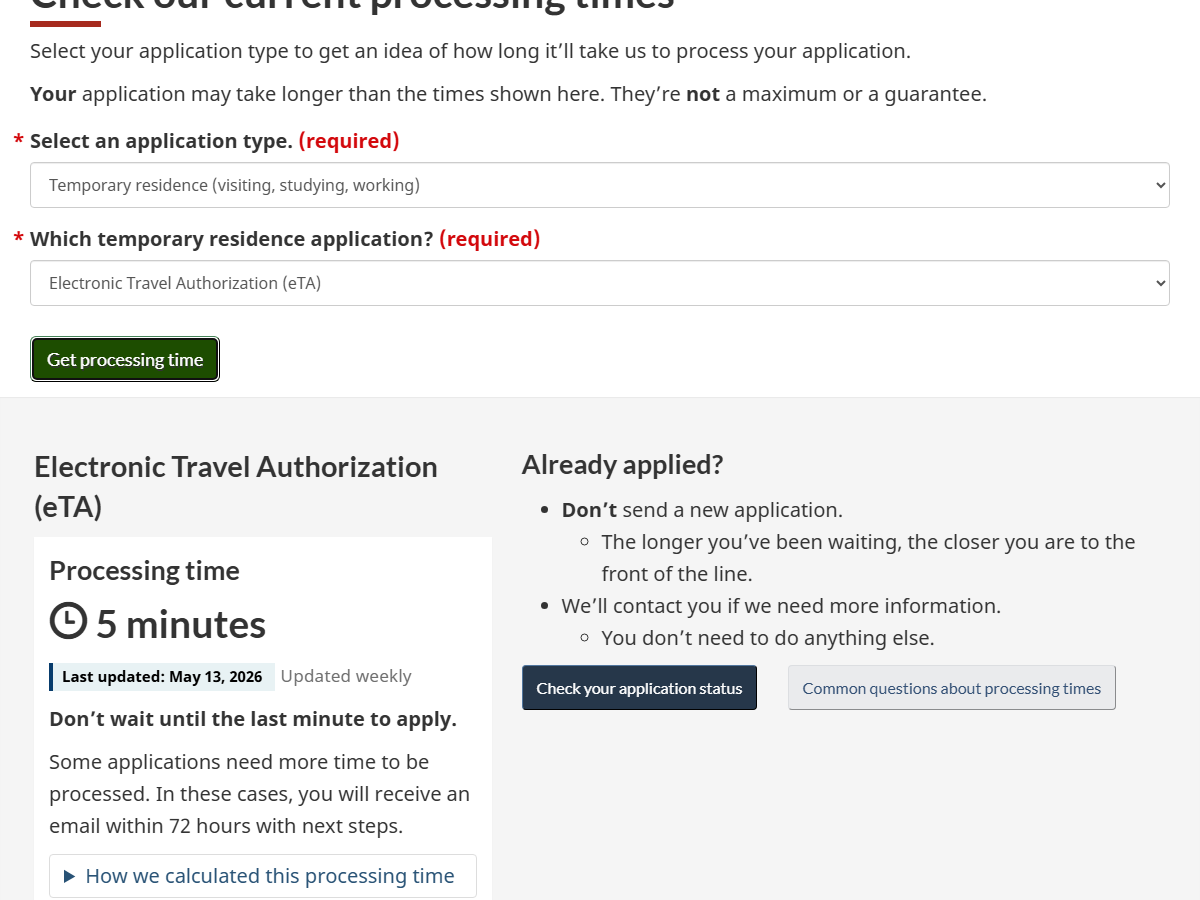
The result: 5 minutes for Electronic Travel Authorization applications as of May 13, 2026.
The 5-Minute Approval vs. the 72-Hour Review
The eTA system runs on automated processing. When you submit your application, the system checks your passport data against IRCC's databases almost instantly. If nothing requires a closer look, your eTA is approved and linked to your passport within minutes. You receive a confirmation email with your eTA reference number, and that is it.
A subset of applications does not clear the automated check. In those cases, IRCC routes the file to a manual review. IRCC's own guidance says: "Don't wait until the last minute to apply. Some applications need more time to be processed. In these cases, you will receive an email within 72 hours with next steps."
The two practical timelines are:
- Most applicants: Approval in approximately 5 minutes, confirmation by email.
- Some applicants: An email within 72 hours explaining that additional review is needed, with instructions on what to submit or expect next.
If your application enters manual review, do not reapply. Submitting a second application while one is already in the system does not speed anything up. It creates duplicate files, which can slow your original application and cause confusion at the border. Wait for the email IRCC promised.
Why Some eTAs Go to Manual Review
The automated system flags applications for human review based on the data it receives. Common reasons include:
- Passport data issues. Typos, mismatched names between the application and the passport, or a passport that was recently renewed and has not fully propagated through systems.
- Travel history. Prior visits to certain countries or patterns in travel history that trigger secondary screening protocols.
- Previous immigration history with Canada. Prior refusals, overstays, or enforcement actions connected to the passport or the applicant's profile.
- Criminal record flags. Even minor convictions in some jurisdictions can trigger a review under Canadian inadmissibility rules.
- Nationality and security screening. Passports from certain countries carry additional screening requirements regardless of the individual's profile.
A manual review is not a refusal. The majority of applications that go to manual review are ultimately approved. It simply means an officer is taking a closer look before issuing the authorization.
What an Approved eTA Looks Like
Your eTA is not a stamp in your passport and it is not a separate physical document. It is an electronic record that IRCC links directly to your passport number. When you check in for your flight to Canada, the airline's system verifies your eTA automatically by reading your passport. If the eTA is valid, boarding proceeds normally.
What you receive when approved:
- A confirmation email from IRCC containing your eTA reference number. Keep this email.
- The eTA is valid for 5 years from the date of issue, or until your passport expires, whichever comes first. If your passport expires in 2 years, your eTA expires then too.
- It allows multiple entries to Canada throughout its validity period. You do not need to apply again for each trip.
- Each stay in Canada is authorized for up to 6 months, unless a border officer grants a different period at the time of entry.
One important note: the eTA authorizes you to travel to a port of entry and request admission to Canada. The border officer at the airport makes the final decision on whether you are admitted and for how long. The eTA itself does not guarantee entry.
What to Do If You Have Not Heard Back After 72 Hours
If 72 hours have passed since you submitted your eTA and you have not received either an approval confirmation or an email asking for more information, take these steps in order:
- Check your spam or junk folder. IRCC emails from a government address and some email providers route them automatically to spam. This is the most common reason people think they have not received a response.
- Check the email address you used in the application. If you have multiple email accounts, confirm you are checking the one entered on the form.
- Contact IRCC directly. You can reach IRCC's client support through the IRCC web form or by phone. Reference your application number when you contact them.
Do not submit a new application while an existing one is pending. Wait for a definitive response on your current application before taking any other action.
eTA vs. Visitor Visa (TRV): The Quick Distinction
If you do not hold a passport from a visa-exempt country, you cannot apply for an eTA. You need a Temporary Resident Visa (TRV), sometimes called a visitor visa, to enter Canada.
The two documents serve the same purpose (authorizing temporary entry to Canada as a visitor) but apply to different passport holders. The TRV requires a much more detailed application with financial documentation, ties to your home country, and proof of the purpose of your visit. It also takes weeks, not minutes, to process.
Citizens of countries including Brazil, India, China, the Philippines, Mexico, and most of Africa and the Middle East require a TRV. If you are unsure which applies to you, check IRCC's entry requirements page before applying for anything.
For a full breakdown of the visitor visa process, read our Visitor Visa Guide.
Ready to Apply or Have Questions?
For most applicants, the eTA is a 5-minute self-serve process. Apply online at least a few days before your flight, keep the confirmation email, and you are set.
If your application has been delayed, flagged for review, or refused, or if your situation involves a prior immigration issue or criminal record, it is worth speaking with a regulated consultant before you travel. Book a consultation with our team if you have questions about your specific situation.
Information current as of May 2026. Always verify at the IRCC processing times tool or with a regulated immigration consultant.