
The IRCC processing times tool currently shows about 33 months for parents and grandparents sponsorship applications submitted outside Quebec. For a file opened in January 2026, there are approximately 32 months remaining. About 43,500 people are currently waiting for a decision on their PGP application.
That is a long timeline, and it raises a lot of questions about what the process actually involves, why it takes this long, and what sponsors and sponsored persons can do in the meantime. This article breaks down the PGP process, what the 33-month figure covers, and the most common sources of delay.
How the Parents and Grandparents Program Works
The Parents and Grandparents Program (PGP) is a permanent residence pathway for Canadian citizens and permanent residents who want to sponsor their parents or grandparents to live in Canada permanently. Unlike some other sponsorship categories, PGP intake is capped each year. IRCC sets a limit on how many complete applications it will accept, typically in the range of 15,000 to 23,500 per year depending on government targets.
Because demand far exceeds the annual cap, IRCC manages access through an invitation system. The process has two stages.
Stage 1: Interest to sponsor. Sponsors submit an online form expressing interest in sponsoring their parent or grandparent. IRCC randomly selects from the pool of eligible interests to sponsor and sends out invitations to apply (ITAs). Submitting an interest to sponsor does not guarantee an invitation, and the wait for an ITA can itself span multiple years depending on the annual pool and selection rate.
Stage 2: Complete application. Once a sponsor receives an ITA, they submit the full sponsorship package. This includes the sponsor's financial information, the sponsored person's identity documents, the relationship proof, and medicals for the sponsored person. The 33-month processing time shown on the IRCC tool refers to this stage. It is measured from the Acknowledgement of Receipt (AOR) date of the Stage 2 application, not from the date of the original interest to sponsor submission.
This distinction matters. The 33 months does not represent your total wait from first expressing interest. It represents the processing time once IRCC has your complete application in hand.
How to Check Your PGP Processing Time
- Go to the IRCC processing times tool.
- Select Family sponsorship.
- Select Parents or grandparents.
- Select Outside Quebec (or Quebec if applicable — see below).
- Select Yes under "Have you already applied?"
- Enter the year and month you submitted your Stage 2 application.
- Click "Get processing time."
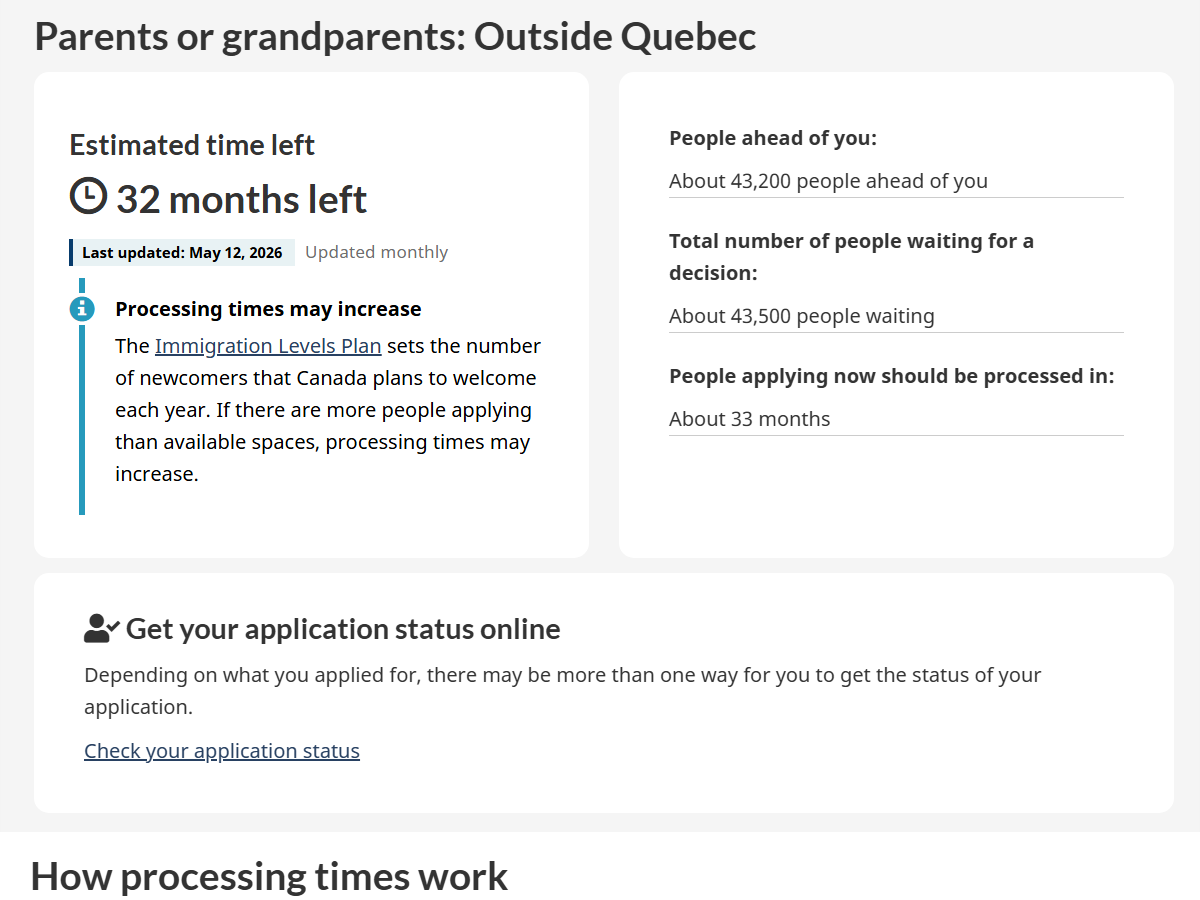
As of May 2026, applicants who submitted their Stage 2 application in January 2026 have approximately 32 months remaining. There are about 43,200 people ahead of a January 2026 applicant in the queue, with 43,500 total waiting for a decision across all submission dates.
What the 33 Months Covers
The 33-month estimate covers both sides of the file: the sponsor's assessment and the sponsored person's assessment. IRCC processes both simultaneously in most cases, which is part of what makes PGP applications more complex than some other sponsorship categories.
Sponsor side. IRCC reviews the sponsor's income against the minimum income threshold set by the federal government requirement, checks the sponsor's immigration history and admissibility, and verifies that the sponsor has not defaulted on any previous sponsorship undertaking.
Sponsored person side. The sponsored parent or grandparent undergoes a medical examination, biometrics collection, and background checks including police certificates from all countries of residence since age 18. If the sponsored person is elderly and has a medical history, the medical review stage can take longer than for younger applicants.
The clock starts at the AOR date: the date IRCC confirms they received the complete Stage 2 application. Incomplete applications are returned, do not receive an AOR, and must be resubmitted, which resets the clock.
Quebec Residents: An Important Difference
If the sponsor lives in Quebec, the 33-month figure shown for outside Quebec does not apply to your file. Quebec has jurisdiction over the selection of immigrants who intend to settle in the province, which means PGP applications where the sponsor is a Quebec resident involve an additional provincial stage.
After IRCC approves the sponsor and the sponsored person meets federal admissibility requirements, the file goes to the Quebec government for a provincial assessment. Quebec must issue a Quebec Selection Certificate (CSQ) before the federal process can be completed. This adds significant time to the total process.
The IRCC processing times tool shows a separate estimate for Quebec applications. If you or your sponsor live in Quebec, use that figure rather than the outside-Quebec number. The total timeline including the provincial stage is substantially longer than 33 months.
Income Requirement for Sponsors
One of the most important eligibility requirements for PGP sponsors is meeting the financial threshold. Sponsors must demonstrate income at or above the minimum income threshold set by the federal government plus a 30% buffer. The exact dollar figure depends on family size, which includes the sponsor's household as well as the sponsored parent(s) or grandparent(s) who will be added to the family unit once the application is approved.
The income assessment is based on the sponsor's Notice of Assessment (NOA) from the Canada Revenue Agency, covering the three most recent tax years. All three years must meet the threshold. If the sponsor's income dropped below the requirement in any one of those years, the application may not qualify.
There is an additional complication. A sponsorship undertaking is a binding legal obligation that lasts up to 20 years for parents and grandparents. If the sponsor's financial situation changes significantly between submission and final approval, IRCC may revisit the income assessment. Sponsors who experience a job change, a reduction in hours, or a period of unemployment during the processing period should monitor their income carefully and get professional advice if their situation changes.
What Can Delay a PGP File
Thirty-three months is the current baseline. Some files take longer. The most common causes of delay in PGP applications are worth understanding before you submit.
Medical inadmissibility. Older sponsored persons are more likely to have existing health conditions that trigger a more detailed medical review. If IRCC's designated medical practitioner identifies a condition that might place an excessive demand on Canada's health or social services, the sponsored person receives a procedural fairness letter and has the opportunity to respond. This process can add several months.
Income documentation inconsistencies. If the sponsor's reported employment income does not align with the NOA for the same year, or if there are unexplained discrepancies between T4s and the tax return, IRCC may request additional documents or flag the file for closer review.
Criminal history. Any criminal history on the part of the sponsor or the sponsored person, regardless of how long ago or where in the world it occurred, must be fully disclosed. Undisclosed history discovered during background checks can result in refusal for misrepresentation, which carries a consequence beyond the single application.
Prior immigration history of the sponsored person. If the parent or grandparent was previously refused a visa to Canada or another country, or was previously removed or deported from any country, those facts must be disclosed and will be reviewed by an officer. Prior refusals do not automatically disqualify an application but they do require explanation.
Expired or missing documents. Police certificates are particularly problematic in PGP applications because they have short validity periods (often 3 to 6 months depending on the issuing country) and the sponsored person may have lived in multiple countries. A certificate that was valid at the time of submission may expire during the processing period, and IRCC can request updated certificates mid-file.
Name discrepancies. Older sponsored persons, particularly those from countries where transliteration of names was not standardized, often have multiple versions of their name across different documents. If the name on the passport does not match the name on a birth certificate, marriage certificate, or prior travel document, the inconsistency must be explained and supported with evidence.
Applied through Up Immigration? We're already watching.
Our team monitors every active application on a regular basis. If IRCC requests documents, updates your portal status, or issues a decision, you will hear from us first.
Super Visa as an Alternative While Waiting
A 33-month processing time is a long separation. Parents and grandparents who want to visit Canada while the sponsorship application is in process can apply for a Super Visa, a multiple-entry temporary resident visa that allows stays of up to 5 years per entry without the need to renew status.
To qualify for a Super Visa, the Canadian child or grandchild must demonstrate that their income meets the minimum income threshold threshold, which is the same income threshold used in the sponsorship itself. The sponsored person must also have Canadian medical insurance coverage for at least one year.
Super Visa processing time is currently much shorter than PGP, roughly 30 days from application to decision in most cases. The Super Visa is a temporary status only. It does not provide a path to permanent residence on its own, and holding a Super Visa does not affect the processing of the sponsorship application in any way. It simply allows the parent or grandparent to be physically present in Canada during the wait.
One practical consideration: if a sponsored person enters Canada on a Super Visa while their PGP application is in process, they need to maintain valid temporary status throughout. Allowing status to lapse creates an admissibility issue that can complicate the landing process once the PGP is approved.
Getting the PGP Application Right
PGP applications involve careful income documentation across three tax years, coordinated document collection across two countries (and sometimes more, if the sponsored person has lived in multiple countries), and close attention to the sponsor's ongoing eligibility throughout a 33-month processing window. A file that qualifies at submission can run into problems if the sponsor's circumstances change and no one is watching.
If you want a review of your sponsorship situation before submitting, or if you have questions about your specific income eligibility, the documents required for your parent's or grandparent's background, or how a prior refusal might affect the application, book a consultation. Larissa reviews PGP files carefully and will give you a clear picture of where your file stands before it goes to IRCC.