
Spousal sponsorship for a spouse or common-law partner living inside Canada is currently running at about 25 months outside Quebec. That is the figure from the IRCC processing times tool as of May 2026, for applications submitted in January 2026.
If you are in the middle of this process and that number feels long, it is. Spousal sponsorship inside Canada is one of the slower immigration pathways, largely because the file goes through two separate assessments: one for the sponsor and one for the sponsored person. This article explains what those 25 months actually cover, how the inside-Canada and outside-Canada streams differ, what Quebec applicants face, and what most commonly delays these files.
Inside Canada vs. Outside Canada Sponsorship
Spousal sponsorship has two distinct streams depending on where the sponsored person is living when the application is submitted. The processing times, forms, and in some cases the evidence requirements differ between them.
Inside Canada (inland sponsorship) is what this article covers. The sponsored person is physically in Canada when the application is submitted. They may be on a valid work permit, study permit, or visitor record. In some cases, they may have no current status at all. The application is processed by the Case Processing Centre in Sydney, Nova Scotia, and results in a permanent resident status decision without requiring the sponsored person to leave Canada.
Outside Canada (outland sponsorship) is the stream for spouses who are abroad. They go through a visa office in their home country or a designated regional processing centre, travel to Canada after approval, and land as a permanent resident on arrival. Outland processing times are tracked separately in the IRCC tool and are not covered by the 25-month figure in this article.
If your spouse is currently in Canada and your application was submitted while they were here, you are in the inland stream and the 25-month figure is the relevant benchmark.
How to Check Your Spousal Sponsorship Processing Time
- Go to the IRCC processing times tool.
- Select Family sponsorship.
- Select Spouse or common-law partner living inside Canada.
- Select Outside Quebec.
- Select Yes under "Have you already applied?"
- Enter the year and month you submitted your application.
- Click "Get processing time."
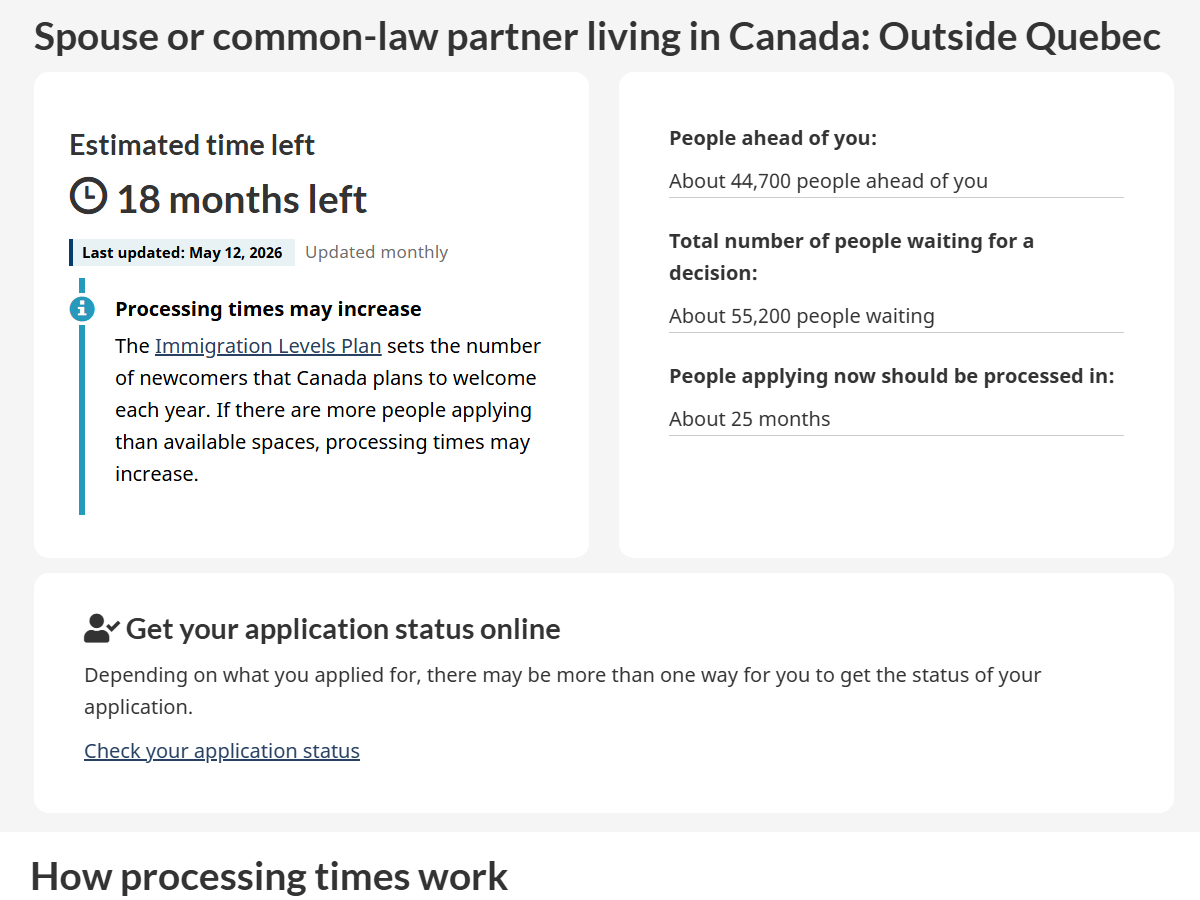
The tool reflects a current snapshot. Processing times shift as IRCC receives new applications, staffing levels change, and policy priorities evolve. The 25-month figure is based on how long it has taken IRCC to process 80 percent of applications submitted in January 2026, as of this writing.
What the 25 Months Actually Covers
The inland spousal sponsorship application is one package submitted by both the sponsor and the sponsored person together, but IRCC reviews it in two distinct stages. Both stages happen within the same file, but the sequence matters for understanding where your file is at any given time.
Stage 1: Sponsor assessment. IRCC first reviews whether the sponsor is eligible to sponsor. The sponsor must be a Canadian citizen or permanent resident, be 18 years of age or older, not be in default of any previous sponsorship undertaking, not be receiving social assistance (with some exceptions), and not have any disqualifying criminal convictions. This stage is typically shorter than Stage 2, often resolved within several months, but it must clear before Stage 2 begins in earnest.
Stage 2: Sponsored person's application. This is where most of the 25 months is spent. The sponsored person's eligibility for permanent residence is assessed, including admissibility reviews for medical, criminal, and security grounds. Biometrics are collected if not already on file. A medical examination is required and must be conducted by a panel physician designated by IRCC. Police certificates are required from every country where the sponsored person has lived for 6 months or longer since age 18. Relationship evidence is reviewed by an officer to assess whether the relationship is genuine and not entered into primarily for immigration purposes.
There is no single queue for these reviews. Different checks run in parallel where possible, but a hold on any one of them pauses the overall clock.
Maintained Status While Waiting
One of the most practically important aspects of the inland sponsorship process is maintained status, sometimes called implied status or status pending renewal.
If the sponsored person was in Canada on a valid temporary permit (work permit, study permit, or visitor record) and applied to extend or change that status before it expired, they are generally allowed to remain in Canada under the same conditions while the extension is being processed. This is not a new status but a continuation of the existing one.
For spouses who are in Canada on an open work permit or a closed work permit, maintaining that work authorization is often a priority during the 25-month wait. Some inland spousal sponsorship applicants are eligible to apply for an Open Work Permit (OWP) as part of the same application package, allowing the sponsored person to work for any employer in Canada while the PR application is pending. This OWP is specifically available for inland spousal applicants and is processed separately from the main file.
If the sponsored person has no current status in Canada, or if their status lapsed before the sponsorship was submitted, the situation is more complex. Restoration of status or other options may need to be explored before or alongside the sponsorship application. This is a scenario where getting proper guidance before filing matters significantly.
What Quebec Applicants Face
Quebec has a distinct immigration agreement with the federal government that gives the province authority over the selection of immigrants settling in Quebec. For spousal sponsorship applications where the couple intends to live in Quebec, there is an additional layer of processing that does not exist for the rest of Canada.
The sponsored person must obtain a Certificat de sélection du Québec (CSQ) from the Quebec government before IRCC can complete the federal permanent residence assessment. The CSQ is a provincial document confirming that Quebec accepts the sponsored person as an immigrant to the province. Applying for the CSQ requires a separate application to the Ministère de l'Immigration, de la Francisation et de l'Intégration (MIFI), the Quebec immigration ministry.
Because the federal and provincial processes do not run in parallel for this purpose, Quebec applicants face a total timeline that is longer than the 25 months shown in the IRCC tool. The IRCC tool reflects only the federal portion. The Quebec portion adds additional months on top of that, and the combined total varies depending on MIFI's current processing volumes.
If you and your spouse plan to live in Quebec, selecting "Outside Quebec" in the IRCC tool will give you a misleading number. The correct figure for Quebec applicants requires checking both IRCC and MIFI processing times together.
Conjugal Partners and Common-Law Partners
The 25-month processing time applies to spouses, common-law partners, and conjugal partners in the inland stream. The timeline is the same, but the evidence requirements differ significantly between these categories.
Spouses must provide proof of legal marriage, which means a marriage certificate recognized under the law of the country where the marriage took place, or under Canadian law.
Common-law partners must have cohabited continuously for at least 12 months in a conjugal relationship. The evidence package for common-law sponsorship typically includes proof of shared residence (lease agreements, utility bills, bank statements with the same address), combined financial evidence, and documentation of the relationship over time. IRCC scrutinizes common-law files more closely than married-couple files because there is no single document equivalent to a marriage certificate.
Conjugal partners are a narrower category used when the relationship is genuine but cohabitation was not possible due to exceptional circumstances, typically immigration barriers. Conjugal partner sponsorships are less common and require a detailed explanation and evidence of why cohabitation could not happen.
For common-law applicants in particular, the quality of the cohabitation evidence package is one of the most significant factors in how smoothly the file moves through Stage 2.
What Commonly Delays Spousal Files
Twenty-five months is the benchmark, but files can and do take longer when specific issues arise. The following are the most common sources of delay in inland spousal sponsorship files.
Gaps in relationship evidence. IRCC officers are trained to identify relationships that may not be genuine. Applications that rely on a thin evidence package, or where the evidence submitted covers only a short time span, are more likely to trigger a procedural fairness letter or an interview request. Both of those add months to the timeline.
Missing proof of cohabitation. For common-law and spousal applications alike, IRCC expects evidence that the two people actually live together. Evidence that shows two separate addresses, or that the sponsor and sponsored person do not appear to share a household in any meaningful way, will draw scrutiny.
Inconsistencies in the application. Information provided by the sponsor and information provided by the sponsored person must be consistent. Dates of when the relationship began, travel history, and prior immigration history should match across all forms. Inconsistencies, even minor ones, can result in a request for an interview or additional documentation.
Tax filings that do not reflect the relationship. In Canada, married and common-law couples are expected to file taxes as a couple once the relationship is established. If the sponsor has been filing as single for years and the sponsorship suddenly claims a long-standing marriage or common-law relationship, the tax record may appear inconsistent with the claimed relationship history.
Criminal inadmissibility. Criminal inadmissibility on the part of either the sponsor or the sponsored person can delay or prevent the sponsorship from completing. The sponsor's criminal history is reviewed in Stage 1. The sponsored person's criminal history is reviewed in Stage 2. Certain convictions are absolute bars. Others may require a Temporary Resident Permit (TRP) or Criminal Rehabilitation application before the sponsorship can proceed.
Medical holds. If the sponsored person's medical exam produces a finding that requires specialist review, the medical stage can extend well beyond the standard timeframe. IRCC will contact the sponsored person with instructions if additional information is needed.
Applied through Up Immigration? We're already watching.
Our team monitors every active application on a regular basis. If IRCC requests documents, updates your portal status, or issues a decision, you will hear from us first.
Preparing a Strong Spousal Sponsorship File
Family sponsorship applications require substantial documentation of the genuine relationship. Errors in documentation, inconsistencies between the sponsor's and sponsored person's forms, or a thin evidence package are among the most common reasons IRCC issues procedural fairness letters or requests for additional information. Both slow the file down considerably.
If you want a review of your document package before submission, book a consultation. Larissa reviews spousal sponsorship files and can identify gaps in relationship evidence, cohabitation proof, and admissibility disclosures before the file reaches an IRCC officer.