
If you are the parent or grandparent of a Canadian permanent resident or citizen, the Super Visa offers something a regular visitor visa does not: up to five years in Canada per entry, without having to apply again. Here is the current processing time data from IRCC, what that number actually means, and what it takes to get this application right.
The Super Visa is a multi-entry temporary resident visa designed specifically for parents and grandparents of Canadian PRs and citizens. Unlike a standard visitor visa, which typically permits stays of up to six months, a Super Visa allows stays of up to five years per entry and remains valid for up to 10 years. That makes it one of the most valuable temporary residence options for families who want extended time together in Canada without committing to permanent immigration.
The trade-off is documentation. A Super Visa requires significantly more supporting documents than a regular visitor visa, and the consequences of an incomplete file are the same: refusal.
For applicants from Brazil in 2026, IRCC's current published processing time is 32 days. Here is what that means in practice.
How to Check the Processing Time for Your Country
The 32-day figure above applies to applicants from Brazil. If the parents or grandparents live elsewhere, the processing time will be different. IRCC publishes country-specific estimates that are updated regularly, and checking them takes under a minute.
Steps to check:
- Go to the IRCC processing times tool.
- Under "What type of application is it?", select Temporary residence (visiting, studying, working).
- Under "What application are you checking?", select Super visa (parents or grandparents).
- Under "Where do your parents or grandparents live?", select their country of residence.
- The result shows the current estimated processing time for 80% of complete applications from that country.
Note the phrasing in step 4: IRCC asks "Where do your parents or grandparents live?" rather than "Where are you applying from?" The question is directed at the Canadian child or grandchild filling out the tool on behalf of their family member abroad.
Below is a screenshot of the tool showing the current result for applicants from Brazil.
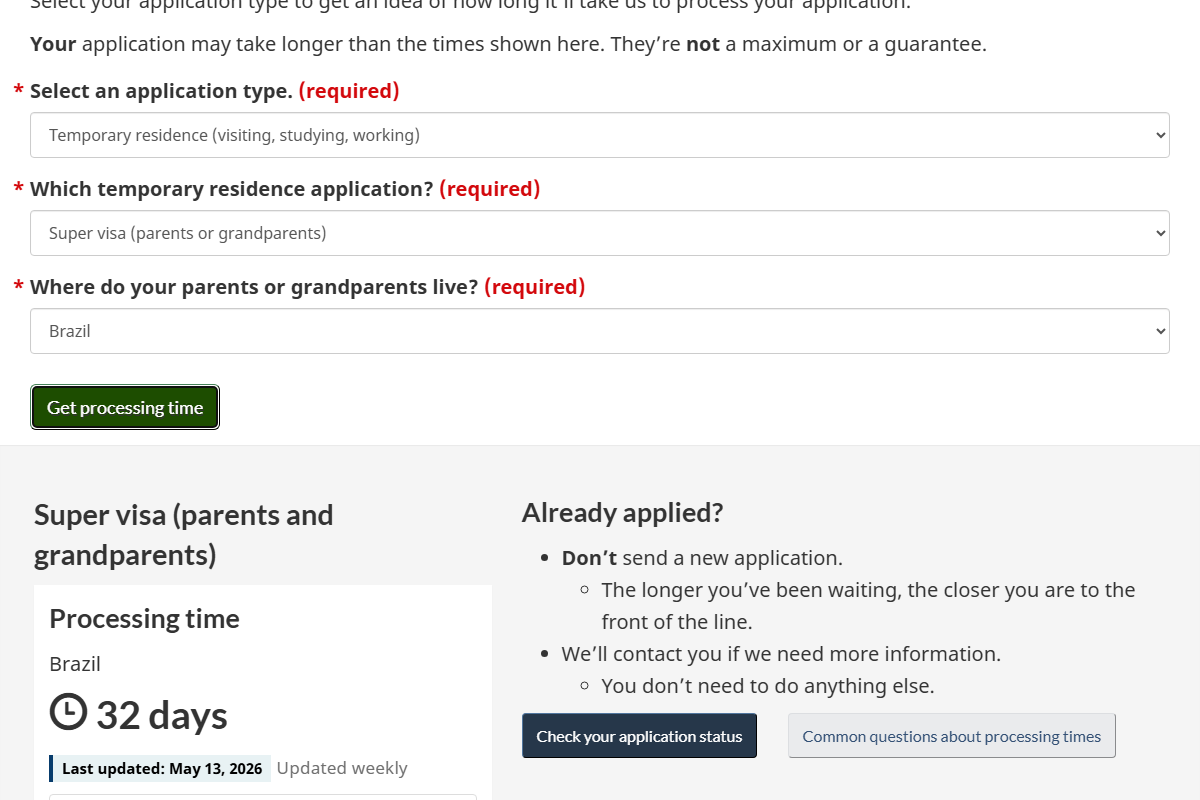
The result: 32 days for Super Visa applications from Brazil as of May 13, 2026.
What "32 Days" Actually Means
Like all IRCC processing time estimates, 32 days represents the time taken to process 80% of complete applications from Brazil in a recent period. One in five applicants will wait longer. Some will wait considerably longer.
The estimate applies only when the application arrives complete. A missing document, an inconsistency in the forms, or a biometrics appointment that is delayed can pause the clock and add weeks to the total timeline. Those pauses are not reflected in the published figure.
Compared to regular visitor visa processing from Brazil, 32 days is slightly longer. That small difference reflects the additional documents IRCC needs to review: proof of the relationship, proof of the Canadian child's or grandchild's status, and private health insurance documentation. None of those steps are difficult, but each one must be correct.
Who the Super Visa Is For
The Super Visa is exclusively for the parents and grandparents of Canadian citizens or permanent residents. It is not available to other relatives, and it is not the same as applying through the Parents and Grandparents Program (PGP), which is a pathway to permanent residence.
The applicant is the parent or grandparent, and they apply from their home country. The Canadian child or grandchild is not the applicant, but they are required to provide documentation proving their status in Canada and their ability to financially support the visiting family member.
Once approved, the Super Visa allows the parent or grandparent to enter Canada multiple times over the validity period of the visa, which can be up to 10 years. Each entry can last up to five years, and the stay can be extended from within Canada. For families who want regular extended visits rather than a permanent move, the Super Visa is the most practical option available.
Documents Required for a Super Visa
This is where the Super Visa differs most significantly from a regular visitor visa. The checklist is longer, and each category of document carries weight in the officer's assessment.
Proof of the child's or grandchild's Canadian status. This is the foundation of the application. Without confirmation that the inviting family member is a Canadian citizen or permanent resident, the application cannot proceed. Acceptable documents include a Canadian passport, citizenship certificate, or permanent resident card.
Proof of financial support. The Canadian child or grandchild must show they can financially support the visiting parent or grandparent during their stay. IRCC sets a minimum income threshold based on family size, and the supporting family member must meet or exceed it. Recent Notice of Assessment from the Canada Revenue Agency and employment documentation are typically required.
Letter of invitation from the Canadian family member. This letter should confirm the relationship, the duration of the intended visit, and the Canadian family member's commitment to supporting the visitor during their stay in Canada.
Private medical insurance. This is one of the most specific requirements of the Super Visa. The parent or grandparent must have Canadian private health insurance coverage worth at least $100,000, valid for a minimum of one year from the date of entry, purchased from a Canadian insurance provider. The policy must cover health care, hospitalization, and repatriation. A printed proof of coverage or an insurance contract must be included in the application.
Proof of relationship. Birth certificates or adoption records that establish the parent-child or grandparent-grandchild relationship must be included. Where documents are in a language other than English or French, certified translations are required.
Standard visitor visa documents. Beyond the Super Visa-specific requirements, the application still needs standard elements: a valid passport, recent photographs, completed IMM application forms, and payment of the processing fee. The applicant must also demonstrate that they have ties to their home country and will return there after their authorized stay ends.
Where Super Visa Applications Break Down
Super Visa refusal rates are higher than many applicants expect, and the reasons are almost always preventable. The most common failure points are worth reviewing before a file is submitted.
Insurance that does not meet the requirements. The $100,000 minimum coverage requirement and the one-year minimum validity are firm. Applications that include insurance with lower coverage, shorter validity, or policies from non-Canadian providers are routinely refused. Some applicants submit travel insurance that covers emergency care but excludes hospitalization, which does not satisfy the requirement.
Insufficient proof of the sponsor's financial capacity. The Canadian family member's income must meet IRCC's minimum income threshold set by the federal government threshold for their household size. Applicants who submit bank statements without an accompanying Notice of Assessment, or whose income falls below the threshold, frequently receive refusals on financial grounds.
Missing proof of relationship. An officer cannot approve a Super Visa without documentation establishing that the applicant is actually the parent or grandparent of the Canadian sponsor. Birth certificates are required, not just a letter claiming the relationship.
Weak ties to the home country. Even for a Super Visa, the officer needs to be satisfied that the visitor will return to their home country after their authorized stay. If the applicant has few demonstrable ties to Brazil, whether property, close family members, financial obligations, or other connections, the officer has limited grounds to approve the application. The length of stay permitted makes this assessment more, not less, critical.
Inconsistencies across documents. Dates of birth that differ between a passport and a birth certificate, addresses that do not match, or income figures that contradict employment letters all raise flags. These inconsistencies are often accidental, but an officer reviewing the file has no way to distinguish an error from a misrepresentation without requesting clarification, which adds time and uncertainty.
Already Applied and Waiting?
Applied through Up Immigration? We're already watching.
Our team monitors every active application on a regular basis. You do not need to log in daily or wonder if something has changed. If IRCC updates your file, requests a document, or issues a decision, we will contact you right away. No need to reach out just to ask "any news?" If there is news, you will hear from us first.
If you applied independently, you can check your application status through your IRCC secure account. Any correspondence from IRCC, including biometrics requests, document requests, and final decisions, will appear there as well as in the email address on file.
If the published processing time has passed without a decision or communication, you can submit a web form inquiry through the IRCC website. Have your application number and receipt confirmation ready before submitting.
Why Super Visa Applications Benefit Most from Professional Help
Of all the temporary residence applications available, the Super Visa is one where professional preparation has the clearest impact on outcomes. The reason is straightforward: the documentation requirements are specific, the insurance requirement has exact technical criteria, and the financial threshold depends on the Canadian sponsor's household composition, which changes the minimum acceptable income.
A Regulated Canadian Immigration Consultant (RCIC) reviews the full picture before a file is submitted. They verify that the insurance policy meets the exact IRCC requirements, not just in coverage amount but in the categories of care covered and the validity period. They confirm that the Canadian sponsor's income documentation is correct and sufficient for the applicable household size. They assess the applicant's ties to their home country and identify any gaps that need to be addressed in the application.
The documentation checklist for a Super Visa is longer than most applicants anticipate, and a single missing or non-compliant document is enough to result in a refusal. A refusal creates a record. Every future application, whether for the same Super Visa or for any other Canadian program, must account for that prior refusal and demonstrate what has changed. The cost of getting it wrong the first time is not just the processing fee, it is months of delay and a more complicated path the second time around.
For families who have waited years to spend extended time together in Canada, that delay is not an abstraction. It has a real cost.
Ready to Apply?
If you are preparing a Super Visa application for your parents or grandparents and want to make sure every document is correct before the file is submitted, Up Immigration's team of regulated consultants can help. We handle the insurance verification, the financial threshold calculation, the proof of relationship documentation, and the supporting letter from your Canadian family member, so the application arrives complete and ready for review.
Book a consultation with Up Immigration →
Information current as of 2026. Always verify at the IRCC processing times tool or with a regulated immigration consultant.