
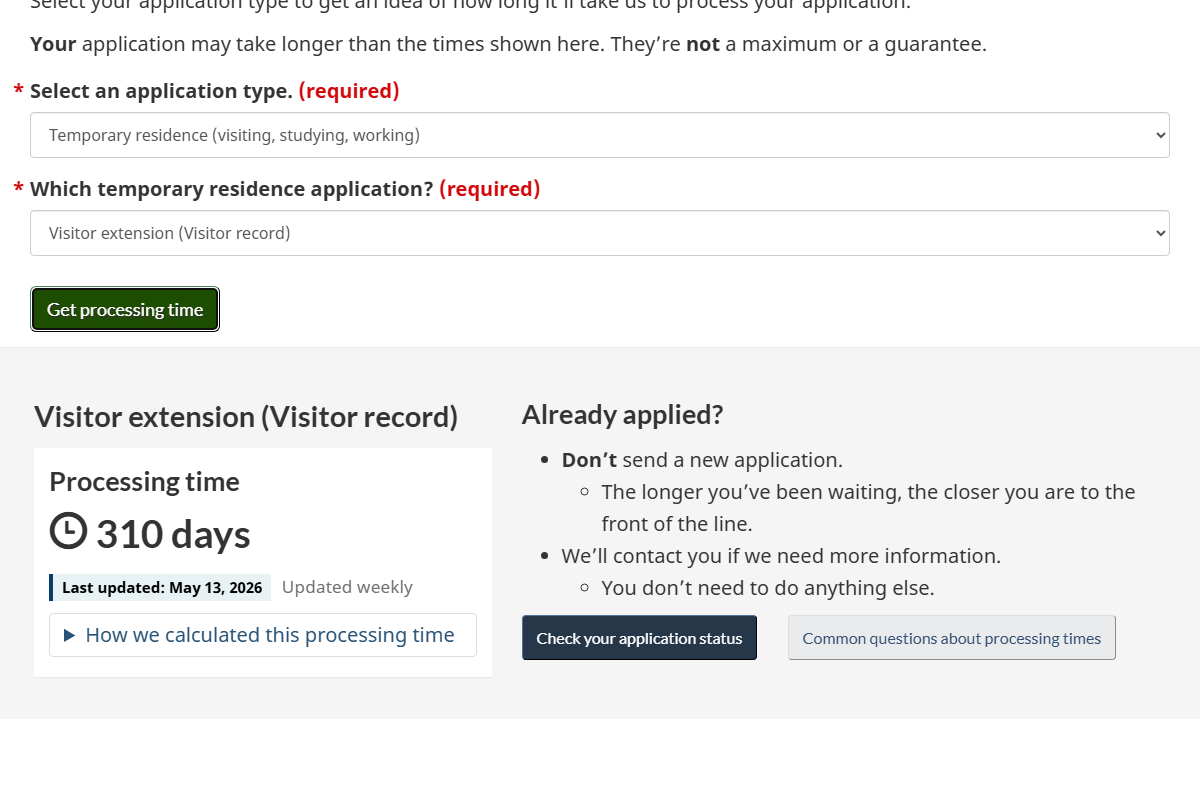
You are already in Canada and you want to stay longer. The process for extending your stay is called a Visitor Record application, and in 2026 the current IRCC processing time is 310 days. That number deserves your full attention before you do anything else.
This article covers who needs a Visitor Record, what the 310-day wait actually means for your situation, the critical rules you must follow while your application is pending, and why a single mistake on this application can cost you far more than the wait itself.
Who Needs a Visitor Record?
When you arrive in Canada as a visitor, a border officer authorizes your stay for a specific period, usually six months from your date of entry. That authorization is your status. Once it expires, you must either leave Canada or have applied to extend your stay before that date passed.
A Visitor Record is the document that extends your authorized stay inside Canada. There are two main groups of people who need one.
Tourists and family visitors who want to stay beyond six months. If you entered Canada on a visitor visa (TRV) or as a visa-exempt traveler and your authorized stay is approaching its end, a Visitor Record application is how you legally extend it. You apply from inside Canada using the online IRCC portal.
People who entered without a visa and need proof of extended status. Visa-exempt travelers, including citizens of countries like the United States, do not receive a paper stamp in their passport the way visa holders do. If a visa-exempt traveler needs documented proof of their authorized stay, for example to show an employer, a landlord, or another government body, a Visitor Record serves as that proof and can extend the authorized period at the same time.
If your situation involves study or work, a Visitor Record is not the right application. You would need a study or work permit extension instead. The Visitor Record is specifically for people whose purpose in Canada is visiting, not studying or working.
310 Days: What That Number Means for You
IRCC calculates published processing times based on the time it took to process 80% of complete applications in a recent period. For visitor extensions, that figure is currently 310 days. That is approximately ten months from the date you submit.
To put that in context: if you apply today, you should not expect a decision before roughly March 2027, and one in five applicants will wait even longer than that.
Three things are important to understand about this number.
It applies only to complete applications. A complete application means every required form is filled out correctly, all supporting documents are included, and there are no inconsistencies in your file. If IRCC sends you a request for additional documents or clarification and you take time to respond, that pause is not counted in the published processing time. Your actual wait will be longer.
It can change. IRCC updates processing times as workloads shift. The 310-day figure reflects data as of May 13, 2026. Applications submitted at different times may see different timelines. This is the best current estimate, not a contractual guarantee.
It makes submission quality critical. At 310 days, you have essentially one opportunity to get this right. A file that triggers a refusal, or one that prompts back-and-forth document requests, stretches an already long wait into something that can genuinely disrupt your plans in Canada for a year or more.
Maintained Status: The Rule That Protects You
A 310-day processing time immediately raises an obvious question: what happens to your legal status while you wait? The answer is maintained status, and understanding it is essential.
If you submit your Visitor Record application before your current authorized stay expires, you are allowed to remain in Canada legally while IRCC processes your application. Your status is said to be "maintained" during this period. You do not fall out of status simply because the processing time is longer than your original authorized stay.
This protection exists because IRCC's processing times frequently exceed the length of a standard authorized stay. The maintained status rule is how the system accommodates that reality.
However, maintained status is not unconditional. Several important restrictions apply.
You must apply before your status expires. Maintained status only exists if your application was received by IRCC while your authorized stay was still valid. If you let your status lapse and then apply, you are applying from a position of no status, which is a very different and far more complicated situation. Do not miss this deadline.
You must continue to comply with visitor conditions. While on maintained status you are still a visitor. You cannot work or study (unless you have a separate permit authorizing you to do so). The conditions of your original status apply throughout the waiting period.
Your maintained status ends if your application is refused. If IRCC refuses your Visitor Record application, your maintained status ends with the decision. You would then need to leave Canada promptly. This is another reason why application quality matters so much.
Do Not Leave Canada While Your Application Is Pending
This is one of the most consequential rules for Visitor Record applicants, and it catches people off guard.
If you leave Canada while your Visitor Record application is pending, your application is automatically cancelled. IRCC treats your departure as a withdrawal of the application. There is no appeal, no way to reactivate the file, and no refund of the application fee.
This creates a real planning challenge given the 310-day processing time. If you have a reason to travel internationally, including a family event, a pre-booked trip, or a return to your home country, you need to factor in the impact on your pending application before you book anything.
If travel is unavoidable, you should speak with a regulated immigration consultant before leaving. In some situations, there may be alternatives or the application may have already been decided. But leaving while an extension is pending without understanding the consequences is a mistake that cannot be undone after the fact.
What Slows Down a Visitor Record Application
At 310 days, any delay you introduce on top of the baseline wait has an outsized effect on your timeline. The most common causes of additional delays are avoidable.
Incomplete forms. The IMM 5708 application form must be filled out fully and accurately. Missing fields, dates that conflict with your passport, or unexplained gaps in your travel history flag the file for additional review.
Insufficient ties to your home country. The central question in every visitor extension is whether the officer is satisfied that you intend to leave Canada when your extension period ends. Employment, family obligations, property, financial commitments in your home country all serve as evidence of ties. If your application does not address this directly, approval is uncertain regardless of how long you have already been in Canada.
No clear reason for needing more time. A visitor extension requires a credible explanation for why your stay is being extended. Medical treatment, a family situation, a delay in a pre-planned event, or any other legitimate reason should be clearly documented. Vague explanations give the officer little to work with.
Prior immigration history not addressed. If you have had previous refusals, overstays, or complications with Canadian or other immigration applications, that history is on record. Ignoring it in a new application is not an option. It must be acknowledged and addressed directly.
Slow responses to IRCC requests. If IRCC sends a document request or a procedural fairness letter, every day you take to respond adds a day to your total wait. Set up notifications on your IRCC account and respond to any correspondence as quickly as possible.
Already Applied and Waiting?
Applied through Up Immigration? We're already watching.
Our team monitors every active application on a regular basis. You do not need to log in daily or wonder whether something has changed. If IRCC updates your file, requests a document, or issues a decision, we will contact you right away. With a 310-day wait, staying informed matters. If there is news, you will hear from us first.
If you applied on your own and want to check your status, log in to your IRCC secure account. Any correspondence from IRCC, including document requests and decisions, will appear there as well as in the email associated with your account.
If the published processing time has passed and you have not received a decision or any communication, you can submit a web form inquiry through the IRCC website. Have your application number and receipt confirmation ready before submitting.
One important clarification: checking the IRCC tool after you have already applied will show you the current estimate for new applicants. That figure does not apply directly to your existing file. Your application is in queue and will be reviewed in its turn. Checking the tool repeatedly will not affect your position in the queue.
Why Getting This Application Right the First Time Is Non-Negotiable
Most visitor visa applications, if refused, can be resubmitted within a reasonable timeframe. A 310-day processing time changes that calculus entirely.
If your Visitor Record application is refused, your maintained status ends. You would need to leave Canada. If you want to return and try again, you are looking at starting the process from scratch, with a refusal on your record that must be addressed in any subsequent application. The cumulative time lost, the disruption to your life in Canada, and the complications a refusal creates for future applications can all be avoided by preparing the application correctly the first time.
A Regulated Canadian Immigration Consultant (RCIC) reviews your specific situation before submission. They assess your ties to home country, check that every required document is present and correctly formatted, identify anything in your history that needs to be addressed, and prepare a covering letter that presents your case clearly to the reviewing officer.
At 310 days, the stakes of a poorly prepared application are simply too high to leave to chance.
Ready to Apply?
If you are approaching the end of your authorized stay in Canada and need to extend it, or if you have questions about whether a Visitor Record is the right application for your situation, Up Immigration's team of regulated consultants can review your case and prepare a complete application.
With a wait of over ten months, there is no margin for error. Start with a consultation so you know exactly what your application needs before you submit it.
Book a consultation with Up Immigration →
Information current as of 2026. Always verify at the IRCC processing times tool or with a regulated immigration consultant.