
You're already in Canada. Your current status is running out, or you need to change it entirely. You need a visitor visa, and you need to know how long this is going to take.
The short answer: as of May 2026, IRCC is processing visitor visa applications submitted from inside Canada in 13 days. That is genuinely fast compared to most immigration applications, and it is much faster than applying from abroad. But there are important details that affect whether that number applies to your specific situation, and there are steps you need to take correctly to protect your status while you wait.
This guide covers who applies from inside Canada, what the current timeline looks like, why processing is quicker than applying overseas, and what to watch for after you submit.
Who Applies for a Visitor Visa from Inside Canada?
Most people think of a visitor visa as something you apply for before you travel to Canada. But there is a significant group of people who apply, or need to apply, while they are already here.
People extending their visitor status
If you entered Canada as a visitor and your authorized stay is approaching its end, you can apply to extend from inside Canada. You do not need to leave the country and reapply at a port of entry. As long as you apply before your current status expires, you remain on implied status while IRCC reviews your application.
People changing status to visitor
If your current status in Canada is something other than visitor, such as a student permit or a work permit that is ending, and you want to remain in Canada temporarily without leaving, you can apply to change your status to visitor from inside the country. This is common for people whose permits are expiring and who need a few extra months while they sort out next steps.
People whose visa expired but who still have status
A visa and status are not the same thing. Your visa is the document that allows you to enter Canada. Your status is your authorization to stay. If your visa has expired but your authorized stay has not, you are still legal in Canada. However, if you plan to travel outside Canada and return, you will need a valid visa. Applying from inside Canada to restore or obtain a new visa falls under this same processing category.
People restoring their status
If your visitor status has expired and no more than 90 days have passed since it lapsed, you may be eligible to restore your status from inside Canada rather than having to leave and reapply. Restoration is a specific application type with its own requirements, but it falls under the same processing stream.
In all of these cases, the application is submitted online through your IRCC secure account and processed under the same category: visitor visa, from inside Canada.
Current Processing Time: 13 Days
According to the IRCC processing times tool, updated May 13, 2026, visitor visa applications submitted from inside Canada are currently being processed in 13 days.
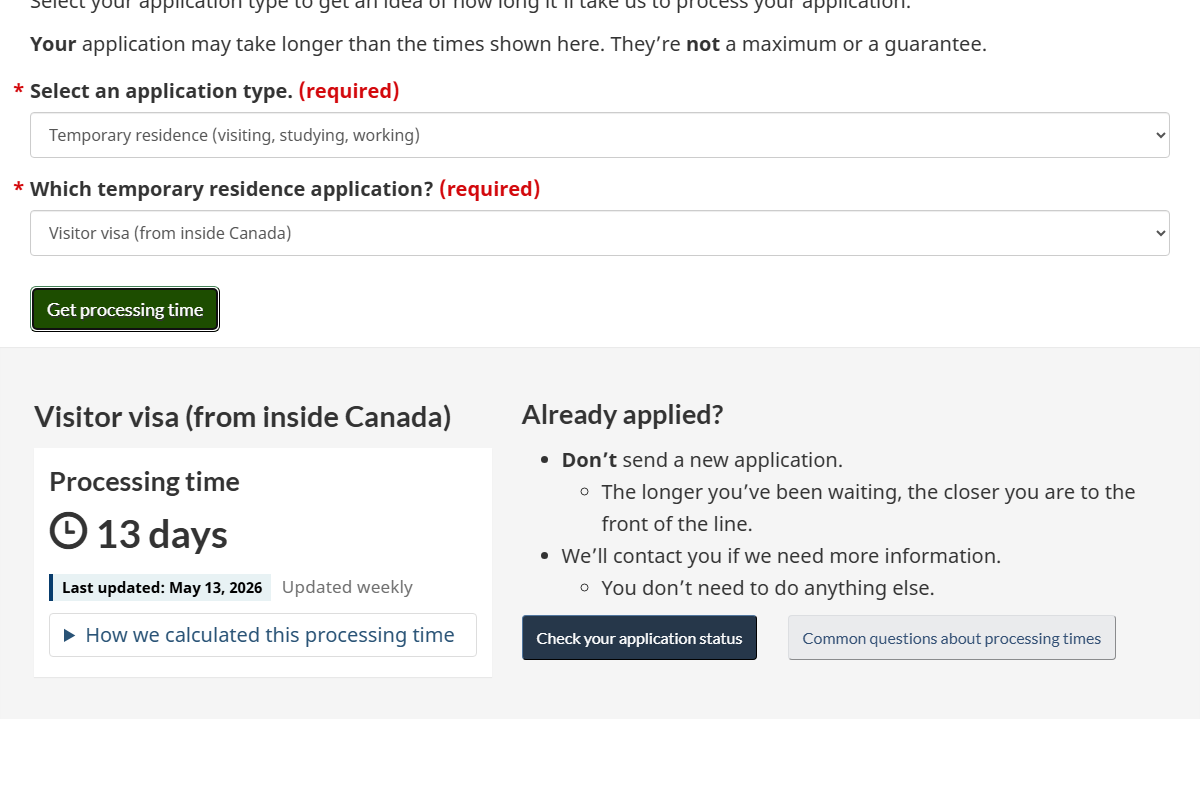
To put that in context: 13 days is under two weeks from submission to decision. For comparison, visitor visa applications submitted from outside Canada can take considerably longer depending on the applicant's country of citizenship and the visa office handling the file.
Keep in mind that IRCC's published time reflects the processing of 80% of complete applications. The remaining 20% take longer. If your application is incomplete, triggers additional review, or involves a prior immigration issue, your wait will extend beyond 13 days. The number is a reliable benchmark for a clean, complete file, not a guarantee.
Processing times can also change month to month based on application volumes and IRCC staffing. Always verify at the IRCC processing times tool before making decisions.
Why Applying from Inside Canada Is Faster
The speed difference between inside-Canada and outside-Canada applications is not random. There are structural reasons why IRCC moves faster on in-country applications.
IRCC already has your biometrics
When you entered Canada, your biometrics were collected and are on file with IRCC. Biometrics collection is one of the steps that can slow down overseas applications, especially if you need to book an appointment at a Visa Application Centre. Applying from inside Canada skips that step entirely if your biometrics are less than ten years old.
Your entry history is already verified
IRCC has a record of your entries into and exits from Canada. When you apply from inside the country, IRCC officers can see exactly when you arrived, how long you have been here, and whether your stay has been consistent with your authorized status. That means less investigation into your travel history and a faster file review.
The application is routed to a domestic processing center
Inside-Canada applications are handled by IRCC's domestic processing network rather than overseas visa offices, which are often handling much higher volumes across many applicant nationalities simultaneously.
You are already in Canada, which removes one risk factor
When IRCC assesses a visitor visa from abroad, one of the key considerations is whether the applicant is likely to leave Canada when their authorized stay ends. When you are already here and applying for an extension or change of status, IRCC is making a much simpler assessment: should this person's current visit continue? That narrower question gets answered faster.
What Happens After You Apply
Once you submit your application, a few things take effect immediately that are worth understanding.
Implied status
If you applied to extend your visitor status before your current authorized stay expired, you are on implied status. This means you are legally authorized to remain in Canada under the same conditions as your previous status while IRCC processes your application. You are not in legal limbo. You are not out of status. Your stay is authorized by operation of law.
Implied status applies only if you submitted your application before your current status expired. If you let your status lapse before applying, you are not covered by implied status and should speak with an immigration consultant about your options, including whether restoration is available to you.
What "in progress" means on your IRCC account
After submitting your application, you can track its status through your IRCC secure account. The status updates you are most likely to see are:
- Application received: your file is in the queue and not yet under review
- In progress: an officer is actively reviewing your file
- Decision made: a decision has been issued, check your account for correspondence
IRCC does not break down processing into granular stages in the portal. "In progress" can mean active review or it can mean your file is queued for officer assignment. Either way, no action is required from you until IRCC contacts you directly or a decision appears.
Do not leave Canada while your application is in progress
If you travel outside Canada while your in-Canada application is being processed, your application is generally considered abandoned. You would need to apply from abroad instead, which is a longer process and may require a new visa to re-enter. Unless your circumstances require it, stay in Canada until you have a decision in hand.
What Can Slow It Down
13 days is the benchmark for a complete, straightforward file. Several things can push your processing time well beyond that.
Incomplete documentation. Missing documents are the most common source of delay. If IRCC sends you a request for additional information and you respond slowly, or if the request goes to your spam folder, your file will sit idle until you respond.
Prior immigration issues. If you have previously overstayed in Canada or another country, had a visa refused, or have any immigration violations on your record, your application will receive additional scrutiny. Officers need to be satisfied that the issues from your past have been addressed and do not indicate an ongoing concern.
Travel history inconsistencies. If the travel history you declared on your application does not match what IRCC already has on file from your entry records, an officer will need to reconcile that discrepancy before moving forward.
Ties to Canada concerns. Even for in-Canada extensions, IRCC is assessing whether you intend to leave when required. If your file does not clearly demonstrate that you have reasons to return to your home country, an officer may request more information or issue a refusal.
Applications submitted with errors. Typos, incorrect dates, and inconsistent information across documents cause delays. A file that requires an officer to track down discrepancies takes longer than a clean file that matches on every point.
Working with a Regulated Canadian Immigration Consultant (RCIC) before submitting significantly reduces the probability of landing in any of these delay categories. An RCIC reviews your application for completeness and consistency before it goes to IRCC, which is when it actually matters.
Already Applied and Waiting?
Applied through Up Immigration? We're already watching.
Our team monitors every active application on a regular basis. You don't need to log in daily or wonder whether something changed. If IRCC updates your file, requests a document, or issues a decision, you'll hear from us first. No need to reach out just to ask if there is any news. If there is news, you will have it.
If you applied on your own and your application has been in progress longer than the published processing time, you have a couple of options. You can submit a web form inquiry to IRCC once your application has exceeded the standard processing window. This is a formal channel for asking about the status of a delayed file. It does not speed up processing, but it creates a record of the inquiry and can sometimes prompt an officer to review your file.
If you are past the processing time by a significant margin, or if you have received a request from IRCC that you are not sure how to respond to, consulting with a regulated professional at that point is worth the cost. A poorly handled IRCC response can result in a refusal that takes much longer to recover from than the original application would have taken.
Ready to Apply? Start with a Consultation.
A 13-day processing time sounds reassuring, and for many people it is. But getting to a clean approval depends entirely on submitting a complete, consistent application that gives an officer no reason to pause.
If you are unsure whether you qualify for an extension or change of status from inside Canada, if your situation involves prior immigration issues, or if you simply want a professional to review your application before it goes to IRCC, Up Immigration's team of regulated consultants is available to help.
Book a consultation with Up Immigration →
Information current as of 2026. Always verify at the IRCC processing times tool or with a regulated immigration consultant.