
You're applying for a Canadian visitor visa from outside Canada and you want to know one thing: how long is this going to take? Here is exactly what the current data shows, what that number actually means for your situation, and what happens between the moment you submit and the moment you get a decision.
A Canadian visitor visa, formally called a Temporary Resident Visa (TRV), is required by citizens of many countries who want to visit Canada as a tourist, to see family, or for short business trips. The process happens entirely outside Canada, which means timelines depend heavily on where you are applying from and the current workload at IRCC's processing centres.
The short answer for applicants from Brazil in 2026: IRCC's current published processing time is 29 days. But that number comes with important context that this article unpacks.
How to Check Your Own Processing Time
Processing times are not fixed globally. They vary by country of application and IRCC updates them regularly. The only reliable source is the official IRCC processing times tool, and checking it takes about 30 seconds.
Here are the steps:
- Go to the IRCC processing times tool.
- Under "What type of application is it?", select Temporary residence (visiting, studying, working).
- Under "What application are you checking?", select Visitor visa (from outside Canada).
- Under "What country are you applying from?", select your country.
- The result shows the current estimated processing time for 80% of complete applications from that country.
Below is a screenshot of the tool taken in May 2026, showing the result for applicants from Brazil.
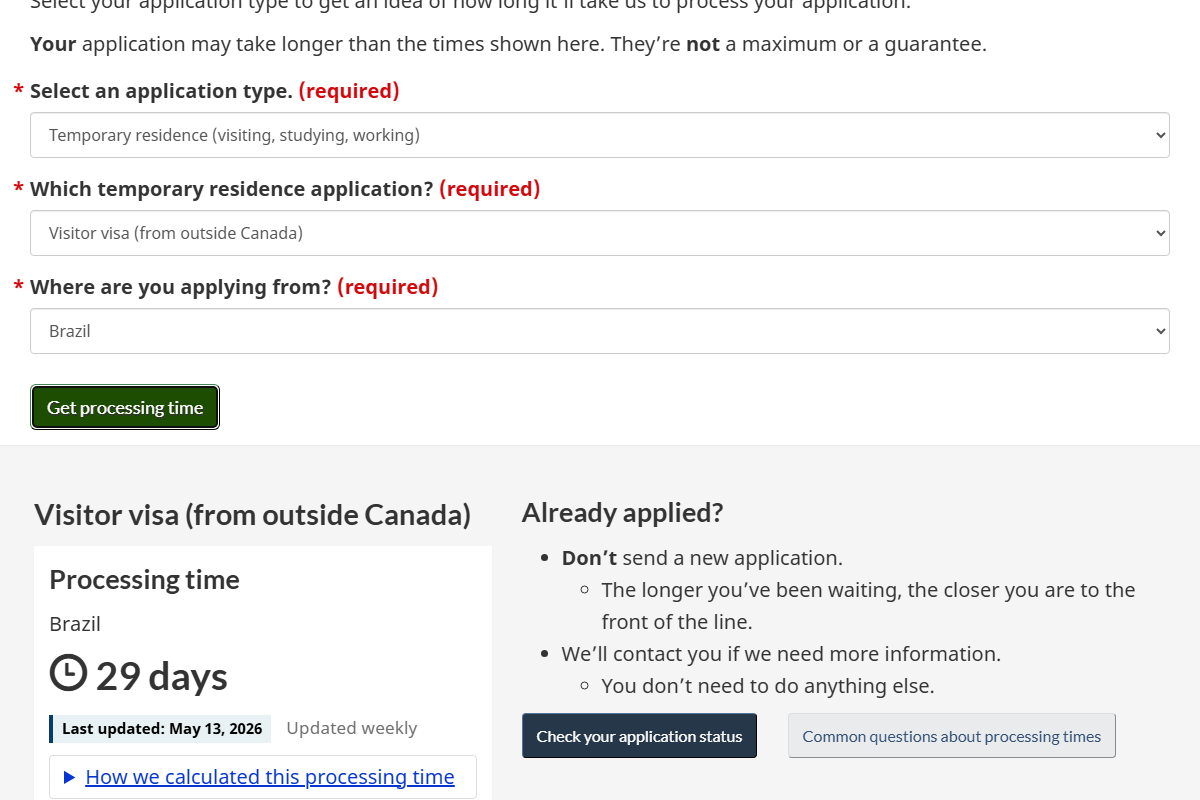
The result: 29 days for visitor visa applications from Brazil as of May 13, 2026.
If you are applying from a different country, your result may be shorter or longer. Some countries with closer ties to Canada and lower refusal rates process faster. Others, due to higher application volumes or additional verification requirements, take considerably longer.
What "29 Days" Actually Means
The published processing time is not a guarantee and it is not a deadline. IRCC calculates this figure based on the time it took to process 80% of complete applications from that country in a recent period. That means one in five applicants will wait longer than 29 days, sometimes significantly longer.
There are three things that determine whether your application lands in the faster 80% or the slower 20%.
Your application is complete. The 29-day figure applies only to applications that arrived with all required documents, correctly filled forms, and no inconsistencies. Incomplete applications pause the clock while IRCC waits for you to respond to requests. That pause is not counted in the published time.
Your country of application. The 29-day figure is specific to Brazil. Applicants from other countries will see different numbers in the IRCC tool. Country-specific timelines reflect historical approval rates, application volumes routed to specific processing centres, and bilateral verification requirements.
Officer workload and discretion. Even complete applications from the same country do not all move at the same speed. Officers exercise discretion. If something in your file warrants a closer look, your application may take longer regardless of the published average.
Think of 29 days as the realistic baseline for a straightforward, well-prepared application from Brazil. Build in buffer time when planning your trip.
What Happens After You Apply
Once you submit your visitor visa application online, your file moves through several steps before a decision is reached. Understanding each stage helps you know what to expect and how to respond if IRCC contacts you.
Biometrics Request
If you have not provided biometrics to IRCC within the last 10 years, you will receive a biometrics instruction letter shortly after submitting your application. You will have 30 days to visit a Visa Application Centre (VAC) in your country to provide fingerprints and a photo.
Book your biometrics appointment as soon as you receive the letter. Delays at this stage are one of the most common reasons applications take longer than the published estimate. In some countries, VAC appointment availability is limited and slots fill quickly.
Medical Examination (If Required)
Most standard visitor visa applications do not require a medical exam. However, if you are applying for a stay longer than six months, or if you have previously been refused on medical grounds, IRCC may request one. If you receive a medical request, you must complete the exam with an IRCC-designated physician and submit results within the specified timeframe.
Document Requests
If the reviewing officer has questions about any part of your application, they will issue a request for additional documents or clarification. Respond promptly and completely. Partial responses or delays on your end extend your total processing time by exactly as long as you take to reply.
Decision
Once the review is complete, IRCC issues a decision. If approved, your visa is typically stamped into your passport or, for applicants in countries that participate in the electronic system, issued as an eTA alongside a paper visa stamp. You will receive instructions on how to submit your passport if a physical stamp is required.
If refused, you will receive a refusal letter explaining the reasons. A refusal is not permanent, but reapplying without addressing the officer's specific concerns rarely leads to a different outcome.
What Slows Down a Visitor Visa Application
Processing times vary. The most common causes of delays are preventable.
Incomplete or inconsistent forms. The IMM 5257 application form must be completed fully and accurately. Missing fields, dates that do not match your supporting documents, or unexplained travel history gaps are common triggers for delays or refusals.
Missing or insufficient supporting documents. Every document listed in the IRCC checklist for your situation is required for a reason. Omitting any of them creates a gap that an officer may use to refuse or to send you an additional documents request that pauses your timeline.
Weak demonstration of ties to your home country. The central question in every visitor visa application is whether the officer believes you will leave Canada when your authorized stay ends. If your application does not clearly show strong reasons to return home, such as employment, family, property ownership, or financial obligations, the officer has limited grounds to approve it. This is the single most common reason for refusal.
Prior refusals not addressed. If you have previously been refused a Canadian visitor visa or any other visa, that history is on record. Reapplying without directly addressing what caused the prior refusal, and showing what has changed, will almost certainly result in another refusal. Each new application needs to confront the prior decision head-on.
Financial documentation that is vague or inconsistent. Bank statements with sudden large deposits, income that does not match employment letters, or financial records that do not clearly belong to you raise credibility concerns. Consistency and transparency in financial documents matter more than the total amounts shown.
Purpose of visit not clearly documented. A vague statement that you want to visit Canada is not enough. Letters of invitation, hotel bookings, itineraries, or documentation of the specific event or relationship you are visiting all strengthen your application and make the officer's assessment easier.
Already Applied and Waiting?
Applied through Up Immigration? We're already watching.
Our team monitors every active application on a regular basis. You do not need to log in daily or wonder if something has changed. If IRCC updates your file, requests a document, or issues a decision, we will contact you right away. No need to reach out just to ask "any news?" If there is news, you will hear from us first.
If you applied on your own and want to check your status, log in to your IRCC secure account. Status updates in the portal are limited, but any correspondence from IRCC, including biometrics requests, document requests, and decisions, will appear there as well as in the email associated with your account.
If the published processing time for your country has passed and you have not received a decision or any communication, you can submit a web form inquiry through the IRCC website. Keep your application number and receipt confirmation handy before submitting the inquiry.
One thing to be aware of: IRCC processing times fluctuate. An application submitted today might take slightly more or less time than one submitted three weeks ago. Checking the IRCC tool again after you have applied will show you the current estimate for new applicants, but that figure does not directly apply to your already-submitted file. Your file is in queue and will be reviewed in its turn.
Why Working with an RCIC Makes a Difference
A visitor visa application looks straightforward on paper. Many people attempt it without professional help and some succeed. But the applicants who get stuck, who receive refusals they did not expect, or who submit incomplete files that stall for months, almost always share a common thread: they did not have a professional review their application before it was submitted.
A Regulated Canadian Immigration Consultant (RCIC) reviews your specific situation before your application is submitted. They identify ties to home country arguments that need strengthening, catch inconsistencies in supporting documents, flag prior history that needs to be addressed, and write covering letters that frame your case clearly for the reviewing officer.
The cost of a professional review is modest relative to the cost of a refusal, which adds months to your timeline, creates a record that must be addressed in future applications, and may affect your eligibility for other Canadian programs.
If your situation involves any complicating factors, prior refusals, complex financial history, ties to Canada through family members with pending immigration files, or a purpose of visit that is difficult to document, working with a regulated professional is not optional. It is the practical choice.
Ready to Apply?
If you are planning to apply for a Canadian visitor visa and want to make sure your application is prepared correctly the first time, Up Immigration's team of regulated consultants can help. We review your documents, assess your ties to home country, and prepare a complete application that gives you the best possible chance of approval.
Book a consultation with Up Immigration →
Information current as of 2026. Always verify at the IRCC processing times tool or with a regulated immigration consultant.